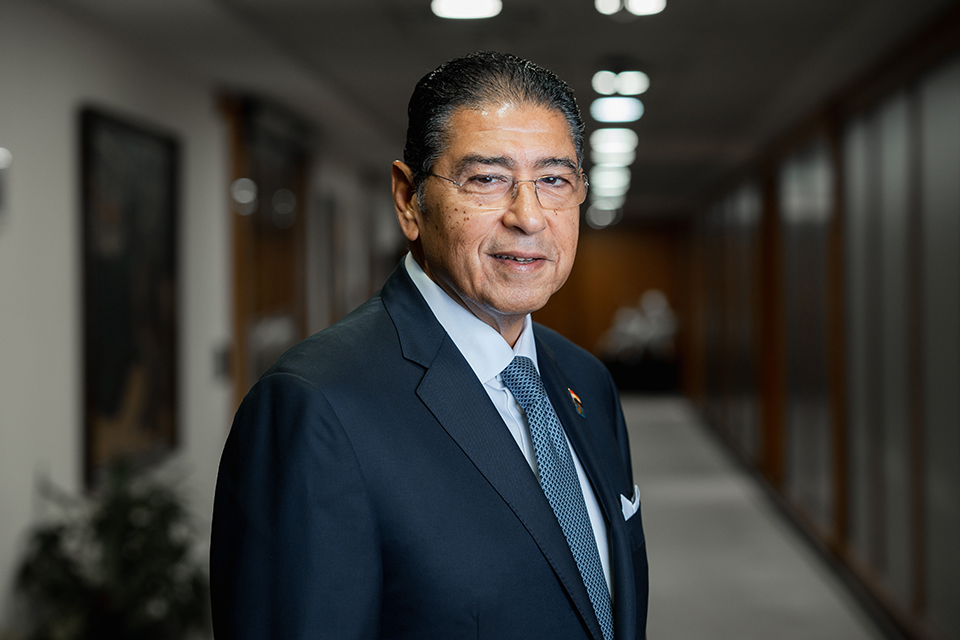
Ana Patricia Botín
Spain
Ana Patricia Botín is a member of Spain’s most prominent banking family, which has been at the helm of Banco Santander since its foundation 140 years ago. The 35-year-old chief executive of the group’s investment banking arm, Banco Santander de Negocios, and group executive deputy chairman, she was educated in the us at Bryn Mawr College and Harvard.
Botín’s banking career began in 1981 at the credit management and financial analysis department of JP Morgan in Madrid. She later worked at the us bank’s capital markets and treasury side in New York. In 1988 she returned to JP Morgan in Madrid and the same year moved to the family bank where she set up the investment banking and emerging markets division. In 1989 she was made a full board member and a member of Banco Santander’s executive committee.
Banco Santander de Negocios contributed about 12% to total group profits of about $100 million in 1995. Botín is the driving force behind Santander’s Latin American expansion in Argentina, Brazil, Chile, Colombia and Venezuela. She was also instrumental in obtaining a New York broker-dealer licence for the bank.
The mother of three children, Botín devotes much of her free time to golf, being fortunate to have as tutor pro golfer Severiano Ballesteros, her brother-in-law. She also finds time to play the piano and paint, and is a member of the panel that will select the design for a millennium footbridge over the Thames in London.
Ana Patricia Botín is tipped to succeed her father, Emilio Botín, as Banco Santander’s chairman, which would make her the first woman to run a major international bank. But she may have to wait a while – her grandfather Emilio was 84 when he retired as chairman.
Colin Coleman
South Africa
Like many South Africans, Colin Coleman, head of the public finance division of Standard Corporate and Merchant Bank (voted top merchant bank in South Africa this year by Euromoney), had his future shaped by politics rather than career choice. His family was highly politicized by the detention without trial in the 1980s of his brothers Keith and Neil. Coleman studied at the University of the Witwatersrand, Johannesburg, where he became embroiled in opposition to the apartheid regime.
After graduating in 1988 he was recruited into and became a key player in the Consultative Business Movement, a voluntary association and network of more than a hundred South African corporations, which played a leading role in accelerating South Africa’s transition to democracy. During this time he played a major role in constitution-making. He assisted in drafting the Memorandum of Understanding for Peace and Reconciliation Agreement, which broke the deadlock a week before the elections, bringing into the process Mangosuthu Buthelezi’s Inkatha Freedom Party.
As Standard’s director of public finance Coleman is now playing a significant role in privatization and in arranging development finance, including leading the establishment of the first private equity infrastructure fund in Africa, the $120 million South Africa Infrastructure Fund. The common thread in his activities has been matching the needs of business and the disadvantaged to stimulate a healthy economy. Coleman says his move to Standard Bank, initially working closely with chairman Conrad Strauss, was not contradictory: “Banking for me provides the means to help South Africa through the transition, from the political settlement to the economic miracle.” Coleman, who is the recipient of various international awards, including the 1996 World Economic Forum’s Global Leaders of Tomorrow, and a co-author of two books on business and South Africa, has contacts in all camps in South Africa. His colleagues consider he will reach the top in banking – if he does not move into politics.
Peter Derby
US
“Seven years of crisis management.” That is how Peter Derby describes life since he came to Moscow in 1989 at the behest of Chicago commodities tycoon and Russophile Joe Ritchie. Yet he has built a bank – Dialog – that dominates corporate services for other expatriates brave enough to roam the Wild East. He is hardly pining for the days when he toiled quietly in New York at Chase and NatWest.
Despite his surname and button-down aura, Derby has reason to feel at home in Russia. His grandparents fled it after the Bolshevik revolution. He was raised in the émigré enclave of Sea CliV, Long Island, hearing tales of the lost, glorious motherland and speaking Russian at home.
He promised Ritchie he’d stay a year. “I’ve been extending that every year since,” he says. “But now I don’t see any curtailment of the extension.” Why should he? From three people and one desk, Dialog Bank has grown to 800 employees – who own 80% of it through a share option plan – and $200 million in assets. Clients include the Russian subsidiaries of Coca-Cola, Pizza Hut and at&t, plus heavy-hitting Russian entities like the MosPromStroi construction conglomerate. Dialog’s seven retail branches have a lock on wire transfers, cash advances, and other life-support systems for Moscow’s 70,000 resident westerners. Brokerage Troika Dialog controls some 20% of Russia’s OTC equities trading and was voted best Russian securities firm by Euromoney.
Derby is now aware Russia is not the promised land. But he contends it is possible to do business honestly there if you are not out for a fast buck. “Lots of money is thrown on the table in front of you,” he says. “But to get all of it you have to do many, many wrong things.” He himself is in Russia “to establish an institution you can be proud of in 100 years”. That would be 90 years after Russia becomes “a G5 nation”, Derby reckons.
Michael Hawker
Australia
During his first year in banking Michael Hawker was also playing centre for the Australian national rugby union team. He says his employers were relieved when he married and finished playing to concentrate on his professional career. Now he is global head of financial markets for Westpac Banking Corporation, a position he has held since August 1995.
Hawker joined Westpac after three years working for Citibank Europe. At Citibank he was a member of the European management team and the global financial markets management team with specific responsibility for derivative products throughout Europe. He was also an executive director of Citibank International, Citibank’s uk-based European banking operation. Before moving to London, Hawker was deputy managing director and board member of Citibank Australia.
Hawker’s goal is Westpac’s domination of Australian and New Zealand trading, making it a prominent niche bank on the global stage. “We are constantly trying to increase our capacity in Australian and New Zealand dollars. We are also keen to strengthen the bank’s capacity in commodities and in equity markets,” he says.
The increasing use of electronic transaction processing is the major challenge facing global banking in the future, Hawker reckons. With banking transactions becoming more standardized through the use of computers, the structure of the business is changing and different skills are being demanded of staff. “Your people are no longer involved in the transaction, they’re involved in why the transaction is occurring. You have to retrain them because clients demand higher and higher service every year,” he says.
At the end of the three years Hawker spent in London his family wanted to return to Australia, partly to escape the alleged greyness of the English weather. His fondness for England is not affected by the fact that he is chairman of selectors for the Australian Rugby Union.
Menno de Jager
The Netherlands
Menno de Jager, one of three managing directors of the new ABN Amro-Rothschild joint venture,was born in 1956 in Groningen in the northern Netherlands, attending a commercial school before joining Amro bank in 1977. Starting as a trainee in trading and sales, he then moved to the international division in London in 1982. There he worked on non-guilder primary and secondary products – mainly fixed income in dollars, Ecus and Deutschmarks.
Returning to Amsterdam in 1987, he was charged with rebuilding primary and secondary trading following the closure of the London office. Soon afterwards he began to concentrate on primary markets. Following Amro’s merger with ABN in 1991, he became head of primary fixed income and equity, then head of equity capital markets when they were separated from fixed income in 1993.
Since returning from London, he laments having to cut back on two favourite pastimes, golf and shooting. He now plays tennis: “although it’s really more a social event with the neighbours than anything else”. He also took up flying just after the first KPN privatization deal in 1994, escaping from his wife and three sons each Sunday for a two- or three-hour flight: “It’s a four-seater, of course,” he boasts. “But it’s only got the one engine.”
De Jager has no plans to transfer to helicopters. “It costs twice as much to learn, is very difficult, and in the Netherlands you can only land at airports – where’s the fun in that?” The joint venture with Rothschild is challenge enough. De Jager is confident of success. “The two institutions have got on for a while, but especially in the KPN flotation. A couple of weeks ago we did the Ffr1.3bn deal for Crédit Local, and we would never have got on the Deutsche Telekom syndicate without Rothschild.” Rothschild’s advisory strengths and ABN Amro’s distribution capabilities look set to propel the joint venture – and de Jager’s career – ever upwards.
Olivier Lefebvre
Belgium
Olivier Lefebvre, 39, is the architect of the reform of the Brussels Stock Exchange. His job as chairman of its management committee was basically created through that reform. Lefebvre had no experience of managing a firm, but, he says, he was told: “You are the guy that drafted it, now do it.”
Lefebvre received an MBA from Cornell in 1984 and a doctorate in economics in 1990. He started his career as a research assistant at the University of Louvain in 1981. After two years in the economic study department of Generale Bank, in early 1990 he joined the staff of Philippe Maystadt, the Belgian finance minister. He became chief of staff there in 1993. During his six years at the ministry he played a major role in reforming the money market, drawing up the legal framework for securitization and reforming the stock exchange. As a result he was chosen for the new stock exchange position.
He joined the stock exchange in January of this year and some are saying he is going to turn it around. Lefebvre’s main goal is to transform the Brussels stock exchange into a user-friendly firm and position it in Europe as an leader in the network of equity exchanges. He feels his biggest challenge is promoting an equity culture in Belgium. He’s happy to take it on. “When I decide whether I want to take a job, I use two criteria,” he says. “One, will I learn something and two, will it be pleasant?”
Einars Repse
Latvia
Einars Repse, 34, is possibly the youngest central bank governor in the world, and when he is not overseeing Latvia’s finances the licensed pilot relaxes with another complex technical task – building his own helicopter.
With a degree in physics, Repse went from his first job as a computer designer to become governor of the Bank of Latvia at the age of 29. “The new government needed someone to run the central bank after independence and the choice fell on me,” he recalls modestly.
But why him? When Latvia was fighting for independence from Soviet rule, Repse became involved in the politics of his country. He founded the National Independence Movement, which evolved into the National Independence Party that still has seats in Latvia’s parliament. As a result, he was elected to the first democratically elected Latvian parliament, where he became chairman of the banking and finance subcommittee. In 1991, parliament elected Repse as central bank governor on a six-year term.
Repse was in charge of setting up the new central bank, drafting the banking law, and designing the currency reform. He is credited with being the author of the concept of monetary reform in Latvia, and it was under his guidance that the lats was restored as Latvia’s currency in 1993. “My biggest challenge was designing the currency reform, and I perceive the lats in a sense as my child,” he says. “So my most important job is to look after the health of that child.” Repse’s ultimate dream is that Latvia will once again become the developed economy it was before Soviet rule.
Nicolas Rohatyn
US
Nicolas Rohatyn is a rising star in a company that does not look with favour on the star system. One of the youngest-ever JP Morgan managing directors at the age of 28, Rohatyn now heads three of the us investment bank’s central business areas: emerging market operations, including sales, trading and research; the foreign exchange group and the commodities group.
Investment banking was a strong option for someone with the Rohatyn name. His father, Felix Rohatyn, a senior partner at Lazard Frères in New York, is a highly regarded investment banker and was widely tipped to become Bill Clinton’s secretary to the treasury in the early 1990s but remained at Lazards. During the 1970s, Felix Rohatyn was instrumental in pulling the city of New York round from potential bankruptcy.
After a degree in economics from Brown University, Rhode Island, Nicolas Rohatyn joined JP Morgan in 1982 and worked in capital markets for the next two years before moving to Tokyo to work on the bank’s swaps book there. After four years in Japan he returned to head JP Morgan’s developing country asset trading unit, a department that changed in the next three years into the respected emerging markets sales, trading and research group. Between 1990 and 1994 Rohatyn was chairman of the Emerging Markets Traders Association.
Spain
José Sainz Armada, 37, was recently appointed finance director and chairman of corporate banking at Argentaria, where he spends up to 14 hours a day implementing a strategic plan aimed at turning the Spanish bank into a major regional institution.
He is the most prominent survivor of Argentaria’s management shake-up last May when the newly elected conservative Popular Party, which still controls 26% of the former state-owned bank, hired a new chairman.
“It’s a good idea to have a master plan but it needs to be flexible enough to react to developments such as Emu and interest rate movements,” he says. “We don’t aspire to be a global bank. Our ambitions are regional, with an emphasis on Latin America.”
Sainz Armada brings to his new job seven years’ experience in investment banking, primarily at JP Morgan’s Spanish operations where he rose from head of sales and trading to general manager before joining Argentaria in 1992 as chief executive of its stockbroking arm and later the entire investment banking operations.
After an MBA from France’s elite Insead in Fontainebleau, Sainz Armada graduated in law and business studies from Spain’s Comillas University. He joined Morgan Guaranty Trust in Madrid in 1985 and moved on to JP Morgan three years later.
“The trend in Spain these days is to put in fewer hours at the office but this hardly applies in my case,” Sainz Armada says. “I’m in by eight o’clock and normally I don’t finish work until eight or ten in the evening.” In spite of this schedule, he manages to slip away for the occasional ski weekend and is a keen runner. “I run whenever and wherever I can,” he says. “In fact I’m happy to practise any sport except golf.”
Peter Yngwe
Sweden
Peter Yngwe, aged 39, is currently chief financial officer and treasurer of Svensk Exportkredit (SEK), where he is leading the agency into a new era of communication and preparing it for the reconstruction of the financial arena, especially in Europe. SEK, which makes loans related to export transactions as well as to domestic infrastructure and industry development, has been one of the most active and innovative international borrowers in the past 20 years. Yngwe joined SEK in 1984 after working at Ogilvy and Mather, Atlas System and Scandinaviska Enskilda Banken.
Yngwe is active in developing risk management in the financial sector, where he believes pricing risk is an essential issue. He has as a central goal the development of financial infrastructure worldwide and as a result his involvement in eastern Europe is increasing. Since the beginning of 1995 he has been the financial adviser for the Estonian Investment Bank and is active in other institutions in the region. He initiated the annual Global Borrower Meeting in which all supranationals and export agencies participate. He considers dereregulation and the abolition of subsidies crucial to a more efficient financial infrastructure.
He took a BSC at the School of Economics and Business Administration in Gothenburg, followed by an MSC in business administration and corporate finance at the Old Dominion University, Virginia, continuing at the Stockholm School of Economics on an advanced management course in 1994-95.
Western Europe
Leonhard Fischer
Germany
Thirty-three would be young for a head of global markets at any bank, but at the hierarchical and formal Dresdner Bank it’s extraordinary. Dresdner is an institution where few graduate trainees are hired before they’re 28. Maybe Leonhard Fischer would have progressed less rapidly had he begun his banking career there. But he chose JP Morgan, and within five years had risen from a trainee in New York to become local head of global markets in the Frankfurt office. In April 1995 he moved to Dresdner Bank as co-head (with Erich Pohl) of global markets.
The unexpected appointment of Fischer was welcomed by Gerd Häusler, who has since left the directorate of the Bundesbank to take over Dresdner’s money markets division. Häusler, himself only 45, says one thing that persuaded him to move was that Fischer and several other German banking stars were already working at Dresdner.
Fischer faces an enormous task: the bank is desperate to become a dominant pan-European bond house before losing its natural franchise when the euro replaces the Deutschmark. A great leap forward was October’s acquisition of London Eurobond boutique Luthy Baillie Dowsett & Pethick. Peter Luthy takes responsibility for Dresdner’s complete Eurobond business in all major currencies, but reports to Fischer and Pohl in Frankfurt.
Fischer is irritated by speculation about broader strategy in German investment banking involving Dresdner. “I dislike all this adolescent talk about London versus Frankfurt,” he winces. “My ambition is less for Frankfurt than for Dresdner Bank.”
António Castro Henriques
Portugal
Born in 1957, António Castro Henriques is a senior executive and member of the board of managing directors for Banco Comercial Portugues (BCP). He is responsible for the international division and NovaRede, the recently established retail banking network. At 39 Henriques is one of the youngest members of BCP’s main board, having served on it since 1995.
Henriques joined BCP in 1988 and spent the next four years being groomed for stardom in various divisions, including corporate marketing, interbank funds and investment management arm BCP Investimentos. He joined the international and treasury division in 1992 and in 1994 was made managing director of NovaRede
BCP has the largest market share in retail banking in Portugal following a merger with Banco Portugues do Atlantico in 1995. In recent years Henriques has played a leading role in product innovation and business expansion. But investor sentiment has not always been with BCP in recent years as the bank’s share price performance has suffered because of the expansion.
Henriques, who is married with three children, is a graduate in business administration from the Université de Paris ix–Dauphiné, which he followed up with an MBA at the Universidade Nova de Lisboa in Lisbon.
Andreas Hübner
Germany
After a few false starts on his career path, including spells as a tennis pro and ski instructor, Andreas Hübner chose banking. Now 36, he is a member of the board of Frankfurt-based investment bank Schröder Münchmeyer Hengst. Born in southern Germany in 1960, Hübner joined the cooperative bank in the small German town of Waldshut. In 1983 parent bank DG Bank sent him to New York.
After three years of training in securities and private-client business, DG brought him back to Frankfurt to work in European institutional sales. Still, trading beckoned and Hübner moved back into equities trading. His big career change followed the 1987 crash: “I figured that as a trader you would only have the great excitement of a crash maybe once or twice in your trading career so it was time to go back to sales.”
From then on Hübner’s rise was meteoric. Several clients touted his name to the Lloyd’s owned SMH which hired him to rebuild its us equity-broking business. In 1989 he started the SMH small cap conference and in 1991 organized a groundbreaking tour of east Germany for SMH staff that produced three well-respected research products called Back to the Future. He went on to build up SMH’s us venture, its German domestic institutional business and its new London office. In July 1994, SMH invited him to join the board.
Hübner believes his task is now a major restructuring of SMH to make it a lean investment bank. This he will do by strengthening broking and expanding the bank’s domestic institutional position in all products. Another goal is the marketing and acquisition of asset management products.
Philip Mallinckrodt, 33, a director and co-head of equity capital markets at Schroders, certainly has the breeding and pedigree to be a banking leader. His mother is Charmaine Schroder and his father, George Mallinckrodt, was the chairman of Schroders from 1985 to 1995.
Although Schroders is now the largest independent quoted uk investment bank, the founding family still exerts its influence there. Young Mallinckrodt is nephew to Bruno Schroder, brother of Charmaine and the leading family shareholder. The Schroder family controls around 40% of the bank. Bruno Schroder himself spends more time on his Scottish estates than in investment banking, though he is a board director.
His brother-in-law is one of the pre-eminent figures of uk merchant banking. George Mallinckrodt charted a course for Schroders which kept it independent when the Big Bang came in 1986 and during last year’s spate of acquisitions by European commercial banks. The younger Mallinckrodt shows a similar appetite for the cut and thrust of the investment banking business. He earned his spurs outside the family firm, working for eight years in the hot-house atmosphere of cs First Boston, a firm renowned for its unstuffy and vigorously entrepreneurial culture.
The younger Mallinckrodt rose to be co-head of equity capital markets at CSFB, working in the thick of major European privatizations and other international equity deals. He moved across to the family bank in March 1994. Colleagues only wonder whether he will retain his hunger for the business. Estimates of the worth of his trust fund range up to £100 million.
Bernard Migus
France
As a recent college graduate and a researcher looking to expand his horizons, Bernard Migus approached French financial institution Caisse des Dépôts et Consignations (CDC) on a whim. Eleven years later, aged 38, he is head of the bourse and capital markets division and can’t imagine himself in any other career.
Migus graduated from French economics institute INSEE in 1982, taking a research post there until 1984 when he went for military service. After that he was ready for a change. “Research is fine,” he says, “but it lacks concreteness. I wanted to join the real world.”
Having “arrived at CDC by chance, really without knowing anything about the business”, he spent six months in fund management before moving to the primary market desk to work on new issues. He stayed from 1985 to 1993, then changed divisions to work with various instruments, including fixed-income derivatives.
A year ago he made his most recent move, to head the capital markets division. There he is responsible for basic capital markets activities: trading, derivatives, equities and bonds. For Migus, the exhilaration of “making a deal”, when a client trusts him with a transaction, is what keeps him in the business. “It’s rather rare to do what you love. But for me, it’s more than necessary. It’s fundamental. I need the passion.”
Alfred Möckel
Germany
Alfred Möckel, 39, may be one of the youngest board members at any German bank, but he is old enough to remember a different age in German banking. “I started out in equity sales when it wasn’t fashionable, and many people asked me why I wanted to work there after such a great education.”
That was during his early years at Deutsche Bank’s now-defunct trading and sales department. After two spells at Morgan Stanley in Frankfurt interrupted by a brief return to Deutsche’s asset management operation, Möckel switched a year ago to BHF-Bank, where he heads its equities and asset management business.
Möckel does not disguise his ambition. He says that as a student at the University of Mannheim’s renowned business faculty his “aim was always to be in the top 5% of any group and to be that bit faster than the rest”. Now he has to concentrate on holding onto his current position. As several board members approach retirement age, he is well placed to increase his clout at BHF. But the bank is also persistently rumoured to be a takeover target. Were it to be swallowed by a foreign bank (UBS is often mentioned), Möckel would be well placed to rise to head of German capital markets at that bank. But if it passed to another German institution, such as Commerzbank, he might be on the move again.
Thomas Östros
Sweden
Thomas Östros, 31, is Sweden’s fiscal affairs minister, having become a member of the Swedish parliament at the age of 29 in 1994. He began his political career in 1988 as organizing secretary of the Social Democratic Youth League in 1988. He became a political adviser at the finance ministry in 1990 and the following year was appointed councillor at the municipality of Uppsala. His strongest concern in the political sphere at is the strength of public finances. “Today it is more important than ever before to have sound public finances to ensure the welfare system,” he says.
After a degree in public administration at the University of Uppsala, Östros began work as a research assistant for the Trade Union Institute for Economic Research. He continued his studies at Uppsala and in 1994 gained a licentiate degree in economics. He has also been a member of the boards of the Uppsala Homes Corporation and of the Uppsala County Tax Authority.
Jacob Wallenberg
Sweden
Jacob Wallenberg, 40, is deputy group chief executive and deputy director of the boards of Skandinavska Enskilda Banken. He is also vice-chairman of the board of directors of forestry and forestry products group Stora.
Wallenberg took an MBA in 1981 at the University of Pennsylvania after a first degree there in economics. Between 1981 and 1984 he worked at Morgan Stanley, Citibank, JP Morgan and Hambros Bank in the uk, Singapore and Hong Kong. From 1990 to 1993 he was deputy managing director of Investor, a holding company with substantial interests in major Swedish corporations.
Wallenberg’s prime objective “is to ensure that Skandinavska Enskilda Banken continues to lead in the Nordic region. The financial sector is undergoing fundamental structural changes, maybe more evident in Europe than in the rest of the world. Only those institutions that really strive for excellence will be well positioned for the next century. By leading, I mean a combination of high rankings and dominating market shares and above all quality of the product and of service to our customers”.
US
Brian Finn
US
Brian Finn never intended to make a career in banking and only chose m&a because he was “21 and it seemed interesting at the time”. Finn joined the two-year analysts’ training programme at cs First Boston in 1982 after studying economics at the University of Pennsylvania. He only intended to stay for the programme and then go to graduate business school. Still at CSFB, he’s now 36 and managing director and joint head of the m&a department. So far, he has steered over $200 billion of m&a business to completion for CSFB.
Finn is still happy working in the business. “I enjoy being hired by businesses for m&a because it’s quite a compliment that they are prepared to involve you in their most important strategic transactions,” he says. And his ambitions for the m&a department remain strong. “I enjoy certain internal successes: building a business, and helping people develop their careers.”
What has kept him in m&a for 12 years? “I’m interested in financially complicated transactions – I like puzzles and problem-solving.” he says. And all m&a transactions are solutions to problems.” And if he wasn’t in banking? “If I wasn’t in m&a solving problems, I’d probably be somewhere creating them.”
David Solo
US
David Solo, 31, is managing director and global chief operating officer of SBC Warburg and a board member. He is also a member of the group executive board at Swiss Bank Corp and a partner at O’Connor, SBC’s derivatives house.
Solo has bachelor’s and master’s degrees in electrical engineering from Massachusetts Institute of Technology. He began his financial career in 1987 as a trader with O’Connor & Associates in Chicago where he developed proprietary risk control technology. With only four years in the business he was made a general partner and became head of global foreign exchange options trading. Later he co-founded SBC’s interest rate options business, developing proprietary interest rate derivative pricing models and the global trading/risk control system. From March 1993 when he was global head of the rate division, it took just three years for him to become chief operating officer.
Solo, whose colleagues describe him as shy and goal-oriented, previously worked at the Charles Stark Draper Defence Laboratory on wideband digital optical communications and the MIT Artificial Intelligence Laboratory on knowledge-based systems.
Asia
Chartsiri Sophonpanich
Thailand
Birthright put Chartsiri Sophonpanich at the head of south-east Asia’s largest bank, but hard work and a mild-mannered approach has earned him the respect of staff and customers.”He is very Asian in manner and very western in his thinking, says Sathit Uthaisri, group executive vice-president at the bank. Chartsiri’s grandfather, the late Chin Sophonpanich, bought into the Bangkok Bank on the back of his rice-trading business and took control in the 1950s. Chin’s son Chatri, who still retains “absolute power” as executive chairman, was president of the bank until the end of 1994, before handing the position over to Chartsiri.
“Being the father’s son and rising fast you have got to force yourself to show others you have something extra. You earn it and work for it and that is what he has done,” says Sathit. After a us education including master’s degrees from mit and the Sloan School of Management, Chartsiri, 37, learnt the ropes by working his way through various departments in the bank, starting in 1986 as a senior dealer and assistant vice-president in the foreign exchange trading office after a year at Citibank. Two-and-a-half years later, Chartsiri was vice-president of the marketing services department, before moving on to fund and liquidity management. By June 1991 he was senior vice-president; a year later executive vice-president and then in another year senior executive vice-president, before securing the top job in December 1994.
Ariful Islam
Pakistan
Ariful Islam set up the investment banking group of Muslim Commercial Bank in 1992. Aged 37 he is now the senior executive vice-president. Islam started as an executive vice-president at MCB and was soon promoted to his current position.
Under Islam’s direction MCB has been working on developing the debt markets in Pakistan. “Working on the changes in the financial sector is an exciting process to be involved in.” says Islam. Privatization is another huge undertaking for MCB. Islam is currently working on the privatization of Pakistan Telecom.
An accountant by profession, Islam worked in London at Peat Marwick’s banking department, which gave him a lead into banking as a profession. He worked at Faysal Islamic Bank in Bahrain and returned to Pakistan to open up the Faysal Karachi branch in 1987 and became the chief manager.
Islam feels he has been lucky. “In Pakistani culture, seniority is many times assumed by your age and it is not common for young people to be in senior positions,” he says. “I came in with a certain view, and took the mandate which allowed me to do what I’m doing.”
Farrukh Khan
Pakistan
Born in 1962, Farrukh Khan was 30 when he founded BMA Capital Management with four others. He is now chief executive. BMA is one of the leading securities firms in Pakistan and a corporate member of the Karachi Stock Exchange.
After a degree in economics and finance at the University of Manchester, Khan worked as an accountant in London, starting his banking career at American Express Bank in Karachi in 1986 as director of treasury. While at Amex he rapidly took the treasury into new lines of business. Since starting BMA Khan has been heavily involved in privatization. He was a senior member of the Kot Addu power-plant privatization, the first successful utility privatization in Pakistan. He is currently on the Jamshoro power-plant privatization team.
Khan says being able to contribute to the rapid changes in the financial sector in Pakistan is the most enjoyable part of his job. “At the end of 1991, foreign exchange was deregulated, the economy was liberalized, and the stock market was opening up to international investors,” says Khan. “The opportunity was there and that’s why we formed BMA.”
In his spare time Khan enjoys playing with his one-year-old daughter and is an avid golfer.
Milton Kim
Korea
In a country where the average age of top management in the financial industry is about twice his 35 years, president and ceo of Ssangyong Securities Milton Kim has to prove that his meteoric rise has been due to more than his being the younger brother of the chairman of the Ssangyong industrial group. In the president’s office for less than a year, Kim has already raised eyebrows by introducing a merit-based, gender-neutral system of promotions. Kim described his own personnel policy as “a new concept in Korea”; the manager of a rival firm called it revolutionary. In Korean securities houses, women usually answer telephones and pour tea.
The European-educated (Insead 1989) American-trained (Citibank 1986-88) Kim has also chipped away at seniority-based salary scales. “If you maintain a promotion system based solely on time spent with the company, your best people will quit and you will be left with laggards,” he says.
Asked to rate his own performance since assuming the leadership of Korea’s Wfth-ranking securities firm, Kim said, “It’s been a bearish market but I think I’ve set up the infrastructure so that we can deal better with changes in the future.” Kim is proud of is his introduction of a risk-management regime by which Ssangyong monitors daily the $700 million in its proprietary accounts. One deal that bears Kim’s imprimatur is Ssangyong’s 25% share in Caspian Holdings, a $150 million fund set up by Christopher Heath, formerly of Barings.
Kongkiat Opaswongkarn
Thailand
The paintings on the walls of the Asset Plus office are an eclectic blend of traditional Thai art and modernism, mirroring its president’s approach to business. Kongkiat Opaswongkarn, 40, who is also ceo and the largest shareholder, founded the company in 1993 and has developed it into Thailand’s leading m&a and advisory boutique, straddling the best of both worlds by drawing on Asian networking and adding five years of us education. His biggest deal to date has been the $1 billion merger of department store chains Central and Robinson along with IPO sponsorships and equity placements.
He has now set his sights on region-wide cross-border deals. Kongkiat did not set out to be a finance specialist, however, taking a first degree in computer engineering at Chulalongkorn University before going on to a Pennsylvania MBA, followed by an MSC and a PHD in operations research.
Asset Plus is not the first business Kongkiat has started from scratch. At TFB he was charged with setting up the first merchant banking division and the first venture-capital team in Thailand. During his four years there he met Baring’s Christopher Heath and was asked to set up Baring Securities’ representative office in Bangkok. Kongkiat got to know many of his contacts through lecturing and writing 18 books, including a Thai best seller on entrepreneurship.
Korn Chatikavanij
Thailand
At the time of the October 1987 crash, Korn Chatikavanij was just 23. The collapse concentrated the mind of the Winchester and Oxford-educated Thai and he decided to return home after three years as a fund manager with SG Warburg’s Mercury Asset Management. As he turned 24 he joined forces with Finance One managing director Pin Chakkaphak, bought a shell company and started Jardine Fleming Thanakom Securities, in which both Finance One and Korn’s family are still major shareholders. He was president from the start of JF Thanakom, which now boasts 310 staff, full Stock Exchange of Thailand membership and the one of the highest market shares of foreign business in the country at 8.5%. But he admits: “I have not reached the stage when it has been appropriate to sit back and reflect. I do feel that luck has been on my side.” The company is strong in corporate finance with a good record in primary issues and m&a in recent years, being the first to advise on a public tender offer and on an all-share takeover offer. Korn sits on the Thai Securities and Exchange Commission takeover panel, and is a director of the Association of Securities Analysts. “I’m not sure if I can live up to being a “financial leader in the 21st century,” he says. “I am a businessman that happens to be in the financial sector.”
Uday Kotak
India
Uday Kotak, 37, is the vice-chairman of Kotak Mahindra Finance Limited (KMFL). In 1985 at the age of 29 he started KMFL and under his guidance it has since grown from a fledgling finance company to a full-services financial giant in India. Kotak has an MBA from Bombay’s Jamnalal Bajaj Institute. He is the chairman of the banking, finance and insurance committee of the Indian Merchants’ Chamber. Kotak is also a member of the Young Presidents’ Organisation. Earlier this year at the World Economic Forum’s annual meeting, he was chosen as one of their Global Leaders for Tomorrow.
When he is not working, Kotak relaxes by playing the sitar.
Victor Li
Hong Kong
As heirs apparent to tycoon Li Ka-shing’s vast family fortune, Victor Li Tzar-kuoi, 32, and his younger brother Richard could one day be Hong Kong’s first Hong Kong dollar trillionaires. The 1996 Forbes survey of the world’s richest men placed 68-year-old Mr Li senior third in Asia and sixth in the world, with an estimated fortune of us$10.6 billion, based on his listed holdings. Then there are his privately held interests.
Although earning less than HK$100 a month in the late 1940s, Mr Li senior managed to tuck away HK$7,000, enough to start his own company in 1950. He named it Cheung Kong, Cantonese for “long river”, a reference to the Yangtze. Cheung Kong today has a market capitalization of HK$125 billion with vast interests spanning property and infrastructure to telecommunications and shipping.
Victor Li, who is being groomed as ultimate successor as head of Cheung Kong, has had a somewhat easier path to the top than his father. A Stanford graduate in civil and structural engineering, he developed his business prowess running the family’s Canadian property group, Concord PaciWc, before being brought back to Hong Kong a few years later to join the family holding.
He was made deputy managing director in 1993 and deputy chairman in 1994. Victor is also executive director of Cheung Kong associate Hutchison Whampoa, director of Hongkong Electric, chairman of Cheung Kong China Infrastructure, chairman of Anderson Asia, non-executive director of HongKong & Shanghai Banking and Hopewell Holdings, and a director of Hongkong Bank of Canada.
When Hong Kong governor Chris Patten created his Business Council in 1992 to cultivate closer ties with the business community, Li was among the first batch of advisers appointed. He was also appointed a member of the Airport Consultative Committee overseeing the construction of Hong Kong’s new airport at Chek Lap Kok.
Beijing is as keen on his advice as the departing colonial administration, having appointed him a Hong Kong affairs adviser. Earlier this year he was one of 14 new businessmen to join Hong Kong’s leading pro-China think-tank, the One Country, Two Systems Economic Research Institute.
Victor Li, like his father, has a modest life style and Wercely defends his privacy. He says he works not for money, but for love – sometimes 16 to 18 hours a day. However, money he will get. Last year Li Ka-shing shifted his 34.95% shareholding in Cheung Kong into a trust under his name to avoid paying inheritance tax. Victor and Richard are its beneficiaries.
Cyrill Noerhadi
Indonesia
Few people in positions of power in Indonesia can boast that they got there via a secret ballot in a democratic election. One such is Cyrill Noerhadi, 35, voted in as president director of the Jakarta Stock Exchange in April. He was chosen for the job by more than 160 broker shareholders in the privatized JSE in a close fight against three other candidates.
Noerhadi had high-level support. Two big government-owned brokers, Danareksa Securities and Bahana Securities, backed his candidacy along with BZW-Niaga Securities, the local branch of BZW, a big player in the market. They were impressed with his work at the Indonesian Securities Clearing Depository, where he proved his professionalism and competence in setting up a back-office system that worked.
Noerhadi, who returned to Indonesia in 1988 after an MBA from the University of Houston, aims to boost the JSE’s market capitalization, now $80 billion. A raft of privatization issues is expected next year. Scripless trading and division into three trading boards are also planned for 1997. Surveillance systems are being tightened up as a growing number of local investors discover the delights of punting on speculative stocks.
Ajeya Singh
India
Ajeya Singh, 38, is head of Lehman Brothers India. Singh is responsible for overseeing the provision of investment banking and related services to clients throughout the Indian subcontinent, in addition to advising international clients on opportunities in the region. He was appointed in 1995 to start the Lehman Brothers office in India and give it direction. Under Singh’s direction Lehman Brothers led the largest equity offering out of India for the State Bank of India this year.
Before joining Lehman Brothers, Singh was director of corporate finance at Bear Stearns in New York where he was responsible for investment banking coverage of the Indian subcontinent, with emphasis on equity and debt financing, project finance advisory and cross-border m&a.
Singh is a British trained chartered accountant and an associate of the Institute of Chartered Accountants, England and Wales. He graduated from Mayo College in Ajmer, India, and is married with two children. He enjoys hunting and squash.
Tong Kooi Ong
Malaysia
Tong Kooi Ong, 37, is the CEO of PhileoAllied, a financial services group with interests in commercial banking, stockbroking, finance company operations, corporate finance, options and futures, and information technology services. It is listed on the main board of the Kuala Lumpur Stock Exchange.
Tong’s background is in stockbroking industry – he became an equity analyst in 1986 after a spell as an economist in the Malaysian tin industry. He was at Morgan Grenfell for three and a half years becoming chief representative and head of research for Morgan Grenfell Asia & Partners Securities and also director of marketing and research for Morgan Grenfell Asia Holdings.
Tong lived in Canada for almost five years, taking degrees in business administration and economics at Simon Fraser University in Vancouver. Tong doesn’t seem to have much time for hobbies, but he enjoys jet-skiing, reading, and fishing.
Renee Zecha
Indonesia
Perhaps it was the mini gold bars presented at the door. Or maybe the high-status guests had something to do with it. Whatever, the Jakarta financial community voted the opening party of SBC Warburg Indonesia at the Grand Hyatt Hotel in September one of the better broking bashes of 1996.
Usually publicity-shy Indonesian finance minister Mari’e Muhammed officiated at the event. Up on stage with him was Renee Zecha, 38, joint-venture partner of the new investment bank in Jakarta and its president.
From Surabaya, Indonesia’s second city, Zecha’s family has a reputation for quality. Her uncle Adrian owns the Amandari group of luxury resort boutique hotels. Zecha was educated at an exclusive boarding school in Australia, going on to a London School of Economics economics degree. After a few years at the Economist, she joined Hambros Bank in London, specialising in Eurobonds, and later moved to Citibank in Geneva.
Back in Indonesia, she managed IPOs for HSBC from 1992 and then joined SBC Warburg in 1995. The bank has advised the Indonesian government for 20 years and has a star-studded list of clients ranging from telecom companies Telkom and Indosat to Paiton Energy and Astra International. Zecha wasted no time in hitting the markets after her office opened. In late September a flotation put blue-chip auto maker Astra into play. No doubt Zecha has already covered the cost of the presentation gold bars.
Eastern Europe
Petr Budinsky
Czech Republic
At 36, Petr Budinsky is the youngest of the seven-member managing board of Komercni Banka, the biggest Czech bank. He is usually one of the first ports of call for visiting foreign bankers and analysts. He assumed his position as one of six deputy chief executives in May 1995 after serving two years on Komercni’s supervisory board as the elected representative of its staff.
Budinsky is sometimes tipped as a possible successor to Richard Salzmann, Komercni’s 67-year-old chairman and chief executive who last month left to run as a candidate for the Civic Democratic Party in the Czech Republic’s inaugural senate elections. Although Salzmann says he will remain chairman of Komercni whatever the electoral outcome, it is understood his heir is being groomed. Although Budinsky has talent on his side, he is probably too young for this role – a little grey hair is a prerequisite for eminence in the conservative world of Czech finance.
Budinsky graduated from the mathematics and physics faculty of Prague’s Charles University in 1984 and worked until 1994 at the Czech ScientiWc and Technical University. During this time he also lectured at the Banking Institute, where he taught asset/liability management and prepared courses introducing bankers and financiers to stocks and bonds. In 1993 he became an adviser to the newly established Prague Stock Exchange.
Gyorgy Jaksity
Hungary
Gyorgy Jaksity developed his taste for finance reading Business Week in the library of Budapest’s Karl Marx University of Economics in the late 1980s. “At the time, Business Week was writing a lot about LBOs,” he recalls. Fascinated, he sought more on the subject.
The university still taught Marxism-Leninism and central planning but its library held sophisticated western finance journals paid for by billionaire Hungarian expatriate George Soros. Jaksity could not have done better with a Harvard MBA. Today, the 29-year-old is the chairman of the Hungarian Society of Investment Analysts. He runs Concorde Securities, an investment bank and brokerage firm he created in 1993 currently capitalized at $3 million. Concorde holds its own against deep-pocketed multinational competitors -– consistently ranking among Budapest’s top five brokers in equity trading volume – largely because of the quality of its research.
Unlike many of his competitors, Jaksity is “completely unspoiled, completely without ego,” says Paul Greatbatch, who worked with him in Budapest in the early 1990s before becoming a director at Genesis Investment Management in London.
Jaksity says his involvement in finance grew from his first love, philosophy. “At the end of the 1980s, stock exchanges, finances, and investments had a lot in common with philosophy – their remoteness and strangeness,” he said.
Jaksity’s college thesis was on Jean-Paul Sartre, and he published a novel about Socrates in 1991. Jaksity says that, like Socrates, he’s an ardent questioner. “Taking this questioning view, I can make people be fed up with me quite without difficulty,” he says. But the questioning makes for good research. “He’s got a wry detachment from all the bullshit, a unique way of seeing things in proportion,” says Greatbatch.
Mikhail Khodorkovsky
Russia
Mikhail Khodorkovsky, 32, is the great innovator of Russian finance. A chemist and one-time Communist activist, he floated the ussr’s first public offering for the Menatep bank in 1990. Then he imported tv advertizing to push the shares. When the state yielded its hard-currency monopoly in 1991, Menatep was first on the street with forex outlets.
Khodorkovsky also divined when the time had come to stop undermining the old regime and start cooperating with it. In 1994, Menatep became the first “brat pack” bank to crack the lucrative circle of approved agents for state investment programmes. Deepening relations culminated in a terse announcement early this year that the state had purchased 15% of Menatep for shares in natural resource companies.
Menatep’s foreign exchange expertise has won clients among Russia’s industrial elite, particularly in the oil sector. “Who would want to use Promstroibank [the former state industrial bank] when they could do business with Menatep?” remarks Alexei Antipov, financial director of the Komitek energy holding. The inWltration climaxed in Menatep’s takeover of Russia’s fourth-leading oil producer, Yukos, in a November 1995 loans-for-shares auction.
Other Menatep holdings include the paper complex at Ust-Ilimsk in eastern Siberia, and the Volga Pipe Factory. This portfolio ranks Menatep as the leading rival to twice-bigger Unexim Bank among incipient Russian robber barons. “Our role model is jp Morgan or Chase as they were in the 19th century,” proclaims Yuri Milner, who heads the Alliance-Menatep brokerage.
Khodorkovsky has succeeded with a personalized organization full of trusted old college friends, keeping his cards close to his chest and playing the backroom bureaucracy like a violin. Yet these assets can be liabilities in dealing with the foreign investors Menatep needs to capitalize its rich but run-down properties. Yukos’s stock underperformed this spring, largely because analysts felt ill-informed. But Khodorkovsky is young and adept enough to regain their favour.
Wojciech Kostrzewa
Poland
Wojciech Kostrzewa “is being groomed to supersede Mr Szwarc [current president of Bank Rozwoju – BRE]” wrote Robert Fleming analysts last month. Although he’s only 36, Kostrzewa spent five years as president of the Polish Development Bank (PBR). Before that, as adviser to finance minister Leszek Balcerowicz in 1990, he was in charge of creating Poland’s insurance system from scratch.
Kostrzewa considers himself a “builder” who is keen to use foreign expertise but he has an unreconstructed faith in local market forces. He laid the foundations for an insurance industry after examining how it worked in the uk and western Europe but believes that from that basis the Polish model should develop its own framework, including self-regulatory mechanisms – the state can redress the more glaring faults later.
At PBR Kostrzewa was the first to employ overseas bankers and now believes the greatest challenge for Polish financial institutions is to “move beyond the country’s borders”. This will be facilitated by Poland’s likely future role as a regional financial centre, he says. He has spent the last eight months travelling to more established hubs, aided by Commerzbank which has a 21% stake in BRE, Poland’s largest private bank.
After two years at Warsaw University, Kostrzewa’s German links were forged at Kiel University, where he studied economics between 1982 and 1987, and then as a researcher at the Kiel Institute of World Economics. He then worked his way home by helping the Polish finance ministry reform the banking system and implement zloty convertibility. In 1994 the World Economic Forum in Davos selected him as a member of its Global Leaders for Tomorrow programme.
Csaba Lantos
Hungary
Born in 1962, Csaba Lantos was 27 when he became the head of securities trading at Creditanstalt Securities in Budapest. He is now the ceo of Creditanstalt Securities Investment Fund Management, the fund management subsidiary of Creditanstalt. It manages the assets of investment funds, pension funds and other collective investment units.
Before moving to Creditanstalt, Lantos was a bond trader at Budapest Bank for two years after receiving a master’s degree from Budapest University of Economic Sciences. During that time Lantos was actively involved in the re-establishment of the Hungarian Securities Market, the reopening of the stock exchange and the creation of the relevant laws.
Lantos has been chairman of the Board of the Central Clearing House and Depository (Keler) since 1993, which was founded by the Hungarian National Bank, the Budapest Stock Exchange, and the Budapest commodity exchange. He has been a member of the council of the Budapest Stock Exchange since its foundation. He was also for six years chairman of the supervisory board of Pharmavit, a Hungarian pharmaceutical company.
Vladimir Potanin
Russia
Russian banking came of age this autumn when Vladimir Potanin, 35, was named to the top economic portfolio in Boris Yeltsin’s second-term government. His appointment as first vice-premier for economic policy confirmed commercial bankers’ transformation from marauding Visigoths to pillars of the post-Soviet establishment.
Potanin himself was bred for high position. He graduated from the elite Moscow Institute of Foreign Relations in 1983 and worked his way up the foreign trade ministry. In 1993 he became founding chairman of United Export-Import Bank (Unexim), which was established by a cabal of big hard-currency exporters dissatisfied with their traditional state-owned financial agents.
Potanin added a brilliant managerial team drawn from other under-40s who had served in the elite state organs, particularly Vneshekonombank. “Nobody matches their quality of service to the client,” observes Sergei Rutkovsky of the Rating consultancy.
Within two years, Unexim was Russia’s largest private bank, and fourth biggest overall. Its old-boy founders realized too late they had hatched a monster beyond their control. This became evident in 1995, when Potanin and his colleagues dreamed up the “loans-for-shares” scheme, which allowed commercial banks to take “custody” of controlling stakes in state enterprises. Unexim swept up metals giant Norilsk Nickel and number-three oil producer Sidanco in auctions that it organized itself.
The means were not pretty but the auctions may have achieved their end – a revolution in Russian corporate governance. Unexim removed Norilsk Nickel’s hapless management after a bitter struggle, and shows signs of cleaning up their mess. Privatization tsar- turned-Kremlin major domo Anatoly Chubais meanwhile drafted Potanin to work on the biggest mess of all, the national economy.
Potanin has started quietly in government. The early second-term battles – fending off Alexander Lebed and assaulting the industrial oligarchy to collect taxes – have been led by Chubais and finance minister Alexander Livshits, both heavily scarred political hands. But Potanin did not get where he is by playing second fiddle. Expect him to make his mark before long.
Cezary Stypulkowski
Poland
Cezary Stypulkowski, the president of Bank Handlowy w Warszawie, describes the two years he spent working at Citibank in New York as the most important influence on his banking career. Now he views Citibank’s Polish office as his most important competitor.
Stypulkowski has ambitious plans for Handlowy. “We aim to be the JP Morgan of Poland,” he says. When in 1991, aged 35, he became Handlowy’s president, he gave himself 10 years to justify his boast. But his previous career as an academic and adviser to the government on economic reform suggests he will build carefully, avoiding impetuous leaps.
In 1980 Stypulkowski began teaching and researching business law at Warsaw University. He completed his PHD in 1989 and was then awarded a Fulbright scholarship to Columbia University Business School, joining Citibank a year later. That “was my real business school,” he says.
In the 1980s he also worked on the changes being undertaken by Poland’s Solidarity-led administrations. As a staff member of the office of the council of ministers, he was an adviser to the economic reform minister, then to the chairman of the economic consulting group in 1985 and in 1987 to the deputy prime minister and secretary of the council of ministers’ committee for economic reform.
Next year’s challenge, he says, is the likely privatization of Handlowy. He wants to entice long-term international investors, possibly as strategic partners. But he will not neglect customers at home. “We have a reputation overseas that needs to be properly vindicated,” he says, “which means expanding the bank’s domestic corporate activities.”
Nurzhan Subkhanberdin
Kazakhstan
Nurzhan Subkhanberdin, 31, the chairman of Kazkommertsbank, is a difficult man to get hold of. But he wasn’t shy about publicizing the success of his bank on its Wfth anniversary. Newspapers in Kazakhstan’s capital, Almaty, carried a full-page ad on October 18 detailing the bank’s current financial status.
Within five years, Kazkommertsbank has risen to the top of the Kazak banking world – only the state-owned People’s Savings Bank is ahead of it – with a capitalization of $27.5 million and more than 12,000 clients. It holds shares in other major local players, including ABN Amro Bank Kazakhstan (29%) and Texas-Kazak joint-venture bank TexaKaBank (17%). In addition to serving as the government’s consultant on oil industry restructuring and privatization, Kazkommertsbank has been tapped by the European Bank for Reconstruction and Development and the Asian Development Bank for small business development and agricultural reform projects.
Some of the bank’s success is attributed locally to former employees who subsequently joined the central bank and the finance ministry. “Such ties are always helpful,” said one banker. “Kazkommertsbank is the government’s favourite.” Others say the bank deserves more credit. “Its approach to business comes close to any western bank,” says Noman Siddiqui of ABN Amro. As for Subkhanberdin, Siddiqui says: “He’s keen on what’s going on in the financial world.”
Subkhanberdin isn’t ready to stand still. The main challenges ahead include tightening up on questionable loans and increasing capitalization. He recently received the go-ahead for a third share issue of kt1.9 billion ($27.6 million) slated for early 1997.
Latin America
Gustavo Franco
Brazil
Gustavo Franco, considered by many the “intellectual father” of the Real plan, which halted Brazilian hyperinflation in mid-1994, tends to raise controversy and respect in equal measures. Number two at the central bank, where he is director for international affairs, he is not afraid to use colourful language to defend his tough positions on inflation and spending cuts. He was criticized recently by mit economics professor Rudiger Dornbush for maintaining an overly tight monetary policy to the detriment of growth. Franco responded that if growth had to suffer, so be it: constant vigilance against inflation was necessary, he said, as was waging “guerrilla war” on fiscal spending.
Franco is a Harvard-educated economist and fond of showing off his English. He made his way to the top of the central bank, at what in Brazil is considered a remarkably youthful 40, via a teaching stint at a Rio de Janeiro university, and consultancies for public and private organizations including Rio’s finance ministry, the central bank and Shell. In 1993, he became deputy secretary for economic policy at Brazil’s finance ministry.
Franco, is supremely self-confident – some label it arrogance – and has written six books and countless academic articles. A recent piece advocated a radical opening of the Brazilian economy. Franco has the intellectual capability to ward off criticism. But the rising star of Brazilian finance often prefers a simpler tactic – his boyish grin.
Raul Henriquez
El Salvador
El Salvador’s undeveloped capital market will eventually take over the financing of the country’s longer-term projects. When it does, Raul Henriquez, the entrepreneurial chairman of Grupo Financiero Capital, the only Salvadorean group devoted exclusively to investment banking and brokerage services, is sure to be in the thick of the action.
The son of a businessman, Henriquez was born in 1961 and studied at Georgia Tech and the University of Florida. After an MBA at the University of Pennsylvania he joined the Miami office of futures brokerage Refco.
In 1989 Henriquez established independent broker/dealer Hencorp in Miami, later turning it into Hencorp Becstone & Co. In 1992, following the announcement that a stock market was to be set up in El Salvador, Henriquez started an asset management entity and brokerage house Capitales there.
Three years later, having purchased a controlling interest in Salvadorean bank Banfidex, he established Grupo Financiero Capital, comprising a brokerage and investment bank Banco Capital.
The latter has been involved with commercial paper traded on the local stock exchange as well as corporate finance advisory work – it has recently completed its first m&a deal, a medium-sized hotel. Henriquez expects El Salvador’s debt and equity capital markets to develop briskly after 1997 following expected pension reforms. “We’re banking on investment and savings rates increasing dramatically,” he says.
Henriquez is keen on water-skiing, skiing, tennis and reading. He is married with three children.
Martin Werner
Mexico
Martin Werner, 33, has become the man most associated with Mexico’s recent operations on the international debt markets, whereby debt repayment problems have been substantially eased through swaps, new issues and early pay-backs. As general director of public debt at the finance ministry, Werner was responsible for such spectacular deals as April’s 30-year global bond. Holders of $1.7 billion of Brady bonds were persuaded to swap their collateralized paper for pure Mexican risk, lengthening the maturity of the sovereign debt and reducing the country’s immediate servicing costs.
Known as a technocrat, though a politically astute one, Werner graduated in economics in Mexico from a Mexican university and then presented a PHD on public debt at Yale. Back in Mexico he was appointed to the planning ministry where he got to know Ernesto Zedillo, who became Mexico’s president in 1995.
There, too, he got to know Guillermo Ortiz, now Mexico’s finance minister. When Ortiz was named as communications minister in the new Zedillo government, Werner was put in charge of the liberalization of the telecommunications sector.
But the disastrous Mexican devaluation of December 1994 interrupted this and Werner was off again, this time following Ortiz to the finance ministry. Since February 1995 he has been in charge of public debt.
A friend describes Werner as “a brilliant fellow, a little bit of an academic but with a great amount of sensitivity to understanding political and social changes”. Werner is not Mexican-born, which excludes him from the presidency, but most other jobs look well within his grasp.
Africa and the Middle East
Hassan Ait Ali
Morocco
Hassan Ait Ali founded Upline Securities in 1993 to provide research for international investors in Morocco’s secondary debt market. It is now one of the country’s leading investment banking boutiques. Born in 1963, the son of a middle manager in a state-owned fruit exporting company, Hassan studied business administration in Belgium. Returning to Morocco, he worked for us computer systems company NCR for two years before founding Upline.
Australasia
Stevan Lambert
Australia
At Merrill Lynch Australia Stevan Lambert, 38, holds the title of managing director and is head of fixed income, swap trading, debt and equity origination, futures and options groups, debt sales, equity sales, equity derivatives, equity trading and structured finance.
Born in 1958, he took a degree in economics from Macquarie University. In 1982 he joined Lloyds International to work in its capital markets department.
Lambert joined Merrill Lynch in 1985 and started the Australian dollar swap book for it the same year. Shortly afterwards, in 1986, he moved to Merrill Lynch International in London to work on the frequent borrowers desk for Australian credits, returning to Australia in 1990.
The research for this article was coordinated by Heidi Schwindt, with contributions from Gill Baker, Nick Bradbury, Bruce Cameron, Joe Cook, Henry Copeland, Laura Covill, Antony Currie, Nigel Dudley, Philip Eade, James Featherstone, Rupert Gordon-Walker, Andrew Horvat, Leslie Holstrom, Peter Lee, Craig Mellow, David Pilling, Emma Rea, James Sinclair, Jules Stewart, Jen Strayer and Heidi Schwindt