Trade finance in the UK in 2025 was supported by resilient and increasingly diversified trade flows. Over the 12 months to November, UK exports of goods and services reached £929 billion, up more than 4% year on year, with services exports rising close to 9%[1], reinforcing the UK’s position as a globally connected trade economy. Continued growth in goods imports reflected robust domestic demand and deeply embedded global supply chains.
A digital foundation for growth
At the core of this approach sits HSBC Trade Solutions (HTS), the bank’s global front-to-back trade platform. HTS underpins letters of credit, guarantees, trade loans and supply chain finance on a single digital architecture, giving UK corporates operating across jurisdictions a consistent experience and faster execution. For clients, this consistency matters. One UK corporate highlights that HSBC “stands out for its global network and consistent cross-border support”, pointing to a digital platform that is “reliable, secure, and user-friendly”, supported by proactive relationship management.

Clients are looking for full digital journeys, linked to their systems and embedded in their processes.
Vivek Ramachandran, head of Global Trade Solutions, HSBC
From Vivek Ramachandran’s perspective, head of Global Trade Solutions at HSBC, the value of HTS is structural. A single global instance allows HSBC to support trade activity consistently across markets, now live in 25 countries. “HTS is fully integrated from the client channel all the way through to fulfilment, with one version of data flowing through,” he explains. “Clients are looking for full digital journeys, linked to their systems and embedded in their processes.”
Part of HTS, TradePay has been scaled in the UK as an industry-first proposition. The solution allows corporates to draw down a trade loan and execute just-in-time supplier payments within minutes rather than the traditional 24 to 48 hours. Powered by straight-through processing, TradePay removes paper, improves transparency for buyers and suppliers and tightens cash-conversion cycles by embedding liquidity directly into the payment event.
Expanding reach beyond large corporates
HSBC has also focused on lowering barriers to entry for smaller and mid-sized businesses. SmartSweep, for example, enhances invoice discounting by automatically transferring selected payments from a client’s business current account to the HSBC receivables finance trust account for invoice settlement. The result is faster, simpler access to liquidity through an end to end digital journey.
“In a fully digital journey, the client doesn’t need to open a new bank account,” Ramachandran explains. “There is no need to notify all the UK buyers, as the funds are automatically swept.”
This digital design reflects a broader ecosystem approach which HSBC is taking for its trade finance business, where liquidity can be deployed across the entire supply chain. “We bank both the supplier and the buyer,” Ramachandran adds. “There is increasing demand for pre-shipment finance and the relationship with the buyer uniquely places us to support suppliers using more structured trade loans.”
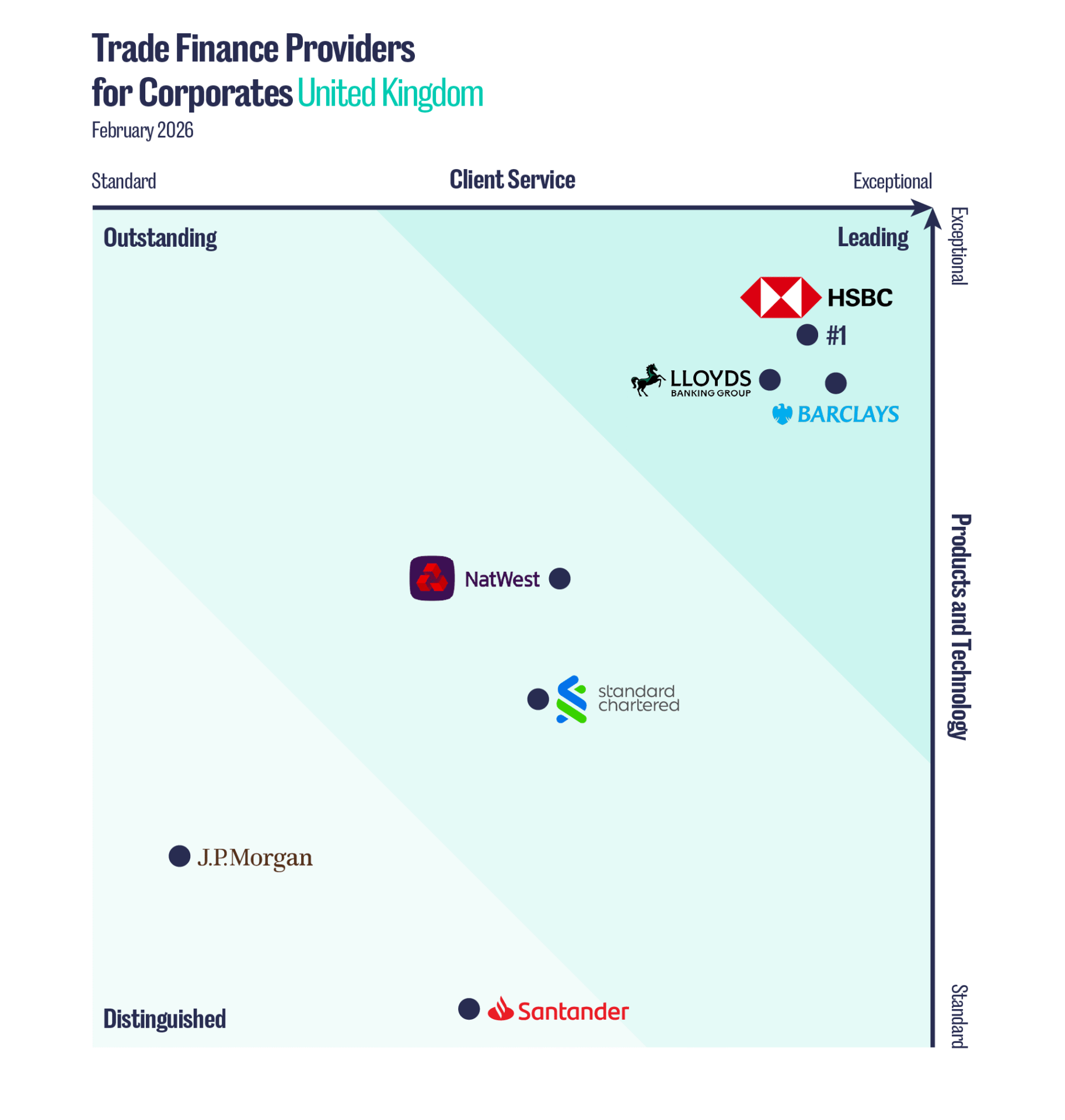
UK corporates ranked HSBC as the #1 provider for working capital solutions, structured trade, advisory services, embedded foreign exchange services and letters of credit, with technology and service levels representing the highest differentiation versus competitors.
Product breadth and customisation are also recognised by respondents. A manufacturing-sector client points to HSBC’s ability to deliver customer-specific trade solutions aligned with operational needs, while a head of treasury in the technology sector highlights invoice financing as a key component of the bank’s offering.
Consistency, backed by expertise
Across the UK client base, feedback reinforces a consistent message: digital capability delivers value when it is paired with informed decision-making and fast issue resolution. One respondent highlights “responsive and effective” customer service, particularly in handling fraud alerts quickly, while others emphasise the importance of advisers who can translate complex trade structures into workable solutions.
HSBC provides proactive relationship management, with advisors offering timely and personalised guidance.
Euromoney Trade Finance Survey respondent
That combination matters because, despite the pace of innovation, reliability remains non-negotiable. Corporates consistently highlight HSBC’s strength in execution – a UK-based retail trade company notes that HSBC “excels in trade finance and cross-border business banking”, adding that a documentary credit transaction “went through smoothly, ensuring no delays in shipping”.
Clients link the bank’s execution strength directly to relationship quality. One treasurer highlights that “the stand-out quality of the HSBC team is their focus on really understanding our business needs and delivering appropriate products that work for us”, adding that HSBC is viewed as “a trusted partner”, not just a provider.
Alongside product innovation, HSBC has also expanded its advisory engagement with UK clients. As uncertainty has become a new operating reality, corporates increasingly value banks that can interpret regulation, risk and optionality. As another respondent puts it: “HSBC provides proactive relationship management, with advisors offering timely and personalised guidance.”
By combining global consistency, a broad product suite and relationship-led execution, HSBC is supporting UK corporates navigating increasingly complex supply chains with greater control, speed and confidence.