As the immediate chaos of the global financial crisis subsided, Morgan Stanley took a long hard look at its strategy and chose to focus on wealth and investment management. It is a decision that has paid off. Private banking generates steadier, more reliable income streams than the more cyclical business of investment banking.
In 2022, wealth management generated pre-tax profit of $6.6 billion on revenues of $24.4 billion – both record numbers. Most of that was generated in North America, where it has more than 520 wealth management branches. It pulled in $311 billion of net new assets (NNA) last year, pushing total wealth-related client assets to $4.2 trillion. In the last three months of 2022, the Wall Street bank generated record revenues of $6.62 billion, up 5.9% year on year.
Its success has been rewarded by investors who, unsurprisingly, like the quality of its strategy and the scale of its ambition. The bank’s aim is to generate $1 trillion in wealth-related NNA every three years to reach its longer-term goal of $10 trillion in client assets. Morgan Stanley was named best private bank in the US and in North America in Euromoney’s 2023 private banking awards, as well as the world’s best digital private bank and the world’s best for family offices.
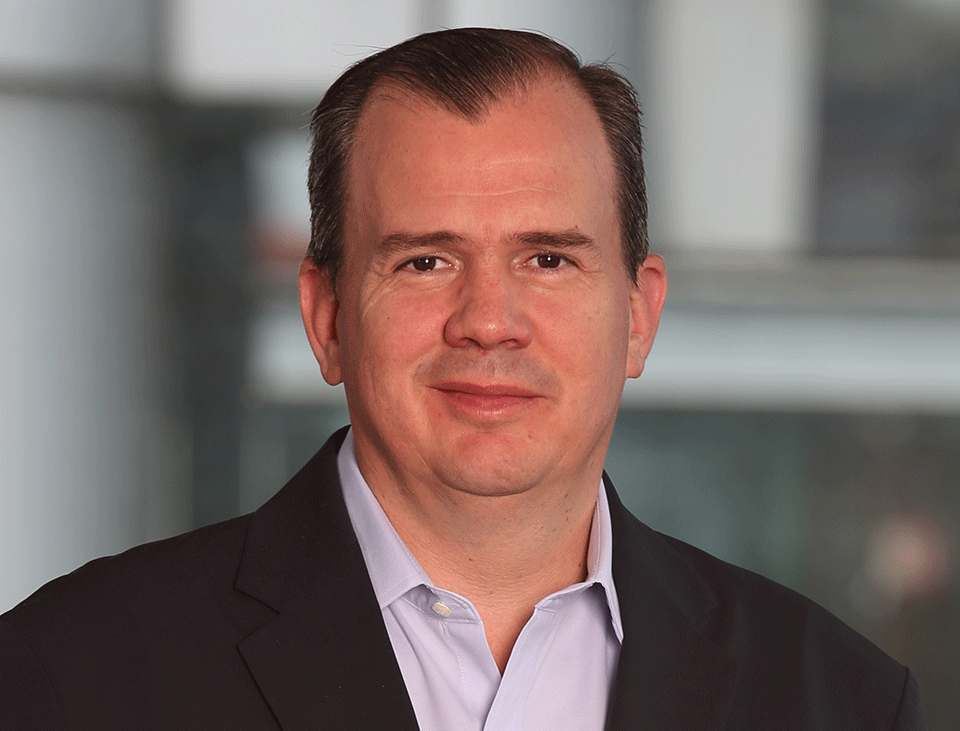
“The secret sauce is not just having the capabilities, it is integrating them,” says Andy Saperstein, head of Morgan Stanley wealth management. “It’s the ecosystem of how the various parts work together that’s the true competitive advantage that we’ve built.”

Morgan Stanley has always been good at private banking, but its second coming as a wealth manager of such scale has evolved through several phases. One was the acquisition of Smith Barney. Another was its forward-looking alliance with artificial intelligence research lab OpenAI, which looks to help its relationship managers better serve clients.
A number of deals before and during Covid, including the acquisitions of investment manager Eaton Vance for $7 billion and E*Trade for $13 billion, helped it become a powerhouse in the workplace channel. Over the past couple of years, the US firm’s number of client relationships has ballooned from 2.5 million to 18 million. The E*Trade deal alone generated a $600 billion uplift in NNA.
“We’ve built a prospecting machine that creates millions of new relationships by the seamless integration of our channels and capabilities through our client acquisition funnel,” adds Saperstein. “We no longer rely on financial advisers to source new relationships. Instead, we are sourcing new opportunities for them and helping to make them more effective and productive.”
Another secret to its success is the depth and diversity of its business. When you break down NNA growth into its main constituent parts – including new retail clients, existing retail clients, new institutional clients, stock-plan vested assets and family office assets – you discover that no single one contributes more than 25% in any full financial year to overall NNA growth.
The secret sauce is not just having the capabilities, it is integrating them
Andy Saperstein
There is evidence of Morgan Stanley’s excellence in wealth management everywhere. Its family-office division delivers the full private-banking experience to family offices in the US and Canada. Its ultra-high net-worth segment delivers world-class services to entrepreneurs, business owners, corporate executives and single-family offices.
Another notable service is Morgan Stanley at Work. This provides corporate clients with access to a comprehensive set of private-banking services for time-stressed, high-income (and often indebted) white-collar workers, including stock portfolios, retirement planning, financial wellness and non-qualified deferred compensation schemes.
Morgan Stanley now reckons it regularly generates more than half of its annual revenues from its wealth and asset management business. In 2022, investment management fees and net interest income accounted for 54% of bank-wide revenues.