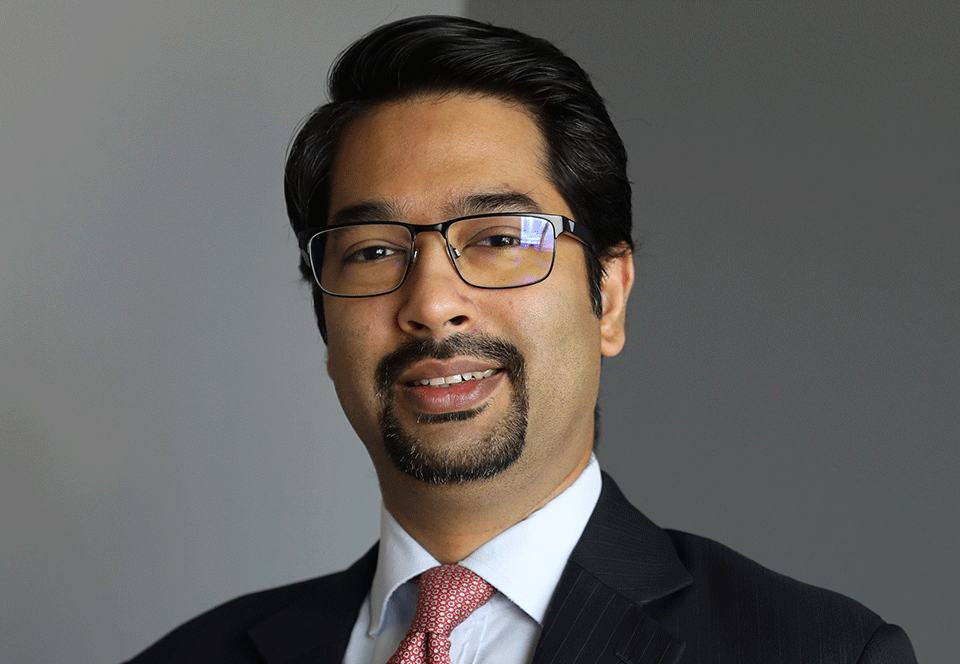
Only the biggest and soundest of the US regional banks were able to come through the wreckage of March 2023 unbowed. None did so better than Citizens, a bank that was already consolidating two fine strategic moves at the start of the awards period and was able to consider another at its end. It wins the award for the country’s best super-regional bank.
The bank’s financial performance has once again been strong, with revenues rising 28% year on year in the awards period, while adjusted pre-provision pre-tax profits are up 44%.
Assets have risen substantially, up 16%, mostly on the back of the acquisition of the East Coast branches of HSBC and then New Jersey-based Investors Bancorp, which completed in early April 2022. Deposits rose 8% over the awards period and loans were up 18%.
The bank’s valuation, however, followed a different path, its market capitalization fell 23% over the review period, which ended in the midst of the US regional banking crisis.
Along with many of its peers, Citizen’s stock was already under pressure before the sector descended into turmoil in March, but the bank still came through the crisis looking like one of strongest. That it was even able to consider a bid for Silicon Valley Bank, like JPMorgan, was a reflection of its confidence.

Part of that was down to intelligent moves earlier on. Like other banks, Citizens faced a challenge when interest rates were low and it had excess deposits to deal with. It could have maxed out on higher-yielding long-dated securities but opted against doing that, choosing instead to invest in safe two-year auto paper.
At one point that had run up to about $14 billion of the bank’s $175 billion loan book, but higher funding costs now mean that marginal portfolios that lack customer relationships are hard to justify. Another example is the student loan portfolios bought from SoFi that banks are not allowed to cross-sell to.
“If you stack our highest-cost funding against those portfolios, we were not making enough to justify having them anymore,” says Bruce Van Saun, chief executive of Citizens. “Adjusting the balance sheet to the new world is another big challenge that we have faced.”
A conservative approach is what had allowed the bank to make not one but two important strategic moves in early 2022, the acquisitions of the HSBC branches and Investors Bancorp. They were just the latest of a string of acquisitions over the years that have been well executed and well-integrated.
Before the March madness of 2023, Citizens’ full-year 2022 had looked impressive. The bank posted a 16% return on tangible equity and the performance was all the more striking considering that only half of its pre-provision revenue growth of 28% was down to its acquisitions.
The bank’s common equity tier-1 ratio rose 30 basis points over the awards period to 10%, the high end of the bank’s target range.
“It was a very strong year in spite of the challenges in the market,” says Van Saun. “We managed through the rising interest rate environment, protecting the balance sheet and making sure that capital, liquidity and funding were strong.”
We have to seize the opportunity to be more than people’s favourite bank but their full wealth adviser
Bruce Van Saun
It meant that on the bank’s year-end earnings call, in mid January, it was confident enough to give robust guidance for 2023 and raise its medium-term return target to between 16% and 18%. Events since then may have tempered short-term expectations, but not by much.
“We were well-placed to play strong defence and disciplined offence,” adds Van Saun. “And we still think we are going to have a solid year. We delivered a 15.5% return on tangible equity in the first quarter.”
Citizens is not short of opportunities either – one of the biggest might be in wealth management.
“We have had to move from a traditional bank model of selling yield products like annuities to a wealth-advice model, thinking about long-term objectives, and a financial planning function,” says Van Saun. “That has begun to lift off – we have to seize the opportunity to be more than people’s favourite bank but their full wealth adviser.”
Citizens bought wealth management and multi-family office firm Clarfeld in 2018, but that caters to the very wealthy rather than the mass-affluent base that the bank thinks it can capture well.
There have been times in US regional bank consolidation when acquirers have been guilty of failing to appreciate the sensitivity of entering a new community. Citizens takes a quite different tack, routinely taking care to invest in local initiatives that develop employee skills or support local businesses.
“You have to become part of the community,” says Van Saun. “You have to listen and learn and then target your approach. So, we heard about the biggest needs in each community, we focused on grants to partners for workforce development, and we helped Chinatown, which had been badly hit in the pandemic.”
Community feeds through in other ways too. It wasn’t just loans and deposits that Citizens got with its Investors Bancorp acquisition. It also inherited sponsorship of the New York Giants in football and the New Jersey Devils in ice hockey, both somewhat downtrodden teams in recent years that had been rattling around the lower ends of their leagues. This time around they both made the post-season.