Citi’s performance in emerging markets investment banking last year is a strong validation of its geographical presence. When capital markets activity is down in certain regions – the Americas and Europe this year – Citi can focus elsewhere, such as the Middle East, where deal flow has remained resilient and where the bank saw the results of years of patient relationship building with the region’s authorities and corporates.
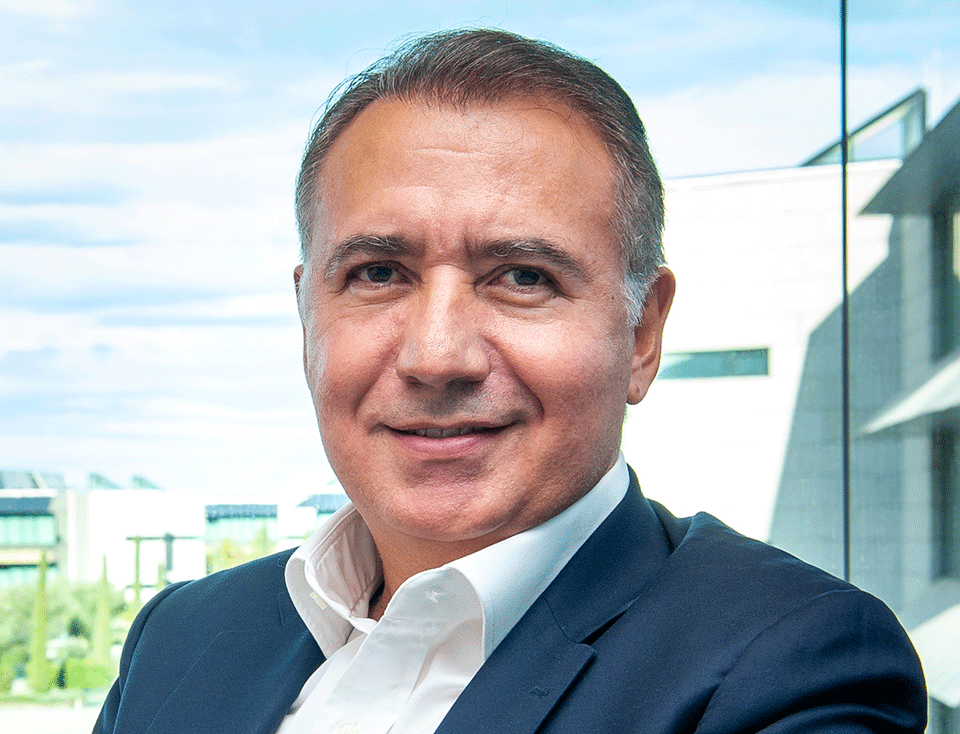
“We’re surfing a big wave right now in the Middle East, and this deal flow is credit to the leadership in the Middle East in setting up the ecosystem in a manner that is conducive to deal making,” says Hamza Girach, co-head of emerging markets in the banking, capital markets and advisory division in Europe, Middle East and Africa.
While Girach credits the Saudi-led transformation of the region for activity levels, Citi is also reaping more than its share of deals.
“Citi has been sowing the seeds in the region for multiple decades, primarily to establish on-the-ground presence and long-term relationships with the biggest government-backed entities,” he says. “That relationship has brought a lot of trust to the table.”
Shortlisted
- Bank of America
- Goldman Sachs
It led to many notable mandates, such as the $6.1 billion Dewa IPO, which was the largest-ever IPO in the UAE. And Citi topped the region’s league tables for equity capital markets, debt capital markets and M&A, confirming its dominance in the world’s busiest investment banking market last year.
Another benefit of Citi’s geographical reach is its ability to capitalize on new cross-border flows. An example of this is Actis and Mainstream Renewable Power’s sale of Lekela Power, Africa’s largest pure-play independent renewable energy power producer, to Infinity Group and the Africa Finance Corporation.
Citi acted as exclusive financial adviser to Actis and Mainstream in a deal that represents the first time that Dubai (through Infinity Group) has put so much strategic investment into Africa.
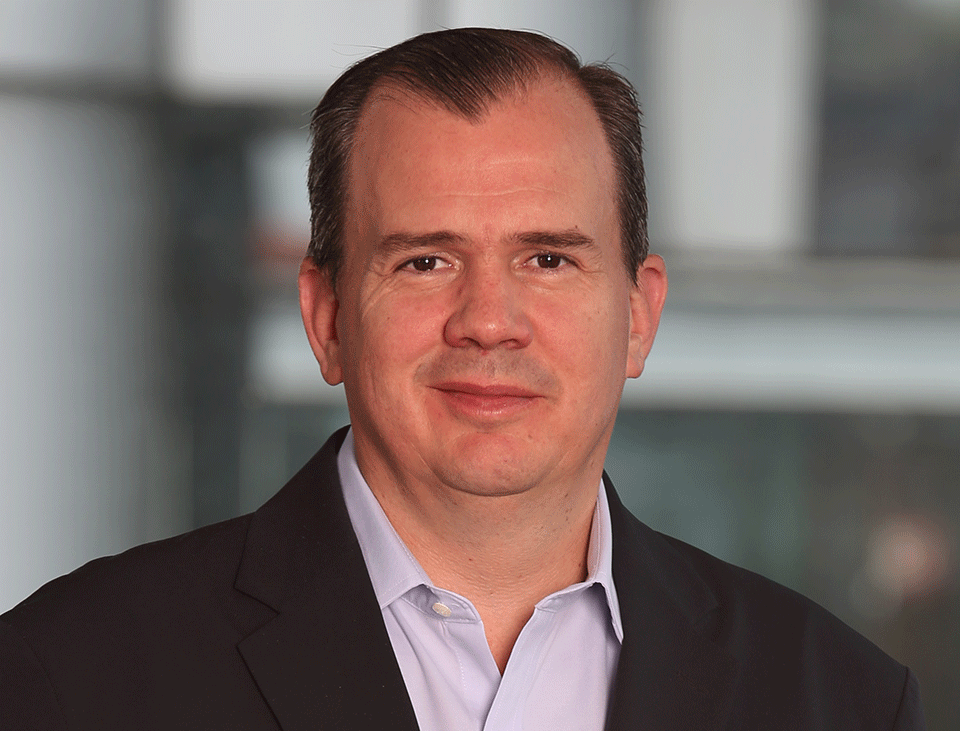
While deal flow in the Middle East is very reliant on state-level relationships, it is a different story elsewhere. Eduardo Miras, managing director and head of investment banking in Brazil, says that Citi’s strength in the corporate banking market in emerging markets is an underappreciated weapon for the investment banking team.
He also says that Brazil, which divested the retail bank in 2017, is a good example of how the bank’s strategy will evolve elsewhere – notably in Mexico – and Miras has been sharing the Brazilian experience internally with the Mexican leadership group as it prepares to spin-off its retail bank.
“There has been a lot of noise about Citi leaving retail banking, but what has been much less appreciated is that this was accompanied with a big expansion of the balance sheet,” he says. “In Brazil, we have almost tripled the size of our balance sheet – it’s now around R$170 billion [$35 billion] from about $R62 billion in 2017. So, we have really reinvested the capital in Brazil and we have significantly expanded the footprint of the wholesale business with clients.”
Miras says developing Citi Commercial Bank across the market is ultimately one of the foundation stones of the bank’s emerging-market franchise.
“I’d say that Brazil is ahead of many emerging markets around the world in executing this strategy – we have been doing this for the last five years – and I’m a believer in this approach.”
There has been a lot of noise about Citi leaving retail banking, but what has been much less appreciated is that this was accompanied with a big expansion of the balance sheet
Eduardo Miras
Miras says this directly led to Citi’s strong performance in Brazil’s IPO wave in 2020 and 2021 – although the capital markets slammed shut for new equity issuance last year. But these are long-term strategies.
“A lot of these IPOs were medium-sized companies that were our clients and we were already lending to them, providing them with FX services, payments, cross-border derivatives,” he says. “The relationship was already there.”
And while the international markets were shut for long periods for Latin American issuers, Citi’s local presence enabled it to turn to local market funding sources for its clients.
Volatility is a fact of life in emerging markets, and so having the ability to pivot to local markets and even to extend the bank’s own balance sheet is critical to remaining relevant to clients through cycles.
Citi’s messaging around its new emerging-market strategy has been well received. Girach credits the efforts of Citi chief executive Jane Fraser as a critical part of this.
“If you look at where Jane Fraser has been within the emerging markets in the past year, I am confident no other Wall Street CEO has visited EM markets as much, which speaks volumes to the commitment she has in supporting the build out in our regions,” Girach says. “And that top-down focus permeates through the organization in terms of our ability to deploy the firm’s capital, technology and resources throughout EM.”
In 2022, Fraser made 11 trips to Mexico, Qatar, UAE, Poland, India, Saudi Arabia and Kuwait. Her actions speak louder than words for Citi’s emerging markets business.