Completed M&A volumes declined sharply in the 12 months of rapidly rising interest rates and falling company valuations that characterized the awards review period. But remarkable deals still got done and Morgan Stanley, the world’s best bank for advisory, worked on many of the most important ones, even though it finished below its two great rivals in the M&A volume league tables.
It featured on the year’s two most memorable transactions: Elon Musk’s takeover of Twitter and the rescue of Credit Suisse by UBS. It did plenty of other work besides and now expects deal activity to pick up.
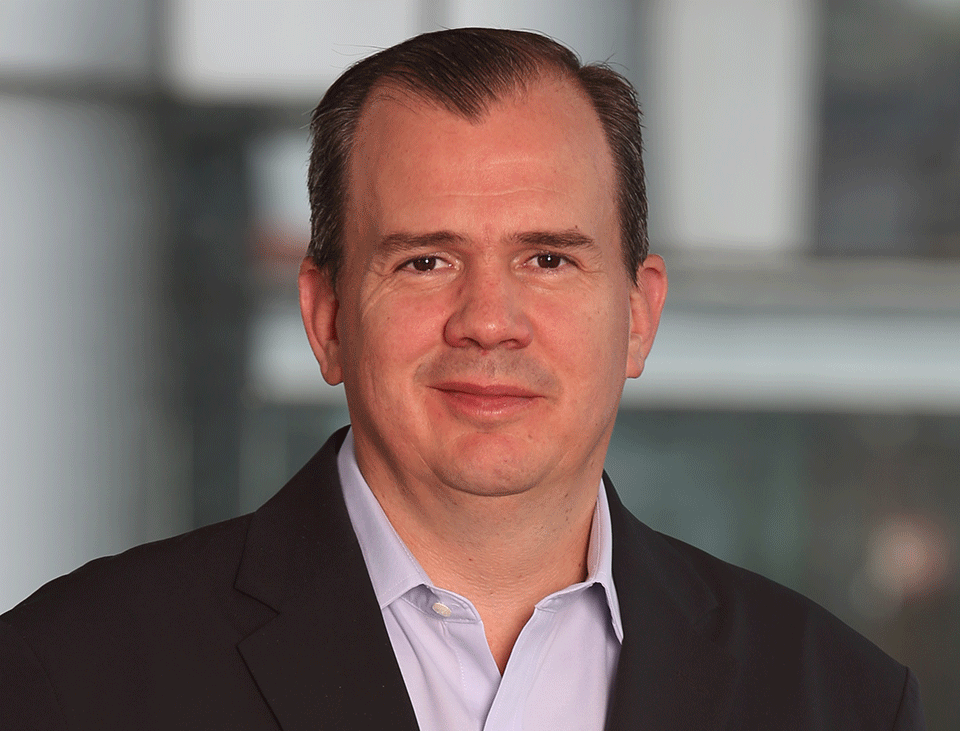
“The quality of businesses being sold has improved,” says Jan Weber, head of M&A, Europe, Middle East and Africa at Morgan Stanley. “At the same time, marginal deals are less likely to happen. Strong companies that are seasoned acquirers can approach targets as a safe port in a storm, while sellers are finally beginning to accept that in 2023 they are not going to get the same price they might have done in 2021.”
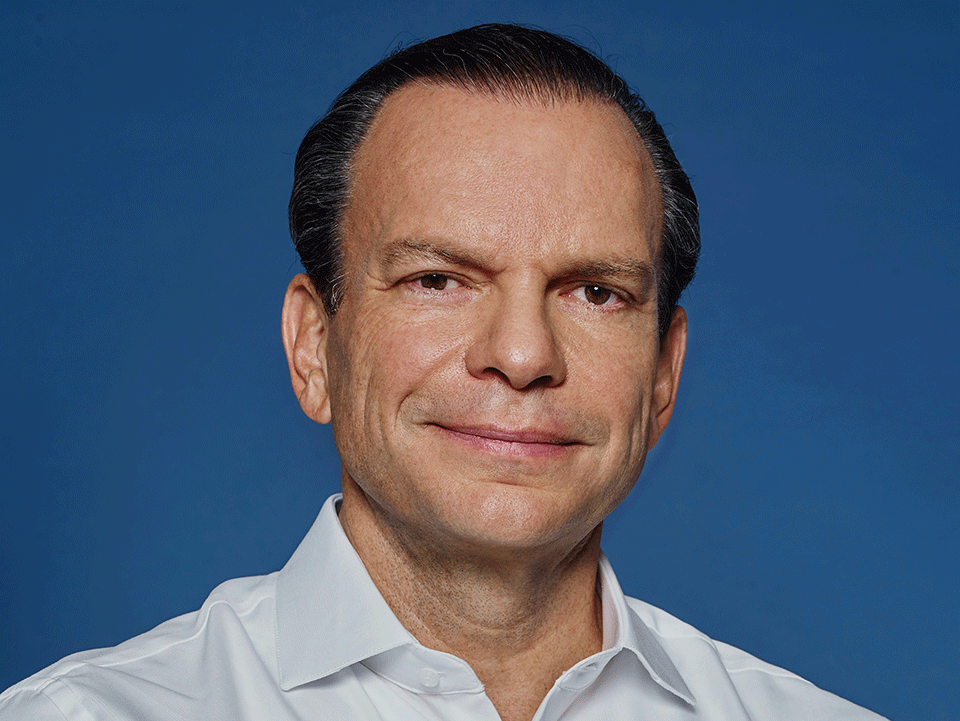
John Collins, global head of M&A at Morgan Stanley, adds: “While we see these periods of uncertainty as an opportunity, Morgan Stanley is not deal driven per se. We are strategic advice driven. We are striving to advise C-suites and boards that in some cases have never seen these kinds of interest rates or inflation.”
Shortlisted
- Evercore
- Goldman Sachs
- Rothschild & Co
While many companies, especially stronger ones, continue to weigh strategic transactions, they may be more reluctant to announce their intentions given the continued volatility of stock prices, the difficulty in agreeing terms and the higher cost of financing. And there is greater regulatory uncertainty to factor in – not just from competition authorities but also government guardians of national security interests in the technology, energy and industrial sectors.
Simplification is one trend likely to persist. Activists continue to press large public companies to spin off divisions, and their targets can do this without seeking shareholder approval, in contrast to, for example, large equity raises.

“We have a long history of advising on separations,” says Collins. “One reason separation activity is relatively high is that corporations can decide to do them unilaterally. They aren’t reliant on any counterparty to agree on valuation. Corporate separations are complex and multi-disciplinary, requiring both industry expertise and understanding of how to position the spin-off to the equity markets.”
Morgan Stanley has been a longstanding adviser to General Electric, a company that has for some years now been reorganizing its vast portfolio of businesses.
It acted as lead financial adviser to GE on its spin-off of General Electric Healthcare and co-led all the related financing on a $30.5 billion transaction completed in January 2023. The delicate challenge here is to be trusted adviser both to the parent and its offspring.
“We have known the management of GE Healthcare for a long time and worked with them in thinking about the business as a standalone entity after years of being somewhat constrained under GE in how they could deploy capital,” says Collins.
This was a healthcare company that had underinvested in healthcare – a sector Morgan Stanley covers well – while lacking its own stock as a transaction currency.
“Sometimes separations are simply to highlight the value of a subsidiary; while that was certainly a driver here, GE was dealing with a complicated and highly leveraged balance sheet,” Collins continues. “There were various points of view over how much debt to put on the GEHC capital structure while still keeping it investment grade.”
Strong companies that are seasoned acquirers can approach targets as a safe port in a storm
Jan Weber
The subsidiary was well understood within GE but not so well followed by public market investors. Morgan Stanley worked hard to position the company, its capital structure and growth prospects in a volatile stock market, while also advising the company on, for example, setting targets for public market investors.
The share has performed well and it remains to be seen how the company may eventually grow, including through acquisition.
One industry sector where consolidation now seems inevitable is US regional banking. Advising UBS on the takeover of Credit Suisse was a reminder of Morgan Stanley’s strength in financial institutions. It was also financial adviser to Bank of Montreal on the $16.3 billion acquisition of Bank of the West from BNP Paribas, completed in February 2023, growing its client’s US assets by a third to over $400 billion and making it the number four regional bank by size in California.
Morgan Stanley also advised MUFG Union Bank on its $11 billion sale to US Bancorp, completed in December 2022.
The bank worked on a string of large commercial real estate transactions too. It was lead financial adviser to VICI on its $16 billion acquisition of MGM Growth Properties, completed in April 2022, and lead left adviser on multiple tranches of associated financing. That showcases the combined strength of the firm’s real estate and gaming investment banking, M&A, leveraged finance and equity capital markets franchises.
It also advised Blackstone on the $23.8 billion recapitalization of logistics real estate company Mileway, as well as on the $13.1 billion acquisition of American Communities. That adds the largest developer, owner and manager of high-quality student housing communities in the US to Blackstone’s own large portfolio of student housing.