“Will China continue to finance global infrastructure development in the same way it used to?”
It’s a question China public policy expert Hong Zhang asks in a report published on February 14 by Johns Hopkins University’s China-Africa Research Initiative (CARI).
It’s also a question that matters deeply, and not just to Chinese state-owned enterprises (SOEs), banks and policymakers, and the countries – mostly emerging markets in Asia and Africa – most heavily targeted by Belt and Road Initiative (BRI) funding in the Xi Jinping era.
In terms of development finance, of working to channel capital to countries that need it most, what kind of China will emerge from the pandemic?
Developed-world sovereigns, and multilaterals like the IMF and World Bank, also care. They too want answers to a key question: in terms of development finance, of working to channel capital to countries that need it most, what kind of China will emerge from the pandemic?
Hong’s report doesn’t mince words.
“China’s infrastructure construction industry, financial institutions and policymakers are cognisant of the problems with [its] overseas infrastructure financing – including financial unsustainability for both host countries and China, and [a] lack of accountability for Chinese companies,” she writes.
Total new funding of BRI projects peaked at $130 billion in 2015, according to data from Fudan University’s Green Finance and Development Center. The size of the average BRI investment that year was $850 million, against $130 million in 2021.
Around this time, policymakers and the heads of China’s big banks and infrastructure firms set out to revisit the country’s long-standing ‘engineering-procurement-construction plus financing’ (EPC-F) development finance model.
Predicated on boundless access to low-cost financing – which Beijing had plenty of in the early to mid-2010s – it had done its job well enough for years. But now Beijing wanted to replace the low-value-add model with an upgrade called ‘integrated investment, construction and operation’ (IICO). This would embed Chinese firms and banks in the full lifecycle of a project; they could finance, build and operate it, contributing equity investment along the way.
“Simply put, IICO would involve Chinese companies taking greater ‘ownership’ – in both meanings of the word – in overseas projects,” Hong explains. They could “climb the value chain by becoming investors and operators” of projects they were contracted to build.
This model – think of it as ‘BRI 2.0’ – was adopted in policy discourse. A new face of Chinese development finance, freshly scrubbed and moisturized, seemed set to emerge.
Around that time, however, state-run Chinese banks and firms got more not less conservative in their risk management. From 2016, the heads of SOEs were held responsible for the entire lifetime of all outward investment projects. Banks also set out rules requiring outbound investors, including those working on BRI projects, to provide guarantees for loans.
The net result is a painfully slow shift to the IICO model – especially in Africa, where investment risks are higher.
This is important because of the outsized role the country now plays in development finance. Pre-pandemic, China was the world’s largest sovereign creditor in development finance. Between 2013-2020, its average annual development finance commitment to international projects was $85 billion, according to AidData, a research lab at William & Mary university in Virginia.
Lekki Port
The world needs Beijing onside, but equally China must show it has learned from its mistakes and up its game, especially when it comes to shifting to an IICO model – and this is where Lekki Port comes in.
Lekki is touted as a game-changer for Nigeria. Located 40 miles east of Lagos, it’s the country’s first deep-water seaport and is deemed essential for the nation’s development. A 2020 report by Dutch logistics consultancy Dynamar found congestion at existing ports cost the country $55 million in economic output each day. Domestic policymakers hope Lekki will create 17,000 new jobs and generate $201 billion in taxable income over the next 45 years.
The main investor in the port is China Harbour Engineering Company (CHEC), which is in turn owned by China Communications Construction Corporation, a top-five global infrastructure contractor and the country’s largest. CHEC has built at least 13 African ports and is considered a dominant player in the sector.
CHEC became an investor in in the Nigerian port in April 2020 after stumping up $221 million in equity financing. Six months earlier, Lekki secured a $629 million loan from China Development Bank.
The Chinese SOE replaced Tolaram Group as the port’s primary investor, after the Singapore conglomerate failed to corral the necessary financing from Nigerian and European banks. It took the role of main EPC contractor and created a joint venture, with CHEC owning 70% and Tolaram the remaining 30%. The port was officially completed in November 2022.
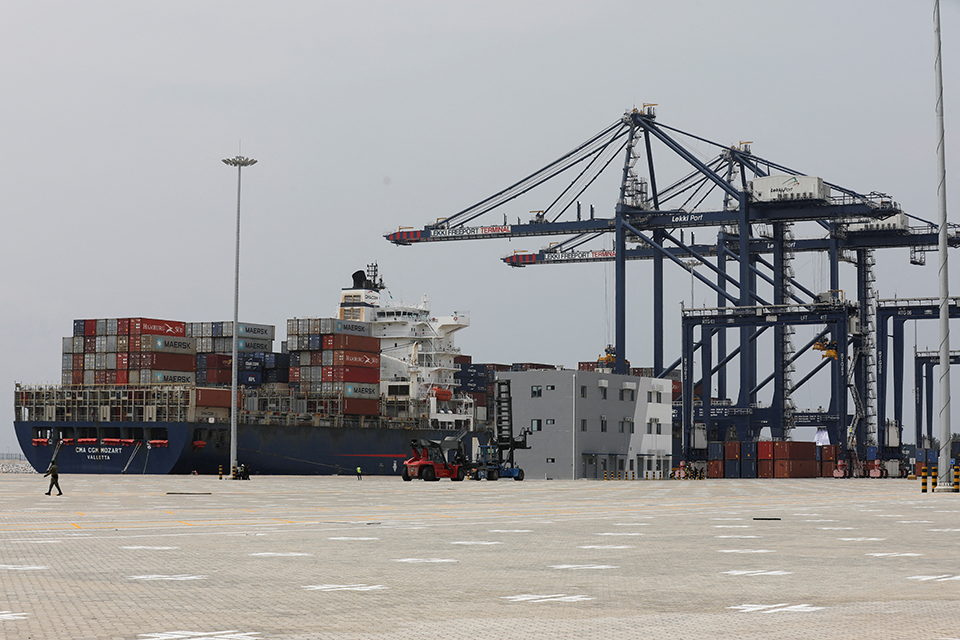
CHEC’s decision to invest in the port only made financial sense, Hong says, if it profits directly from its day-to-day running. But that approach, it seems, was never seriously considered, for two reasons. First, because the Chinese group, while a strong contractor, had no experience in port operation. Second, because Tolaram and Lekki’s Nigerian partners demanded that construction and operation be kept separate.
CMA Terminals, a unit of the French shipping giant, therefore, took an 80% stake in the joint venture that now operates the port, with CHEC controlling the rest.
Tolaram had done most of the heavy lifting – negotiating with the Nigerian government, designing the project – long before CHEC entered the fray. And it was only then that Beijing rushed to label it a BRI project. Hong argues that the investment illustrates the steep learning curve that some Chinese companies face to climb up the value chain.
That Chinese firms are willing to collaborate and take minority roles with international players is in a way good news: it allows SOEs to learn the ropes and make complex projects truly multilateral, and it lets poor countries hold them more accountable for their actions and investments.
But the IICO model “entails greater risks that China’s current banking system and SOE regulations are not quite ready to cope with,” according to Hong.
And so we return to our initial query. Can China once again dominate global development finance, the way it did before Covid hit?
We won’t know the answer for months, maybe years, and navigating an IICO path will not be easy. As Hong notes: “It is also possible that such risks are too great for China’s state capital actors to handle.”