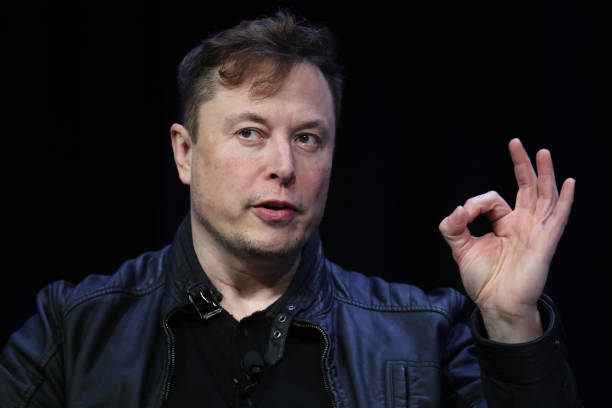
On Monday, Tesla revealed that it had invested $1.5 billion in bitcoin as part of its efforts to diversify and maximize returns on surplus cash.
Just to give a little kicker to its own investment, the company also said that it expects to begin accepting bitcoin as payment for its cars in the near future, subject to applicable laws.
Chief executive Elon Musk has become a crypto influencer, discussing bitcoin with other CEOs on Twitter, declaring himself a supporter of it on the Clubhouse chat app and recently endorsing Dogecoin as “the people’s crypto”.
Its price doubled the day after Musk tweeted the single word “Doge”.
The 10-K filing with the US Securities and Exchange Commission made no mention of any personal account dealing in bitcoin by Tesla staff. Rather, it emphasized that this new policy has been approved by the board’s audit committee.
The price of bitcoin shot up from $39,000 to $46,000 on the news. So the electric car maker’s treasury is already in the money.
Sadly, because cryptos are considered indefinite-lived intangible assets, it cannot mark up any profit until it actually sells its bitcoins. However, accounting rules will require Tesla to take impairment charges if the price falls below its own carrying values. And that could hit its operating results.
Well, it is always risky being an innovator.
Cornerstone
Crypto enthusiasts were quick to claim this as a watershed moment that, alongside the growing interest of institutional investors in cryptos, now also establishes some allocation to digital assets as a cornerstone of a healthy, diversified treasury.
PayPal has already enabled US users to buy, sell and hold cryptocurrencies in a closed ecosystem; this year it will allow its customers to use their cryptos to fund purchases from its 26 million merchants.
A report from RBC Capital Markets on the potential for Apple to profit by adapting the Wallet app that comes with its iPhones for cryptos inspired market rumour that the tech firm will be next. Analyst Mitch Steves points out that payments company Square generates around $1.6 billion a quarter in bitcoin-related revenue from roughly 30 million users.
Apple has 1.5 billion potential users. Even if only 200 million – the number of new iPhones it sells every year – began to transact in cryptos, the potential revenue opportunity would be in excess of $40 billion a year.
If Apple chose to follow Tesla and buy $1.5 billion of bitcoin, that would use up just six days of cash flow.
But it wouldn’t have to hold any bitcoin on its own balance sheet to enable users to hold bitcoin in its wallet or provide a buying and selling mechanism.
Businesses should follow these early adopters establishing in-roads to the payment rails and financial infrastructure of the future
John Wu, Ava Labs

John Wu, president of Ava Labs, says: “Regardless of industry, businesses should follow these early adopters establishing in-roads to the payment rails and financial infrastructure of the future.
“That starts with bitcoin, and will steadily expand to projects that are just outside the frame focused on the programmable, smart-asset side of the ecosystem where enterprises can find more use cases beyond digital gold.”
Function
In reality, none of this makes much sense.
Bitcoin may be an intriguing speculative investment amid the reflation trade now inflating bubbles across mainstream financial and commodities markets. But it is not a stable and reliable store of value or a useful medium of exchange.
Boosters wrap another short-term leg up in the price inside discussion of a broad future-use case.
Simon Peters, crypto-asset analyst at eToro, says: “Multiple other brands already accept bitcoin as payment, and we would imagine that, in time, other major companies will follow Tesla’s example.
“The world is moving online more and more, and bitcoin sits at the heart of online transactions. With this kind of endorsement from a multi-billion dollar company, it is likely the price will hit $50,000 by the end of the week.”
The world is moving online more and more, and bitcoin sits at the heart of online transactions
Simon Peters, eToro

But it is hard to know from one day to the next just how many bitcoins your new Tesla model 3 might cost. Right now, it is about one. However, that could change fast.
From $29,000 at the start of this year, bitcoin shot up to $40,500 on January 8, then fell back to $30,500 on January 27.
It touched $19,500 at the end of 2017; one year later, it was worth just $3,200. That’s an 84% fall.
Bitcoin isn’t really a currency. There’s no central bank to reduce supply if demand falls, as it did precipitously in 2018, or to increase supply if demand rises.
Bitcoin’s total supply is currently around 18.6 million, with a hard-coded cap at 21 million. A global network of computers together mine around 900 new coins a day at a substantial cost to the environment. Its anonymous founder owns just under one million of these.
It is an unregulated market for insiders to manipulate and that needs new converts to sell to.
Speculation
The latest generation of crypto funds being sold to institutional investors, family offices and corporate treasuries, seeks to use derivative overlays to limit downside risk.
“The speculative nature of digital assets is a high-level concern, especially for institutional investors, high net-worth individuals and family offices,” says Nathan Cox, chief investment officer at Two Prime, an investment firm that recently launched two actively managed funds focused on the leading cryptos now enjoying inflows. “These investors have been keeping an eye on Bitcoin and Ethereum, but have been unsure when they should get involved and how.”
The speculative nature of digital assets is a high-level concern, especially for institutional investors, high net-worth individuals and family offices
Nathan Cox, Two Prime
Two Prime’s funds seek to deliver 0.8 times beta on the upside and 0.5 times on the downside using derivatives on large exchanges such as the CME.
However, UBS notes that: “Empirical evidence from established asset classes suggests that higher participation by institutional investors could increase volatility due to their more opportunistic investment approach.”
At the start of February, Deutsche Bank published a report on the future of payments. This points out that bitcoin can process about seven transactions a second.
Mastercard processes 45,000 transactions per second.
The German bank’s own survey of European corporate treasurers found that, in the next 18 months, only 5% are likely to use and receive cryptocurrencies, while approximately 80% say they are unlikely to use them, with the remainder unsure.
Meanwhile big and small investors in the S&P500 now have, through Tesla, a small exposure to bitcoin.
Joseph Spak, autos analyst at RBC Capital Markets, notes: “This is another action that is likely to keep [Tesla Inc] in favour with retail, though the institutional investor reaction may be more mixed. Investors may now also need to worry about the fluctuating price of [bitcoin] on the balance sheet.”