 |
| JAPAN FOCUS |
Although the field of foreign investment banks active in Japan has dramatically thinned over the years, those that have stayed the course are in an unusually bright frame of mind today. The reason is a boost in M&A opportunity; the story of how we got here goes back several generations.
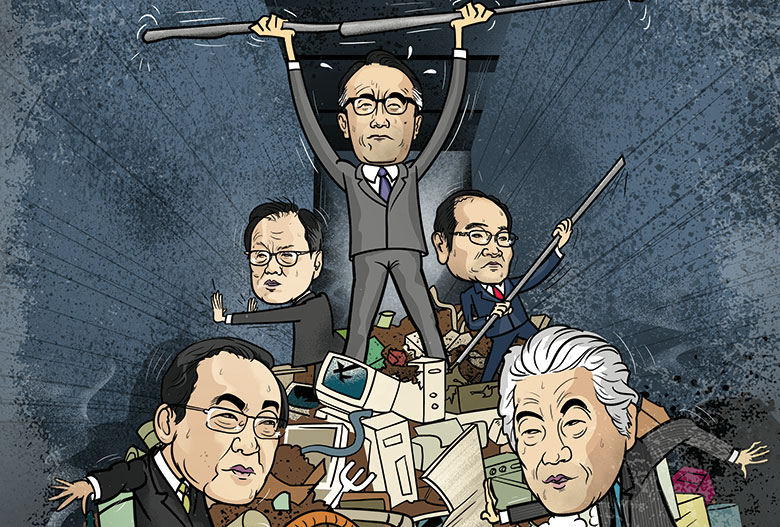
Historically, banks have had a very strong influence on Japanese corporates. After World War II, money was scarce and the capital markets were not yet available, so any company that wanted money needed support from Japanese banks.
This led to some distinctive and rather unhealthy habits.
“Soon after companies announced earnings they would go to Japanese bank CEOs to explain how well they were doing to make sure they would get funding whenever they needed it,” recalls one long-time banker in Tokyo.
They would ask banks to cross-hold their equity so as to have a better relationship, so the banks came to have a big impact on how they were managed.
“And companies would not care about market capitalization maximization or return on equity, because banks didn’t care about it,” says the banker. “They didn’t need to listen to what equity investors wanted.”
The result was the emergence of vast and tangled conglomerates, because, ultimately, that was what banks wanted to see.
From a creditor’s point of view, pure plays are risky. If a business goes sour, the banks are less likely to get their money back than from a conglomerate with diversified businesses and lower volatility. There are examples of it everywhere: Hitachi, Panasonic and Toshiba. There aren’t structural equivalents in the US.
But, just lately, things have started to change.
“In the last five years, we have seen very significant changes and a shift from bank governance to equity governance,” says Haruo Nakamura, head of investment banking at Morgan Stanley in Tokyo. “Now that money is not scarce at all, companies are unwinding their cross-holding shares and are focusing on return on invested capital, return on equity, capital returns and market capitalization.”
This is partly a matter of state prompting. Corporate governance is a keystone of prime minister Shinzo Abe’s economic revival programme and it is articulated in two government-led documents: the Stewardship Code, introduced in 2014; and the Corporate Governance Code, which followed a year later, both of them subsequently revised.
Between them these codes require public companies and institutional investors to engage in constructive dialogue to enhance shareholder value, to disclose proxy results and to demonstrate greater fiduciary responsibility to improve return on equity.
In the early 2000s, it was all about how to deal with non-performing loans, capital raising and building a healthier balance sheet. Most companies are well capitalized now – Tamao Sasada, Bank of America
You can clearly see the shift, illustrated in the success that investors are finally having in their attempts to effect change. In 2011, accounting fraud was revealed at Olympus; investor scrutiny led to an eventual admission of hidden losses and the resignation of the entire board. In 2015, Toshiba admitted overstating its operating profit by almost $1.2 billion, and in 2017 further troubles emerged. Recovery from that has involved selling off assets and restructuring the whole company.
Throughout, institutional shareholders have been central, winning proxy fights where they would previously have had little hope; often they have cited the new codes in their efforts. The fund manager Argyle Street Management wrote to Toshiba in December 2017 asking the company to halt its sale of Toshiba Memory and consider an IPO instead to gain a higher valuation, referring to the obligations of the Corporate Governance Code.
It never used to be like this. Those who have been in the market a long time recall numerous waves of investors attempting to bring a more activist, or at least active, mentality to Japan.
“Every attempt the activists made didn’t succeed,” says Masataka Yamada, head of investment banking at JPMorgan. “At that time society was not accepting of activism. But in the past few years, as the government has pushed towards corporate governance and stewardship, activists have finally had some success.”
Conglomerates
There are few domestic activists, but at least local investors have become engaged, voting their shares and making recommendations to management.
“They’re not really putting strong pressure on, but recommending, proposing corporate changes to management for the long term,” says Yamada. “They’re not asking for a dividend pay-out. It’s more how the organization can be clear on core and non-core strategy.”
Every banker says this has led to a big change in their communication with executives.
“Now,” says Nakamura, “whenever I speak with a CEO or CFO of a large Japanese corporate, what they care about is how they can improve their stock price and how they can convince important global investors that they have changed.”
This is good for investors: conglomerates tend to trade on a nine or 10 times multiple, while pure-play companies with high growth potential – like Uniqlo, Shiseido or Unicharm – can trade at 35 to 40 times earnings.
“There is a significant gap between pure plays and conglomerates, and the gap is widening,” says Nakamura.
What does all this mean for bankers? If Japanese companies now need to listen to equity investors, they also need to change. An active equity investor is unlikely to buy a conglomerate because it’s a lot harder to understand than a pure play. So, to meet the preferences of these shareholders, conglomerates are finally starting to divest non-core businesses – and that is an opportunity for bankers to advise.
Some of the foreign private equity houses have waited a long time to penetrate into Japan, because for them, Japanese transactions looked very expensive in the past – Daisaku Fujikawa, Citi
So far, many of these businesses are going to US private equity. In 2016, KKR bought Calsonic Kansei, an auto parts maker backed by Nissan Motor, for $4.5 billion. Its rival bidders were Bain Capital and MBK Partners.
KKR has since gone on to buy the power-tool and life-science equipment manufacturer Koki and the tech firm Kokusai Electric, both from arms of Hitachi.
George Roberts, the founder of KKR, said this year that Japan was the firm’s highest priority in the world outside the US because of conglomerate divestments: four of the six deals KKR has done in Japan have involved carve-outs from Japanese corporates.
Bain Capital did the biggest deal, buying Toshiba’s memory chip unit in 2018 for $18 billion. Bain is believed to be planning a new fund targeting mid-sized Japanese companies. And, while Carlyle’s deals in Japan so far have tended not to be carve-outs – typically tender offers in free-standing companies such as Orion Breweries – the firm is building a portfolio in Japan and is understood to be attracted by conglomerate divestments.
According to the private equity analyst group Preqin, Japan is now a market at odds with the reduction of new commitments globally.
“Optimism permeates the local private equity landscape,” notes Preqin.
In the first quarter of 2019, 13 Japan-based private equity funds secured an aggregate of ¥221 billion ($2.04 billion), 3.8 times more than in the same quarter a year earlier.
Preqin thinks “new fundraising records could well be ahead in the Japanese market”.
Daisaku Fujikawa, co-head of banking, capital markets and advisory at Citi, thinks this upturn in private equity activity is partly a consequence of valuation in Japan and overseas.
“Some of the foreign private equity houses have waited a long time to penetrate into Japan, because for them, Japanese transactions looked very expensive in the past,” he says. “Now, they are relatively reasonable – not cheap, but other areas like the US and Europe have become much more expensive.”
Alongside all of this is a more long-standing trend of Japanese companies seeking to go out into the world and acquire big, particularly in the US.
|
|
|
Tamao Sasada, Bank of America |
“The theme we’ve seen for the last decade has been a push towards Japanese companies becoming more global,” says Tamao Sasada, president and representative director for Japan at Bank of America. “Cross-border M&A or consolidation domestically have been key themes for the last 10 years.”
Before that, there were other priorities.
“In the early 2000s, it was all about how to deal with non-performing loans, capital raising and building a healthier balance sheet,” says Sasada. “Most companies are well capitalized now.”
This is a key point: companies now have more money than they need and can’t deploy it domestically in anything that looks like it would generate growth.
Nakamura says: “Japanese corporates have too much capital and the Japan market is shrinking, so they have to buy global assets.”
The landmark deal of 2019 has been the acquisition of London-listed pharmaceutical group Shire by Takeda Pharmaceutical in a mighty $82 billion stock and cash deal. But there are numerous others: MUFG, in its various forms, buying Indonesia’s Danamon and Australia’s Colonial First State Global Asset Management; Tokyo Century buying Aviation Capital Group for $3 billion; Tokio Marine buying US insurer Pure Group for $3.1 billion; and Calsonic Kansei – which was bought by KKR in 2016 – buying Magneti Marelli from Fiat Chrysler for €6.2 billion.
This theme also applies to the conglomerates that have sold non-core businesses and now have money to deploy in areas they are actually good at. An example here is Hitachi, a big seller in recent years, buying the power grids division of ABB for $11 billion, which was announced in December 2017.
Historically the US has been the favoured destination for capital because of the breadth of the market, its openness and the ability to allocate capital efficiently.
“If you asked any CEO which would be their favoured destination for an investment north of $5 billion, it’s going to be the US,” says one banker.
But southeast Asia has also become increasingly important. Countries such as Vietnam, Indonesia and Thailand, with a close state-to-state relationship with Japan, are easy to do business with – and they offer GDP growth, something utterly lacking in Japan.
What does all this mean for investment bankers? Firstly, that M&A has become dominant in terms of fees – partly a consequence of the fact that there is far less equity capital markets activity as companies no longer need to raise funds in the volumes that they used to.
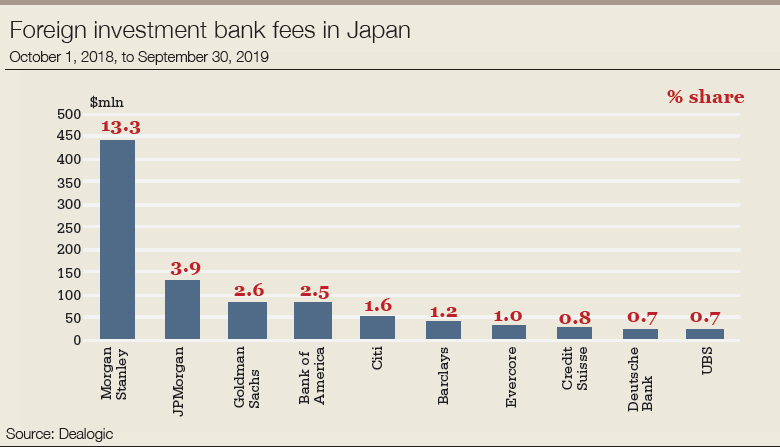
“It fluctuates, but for pure international houses the composition of investment banking revenue mostly came from ECM,” says one banker in Tokyo. “But the ECM business is quite bumpy: one year you have a series of global offerings and one year none. And every time ECM was performing poorly, overall investment banking revenue in Japan went down.”
But for the last few years, M&A revenue has been steadily going up, offsetting drops in ECM fees. One large bank says it has tripled its M&A fees recently.
Bankers see a lot more potential here.
“The Japanese wallet is roughly one seventh of the US wallet in terms of total investment banking revenue,” says Nakamura. “I’m a strong believer that M&A revenue will continue to grow, maybe at a double-digit pace for the next five years.”
Sea change
Generally, there has been a sea change in the role of investment bankers in Japan over the years.
“When I started in the mid 1990s, we began with educating management on the need for advisory work and for global offerings,” says Yamada at JPMorgan. “The biggest difference between then and now is recognition by Japanese society and corporate management of what we do.”
Yamada recalls that M&A started off as “a practice where a securities firm sat in the middle of two parties, brokering them for an M&A transaction. It started from a concept of conflict.”
Things started to change with the bank failures around 2000 and the arrival of foreign investors such as JC Flowers and Ripplewood in rescue roles.
|
|
|
Daisaku Fujikawa, Citi |
While things have clearly improved in terms of recognition and access, bankers are careful not to present the latest changes as universal or complete.
“It’s still not a majority,” says Yamada of corporate governance and change. “We have yet to see an increasing number of companies that would do bold corporate restructurings.”
But are they open to discussions now? “Definitely yes.”
Another banker adds: “The largest change, if you compare 20 years ago and now, is the mindset of the CEOs around what shareholder value means. There is still a shortfall, and I don’t think it’s embedded enough, but if I was to pick the one thing that has had the most impact, that’s it.”
One banker wryly notes that the advice they’re giving hasn’t really changed in 20 years: it’s just now they’re being listened to.
“First of all, 20 years ago they would have had no intention of listening to what we were saying,” he says, recalling a divestment that has now taken place that he first suggested 15 years ago.
The challenge has been persuading Japanese corporates to accept the whole concept.
“The advisory work we do, the equity and debt underwriting, the classic investment banking hasn’t changed at all,” he continues. “But the results have changed. It’s because the mindset of the Japanese corporate CEO is now that they care about and maximize shareholder value.”
Bankers are tailoring their offerings accordingly to help clients get where they want to go.
“As Japanese companies focus more on corporate governance, we have really enhanced the type of services that companies look to us for,” says Sasada at Bank of America.
She says that now corporates are focused on increasing shareholder returns, banks have to make sure they help them do it – maximizing returns for all stakeholders in fact. Sasada ties this in with the bank’s long-standing commitment to environmental, social and governance criteria.
Another banker notes a lucrative new line in defence advisory and activism assignments.
“I never imagined five years ago being hired by so many clients on those mandates,” he says. “There was not much need for it. Now this is the most active part of what we do in the merger business.”
If you’re lucky or smart enough to get a buy-side mandate for a successful bidder, that brings other opportunities: bridge financing, capital markets, forex and swaps.
JPMorgan’s advisory role to Takeda on the Shire deal also got it a lead arranger, lead bookrunner and administrative agent role for Takeda’s $31 billion bridge facility, for example. Even if you’re not an adviser, the big deals still create funding needs: Morgan Stanley lead managed the €7.5 billion and $5.5 billion senior unsecured notes that Takeda used in its M&A financing.
Still, if M&A is good, that doesn’t change the fact that ECM is bad.
“The biggest problem for investment banks right now is that ECM, with the biggest fees, isn’t happening,” says one banker. “There have only been four transactions with international tranches this year and two are mid-sized.”
Worse, the ones that have appeared have not been great successes. The third tranche of the Japan Post sale was postponed following a scandal in its insurance unit. The SoftBank KK IPO, the largest ever in Japan, dropped 14.5% on debut, one of the worst in the country’s history.
Debt
Attention turns, then, to debt.
“If you look back 15 or 20 years, it used to be that the dominant revenue opportunity for debt capital markets was the banks,” says Yamada. “That’s still a big chunk of revenue for DCM in Japan, particularly regulatory capital. Increasingly, banks now target hybrids, with insurance companies particularly active.”
Another positive theme is Japanese corporates issuing non-yen debt in size. Companies including Toyota, Takeda and Panasonic recently tapped international markets for over $1 billion.
“That’s a new trend,” Yamada says.
Sasada says that at BofA, DCM priorities have been multi-currency funding linked to M&A, total loss-absorbing capacity funding for banks in the low-rate environment, corporate issues in dollars and yen hybrids, plus its long-standing strength in green bonds.
Nakamura at Morgan Stanley also mentions hybrids. Unlike issuing new shares, hybrids do not dilute earnings per share, making them increasingly popular.
Bankers note that Japanese companies are increasingly conscious of liability and currency management, which is one reason they are buying companies outside Japan to generate non-yen cash flows. This presents a DCM opportunity.
“For a natural hedge, they think about issuing the bond on the liability side of the balance sheet,” says Yamada, “so it’s not just a cost, it’s cancelling out a foreign currency exposure.”
Domestic yen is a reasonably vibrant market, limited in size but cheap in terms of funding cost.
DCM is also important to the big Japanese banks, who sometimes struggle to get in on big cross-border M&A deals.
“Debt capital markets is a high priority, especially our overseas business,” says Jun Ohta, president and chief executive of SMBC.
So there is plenty to do. But there is still a sense that Japan’s capital markets should be bigger and more active. This is a vast economy, the third largest in the world. Shouldn’t more be happening?
“The capital market in Japan has more room to grow, and that is because just 20% of household financial assets are invested in capital market products,” says Tatsufumi Sakai, president and group chief executive at Mizuho.
International banks agree that more should be happening.
“The wallet has steadily been growing in absolute size, along with further globalization by Japanese corporates,” says Yamada, “but if you look at the sheer size of GDP here, M&A as well as capital markets activity have to be much, much bigger.
“In that respect we have probably lost 20 years, but at the same time, I feel we have large upside here.”
The deals that shaped Japan
Ask bankers in Japan about the deals they consider to be the landmarks of investment banking and they tend to be drawn to the most recent – and, of course, the deals they were on themselves. But here are a few that moved the market forward:
• JC Flowers and Ripplewood buying Long-Term Credit Bank of Japan in 2000 and turning it into Shinsei. The deal that marked the arrival of foreign investment into Japanese banks, following a spate of collapses.
• The megabanks are formed. The mergers of Sumitomo Bank and Sakura Bank to create SMBC in 2001; Dai-Ichi Kangyo Bank, Industrial Bank of Japan and Fuji Bank in 2002 to create Mizuho; and Mitsubishi Tokyo Financial Group and UFJ Holdings to create MUFG in 2005.
• The privatization of Japan Post beginning in 2007. Although the third deal in the sequence is stalled, this was a vast transaction, a triple IPO of bank, insurer and holding company. “The first pitch I did to the Ministry of Postal Savings was 17 years ago, and it took over 10 years to make it happen,” says one banker involved in the deal – not an easy sell, given no obvious direction for growth.
• MUFG bails out Morgan Stanley in 2008. A deal that paid off in many ways: a great investment, an exchange of expertise, a successful domestic joint venture – and it saved one of the world’s finest investment banks.
• Citi sells Nikko to SMBC in 2009. Citi had to sell it after the global financial crisis. It was the only international joint venture in Japan that really worked before Morgan Stanley/MUFG. “That JV gave us a lot of great experience,” says a person who was a part of it.
• Suntory buys Beam for $16 billion in 2014. Bigger deals have followed, but this represents the theme of transformational cross-border acquisitions. “Japanese companies have become convinced that they need to take bold action and attempt transformational deals,” says Morgan Stanley’s head of investment banking, Haruo Nakamura. “Suntory-Beam was the beginning of that trend.”
• Development Bank of Japan launches the green-bond market. This deal in 2014 created lasting momentum in green bonds and came well before the ministry of environment issued guidelines.
• Toshiba Memory’s sale to Bain in 2017. This was one of several deals that stemmed from the many problems at Toshiba, a pillar of Japanese commercial history. It represents the restructurings – some forced, some now intuitive – that have taken hold in corporate Japan. “Because of the troubles it went through, it had to sell its crown jewel and required rescue finance,” says one banker.
• Takeda Pharmaceuticals buys Shire in 2018. Impossible to ignore for its sheer size, it involved $82 billion of stock and cash, a $31 billion bridge facility and several large debt deals. It underlines the global ambitions of Japan’s stronger companies.