 |
| JAPAN FOCUS |
Kanetsugu Mike had big shoes to fill when he became president and chief executive of Mitsubishi UFJ Financial Group (MUFG) in April this year. His predecessor, Nobuyuki Hirano, who is now the group chairman, was the most visible of all Japanese bankers and the profession’s most articulate spokesman on the global stage.
But Mike, pronounced mee-kay, was surely the closest possible equivalent to the man he succeeded. Like Hirano, Mike is an internationalist who incorporates his global experience into Japanese banking. He has worked for the bank in London and twice in New York, eventually becoming regional executive for the Americas, and was in charge of the integration of Thailand’s Bank of Ayudhya, serving as vice-chairman of the Thai bank in the process.
Also like Hirano, he believes in breaking down some of the more staid corporate traditions of Japanese banking and favours more open dialogue. When he took up the chief executive role, he asked people not to address him by his title.
“In Japan, and especially in our organization, it’s very conservative and people always refer to each other with a title,” he tells Euromoney in Tokyo. “If you’re a manager – buchou. Me? President – toudori.”
He asked them to change. “Don’t call me toudori, call me Mike-san. That is a starting point.”
Mike set about visiting branches and having lunches with young employees, as casually as possible; he has done it in about 60 branches, and over the last two and a half years, he says, he has met more than 500 staff in this way.
“No agenda session. I just talk to them, listen to what they say. They throw me tough questions.”
Twice a year he holds a general manager meeting; usually a rather staid and formulaic gathering.
“It was always unilateral communication: what is to be done, what is the action plan.”
|
|
|
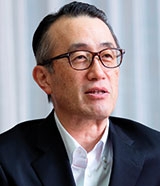
Kanetsugu Mike |
Last year, he changed the style so that he speaks for 20 minutes then opens a town hall, with the heads of businesses on the stage receiving questions from general managers.
It didn’t change immediately. “It was very hesitant: no questions. Very silent, you can imagine.”
He’d expected that and so had prepared a list of people who he told to stand up and give him a question.
This year, to try to get people to open up, he added digital tools so people could throw questions to him anonymously.
“You cannot imagine how many questions were thrown: above 300 in 10 minutes.”
What sort of things was he asked?
“Why there are not more young people. Why we are not that popular among college students. Very good questions.”
Perhaps related to that, Mike has changed the HR system at MUFG. Previously an HR manager decided on the path an employee would take through the bank, a path that rarely deviated.
“I told the HR people: ‘If someone is working as a branch teller and has applied for a job in the asset management business, it will be a big jump, a challenge. We should appreciate that spirit and we have to take it, rather than just moving people to the next desk.’”
Additionally, a new programme called Challenge Leave will allow people who want to start a new business to do so without having to quit the bank. If it works, they’re welcome to leave and pursue it. If it doesn’t, they get their career back in the bank.
“I consider that making a challenge and failing is a very important experience,” Mike says. “We always say that, right? Try and fail. So we have to provide the opportunity to challenge and fail, and also a second opportunity to succeed.”
The evolution is always important. Survival of the fittest. We have to adapt ourselves to the new environment or become a dinosaur – Kanetsugu Mike
Mike says changing the culture is one of three priorities, the first two of which are implementing a six-year strategy plan and revitalizing domestic business. It is all part of an ethos he calls reimagining strategy, the result of a two-year study in which young people within the organization were encouraged to challenge the existing business model.
It is a big ask, given the macro environment: “Unprecedentedly tough for the financial industry,” he says – but unquestionably necessary. “I say a crisis will bring an opportunity as well. After we manage to address this tough environment, we will become much stronger.
“The evolution is always important,” he says. “Survival of the fittest. We have to adapt ourselves to the new environment or become a dinosaur.”
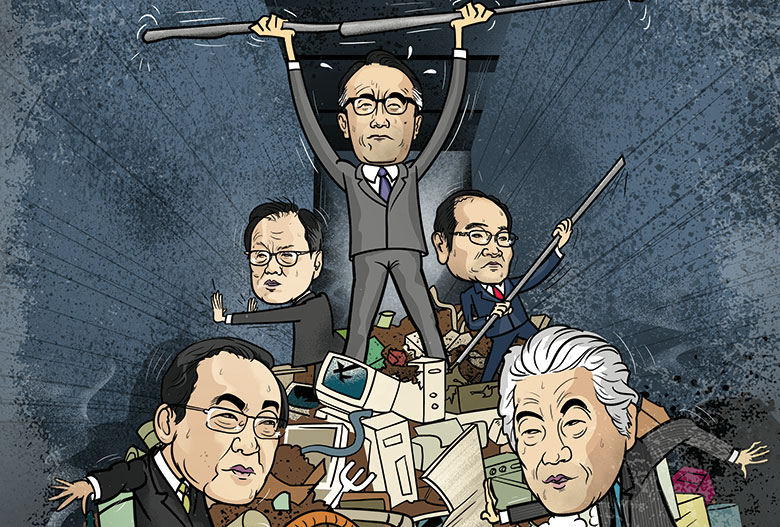
Mike is a sophisticated practitioner of kendo, which is one reason he is a trim and healthy 63-year-old. The ancient martial art has some lessons for life and business too.
If you just hold the sword in front of you, you can defend yourself effectively. But if you want to win – he demonstrates with his hands – you have to lift the sword to strike, exposing yourself to a counter from your opponent.
“The trickiness of kendo is that in order for you to win, you have to be exposed to the risk of losing,” he says. “And you have to overcome that fear. That is the game of kendo.”
And the lesson for business?
“When you’re in a tough environment, rather than sit back, you have to get into that trouble.”