Awards for Excellence 2019
|
|

If there is one refrain that crops up when some Morgan Stanley executives talk about their business, it is “critical judgement”. It refers to those key moments in a deal when the firm’s advice will be the defining factor in determining success. Time and again in the last year it has got these moments right, making it the US’s best investment bank.
Morgan Stanley is on a tear: 2018 saw the investment banking division’s best results ever, as it did for the firm as a whole.
And that was despite a difficult fourth quarter for the sector. Its leading equities sales and trading franchise was a differentiator in the turbulent last month of the year (the bank also wins the award for World’s best bank for markets). And its fixed income business continues to reap the benefits of its radical reshaping in 2015.
On the primary side, there have been landmark deals in all asset classes, including Cigna’s $20 billion senior notes offering to finance its acquisition of Express Scripts, where the firm was lead left on all 10 tranches, and Uber’s $2 billion senior bond that used a 4(a)2 private placement note structure that had only been used once in the traditional high-yield market.
As well as the Cigna deal, completed M&A included such enormous transactions as Time Warner’s $108 billion sale to AT&T and the $66 billion sale of Monsanto to Bayer. In equity capital markets the firm pioneered the direct listing with Spotify, advising the New York Stock Exchange and the company’s designated market-maker throughout the process.
But a situation that has been one of the clearest examples of Morgan Stanley’s ability to coordinate a complex set of moving parts is the work that it has done for Bristol Myers in its $74 billion merger with Celgene.
|
|
|
Anish Shah |

The disposal of a drug to meet US regulatory requirements emerged just as Euromoney was going to press and will mean that the closing of the M&A deal is likely to be pushed back to late this year. But that delay takes nothing away from the immense achievement of the navigation of the original deal and the multi-faceted financing components that have already been put in place.
The bank had been working with Bristol Myers for some time to identify a strategic match for it in the field of oncology, and Celgene fitted the bill. But structuring the financing would be no mean feat and confidentiality was paramount.
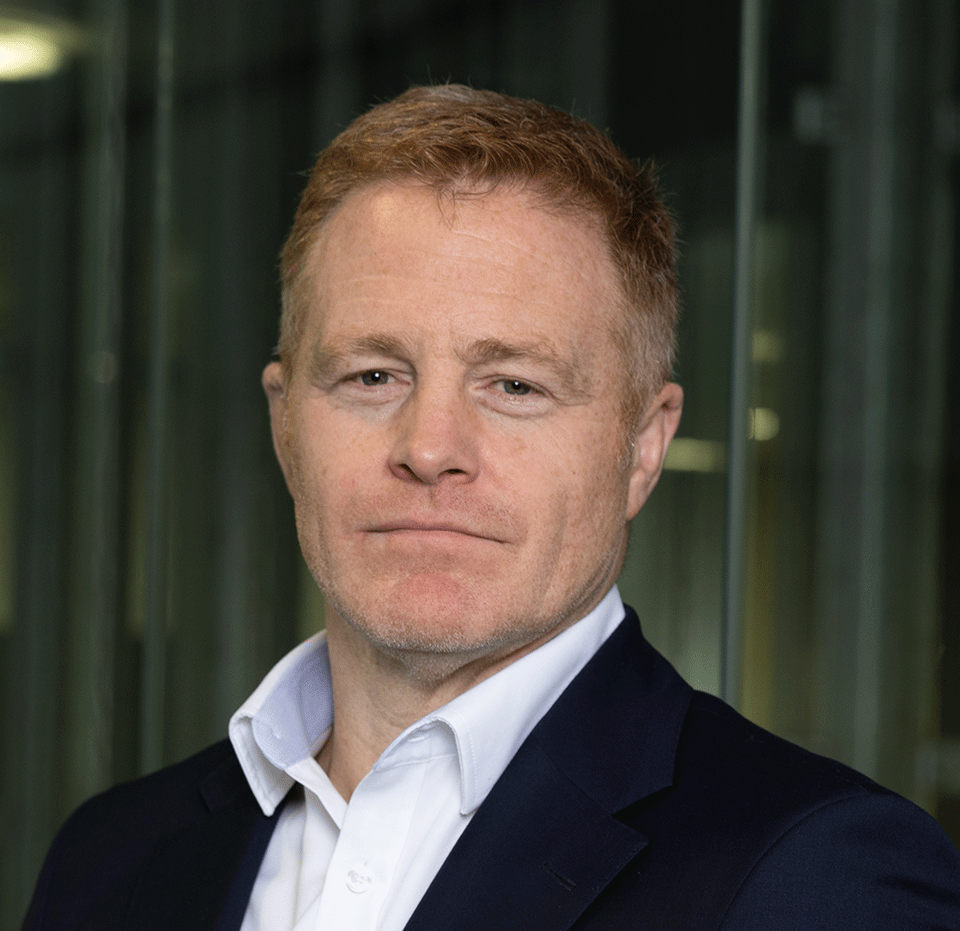
“It was important that there were no leaks, as interloper risk is high in healthcare,” says Anish Shah, global head of investment-grade acquisition finance. “And then the challenge was how to ensure full financing certainty.” Morgan Stanley has a not-so-secret weapon for securing that kind of certainty: its joint venture with MUFG. It allowed the firm to provide the whole $33.5 billion bridge quickly and quietly. It is the third time that the firm has used this ability for an investment-grade credit, but this was the biggest yet.
There was much more than just a big loan, however. With Bristol Myers keen to protect its rating, Morgan Stanley structured a large debt exchange to swap out Celgene securities for new Bristol Myers debt to reduce the risk of downgrade.
There was a new $1 billion revolver and the refinancing of an existing $2 billion revolver. Then there was an $8 billion term loan A, typically a triple-B product in the US. This was one of the largest ever done for an A-rated name and ended up 50% over-subscribed, partly because of Morgan Stanley’s ability to tap into strong European bank demand.
All through the process, the expertise of debt and equity syndicate was relied upon.
“The critical judgement was when we recommended the company go to the capital markets,” adds Shah. “We navigated that very closely and approached the market just after shareholder votes.” Morgan Stanley was lead left on every part of the financing package.
The firm’s bankers are in no doubt that the firm’s structure and interconnectivity are a big part of its success. It is a relationship that Evan Damast, global head of equity and fixed income syndicate, identifies as a key aspect of the culture.
“There are parallels between the kind of cross-product, cross-border complex transactions that we do and the people doing the business,” he says. “We all run our businesses globally and we all work closely together – it’s why we win deals.”