Awards for Excellence 2019
|
|
|
|

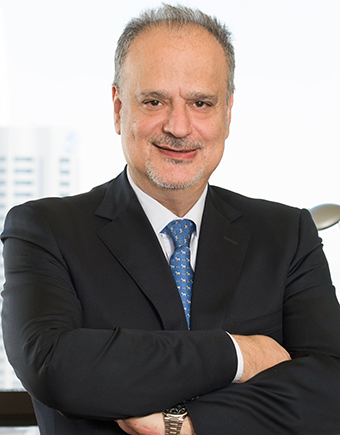
In a career in banking that spans more than four decades, Michel Accad’s talent for making the best of bad situations has earned him the overwhelming respect of his peers.
The chief executive of Al Ahli Bank of Kuwait (ABK) is perhaps still best known for his stint at Gulf Bank, which was bailed out in 2008 and whose rescue, piloted by Accad as chief executive, cemented his reputation as a master at solving banking crises.
Accad has faced seemingly insurmountable challenges from the earliest stages of his career. His introduction to banking, between 1979 and 1984, was in the corporate finance division of Citibank in Lebanon, a country then torn apart by civil war.
He demonstrated calm in the face of danger, each day crossing the divide between the city’s western and eastern areas on his commute between home and work. He swiftly rose through the ranks, starting as a relationship manager and ending up as a department head.
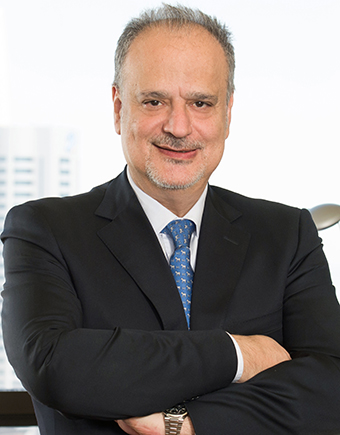
Accad was born in Beirut of a Lebanese mother and a Lebanese-Brazilian father who worked in the oil industry. That work took the family abroad, and Accad spent much of his early life in Switzerland and Italy before returning to Beirut, where he studied business at the American University of Beirut. He then completed an MBA at the University of Texas at Austin.
This experience of travel in his early life was one of the things that drew him to Citibank.
“It was a very good fit for somebody with an international background,” he tells Euromoney.
He thought that a global bank such as Citi would open his career up to international opportunities.
Following his job in Beirut, Accad spent more than two decades with Citi across the Middle East and Africa, first leading Citi’s corporate finance business in Senegal, then as country chief executive in Sudan, Zaire and Nigeria, before landing the job as head of Middle East and north Africa, based in Cairo.
Some of these postings marked him as a banker ready for tough jobs. In Sudan, he witnessed the coup that brought Omar al-Bashir to power.
“It was a proposal I couldn’t refuse because it was my first CEO job, but of course it was the most difficult country you could imagine,” he says.
In Zaire, he had to manage the tense political situation under president Mobutu.
He reached the pinnacle of his Citi career, as MENA head, in 2002.
“It was definitely the most enriching [role],” he says. “The business then was so much more varied than in sub-Saharan Africa. I was covering countries from Pakistan to Morocco.”
Fond memories
With Accad at the helm, Citi forged relationships with some of the region’s largest corporates, among them Egypt’s Orascom and Mansour Group.
Accad looks back fondly on his years with the US bank: “They’re the best years in my life, because I learned so much. A lot of the ideas that I implemented in my other jobs I took from there.”
An offer to join Arab Bank as deputy chief executive, combined with a belief Citi had lost some of its commitment to running a global business, convinced him to leave the bank.
It was a proposal I couldn’t refuse because it was my first CEO job, but of course it was the most difficult country you could imagine – Michel Accad
But he did not stay long at the Jordanian bank. At the time, Arab Bank’s chairman was also its chief executive, a situation Accad thought untenable. He had hoped the two roles would be separated and that he might have a chance at the chief executive position. But that wasn’t to be. The disappointment led to his departure in 2008.
Going from a global bank to a local one was “a bit of a culture shock,” he says in hindsight.
His next venture, at Gulf Bank, proved far more successful. Approached by the Kuwait Investment Authority, which had rescued the bank from the brink of collapse, he agreed to take on the daunting task of turning Gulf around. More than a third of its loans were non-performing and much of the bank was deficient.
“The credit risk function was just a ‘Yes, sir’ function,” he says.
He broke Gulf up into a good and a bad bank, and rebuilt it from the ground up, working to retain the good customers the bank still had and repair the bank’s broken reputation.
Challenge
Had his previous experiences of banking in challenging environments prepared him for the role?
“I knew what it took,” he says.
With that task behind him, an altogether different challenge presented itself at ABK, the Kuwaiti bank he has led as chief executive since 2014: he had to shake up a conservative institution that was losing market share to more enterprising competitors.
He has achieved that by expanding the bank into Egypt, through the purchase of Piraeus Bank’s operation in that country; by revitalizing customer service through an ambitious programme of digitalization; and by making a concerted push into corporate finance in the UAE.
Accad, now 65, says his role at ABK will be his last managerial position. “On the executive side, I’ve paid my dues,” he says, adding that he will remain open to serving on boards once he retires.
He is a worthy recipient of Euromoney’s award for outstanding contribution to financial services in the Middle East.