|
IN ADDITION |
|
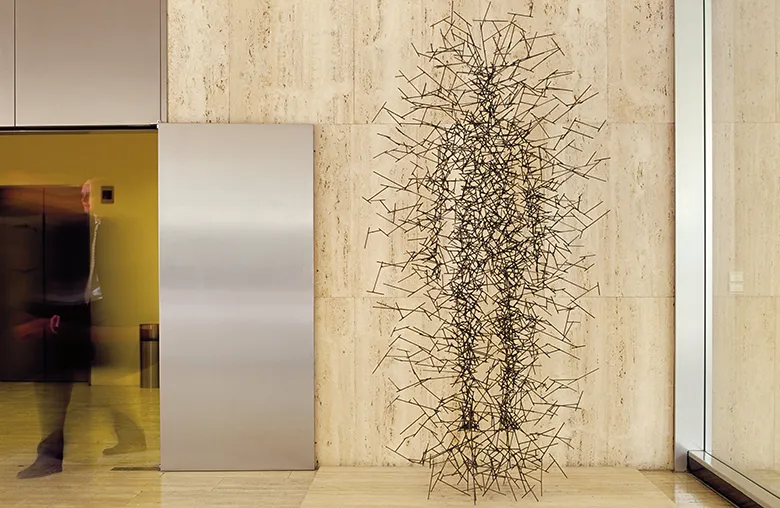
Any visitor to Deutsche Bank’s UK head office will know the lobby’s flamboyant contemporary art – the giant Damien Hirst dots painting and a steel sculpture by Anish Kapoor. Its New York office greets visitors with a massive, swirling triptych by another contemporary art superstar, Gerhard Richter.
Around the world, the scene is replicated at Deutsche and many other banks, which act like modern-day Medicis in art and finance.
The biggest repository of art at Deutsche – and perhaps of any company – is in its global headquarters in Frankfurt. The explosive top floor is reserved for Cai Guo-Qiang, who directed the fireworks at the opening and closing ceremonies of the Beijing Olympics. Among his works, Deutsche owns ‘Head on’, a huge installation of 99 snarling stuffed wolves, all throwing themselves against a glass wall.
While Deutsche’s wolves installation is unusual in its bulk – and is in storage as a result – all this art might now only emphasize the banking sectors’ previous wolf-like aggression. Yet the challenge – how to make a big art collection into a reputational asset of which it can be proud – is by no means restricted to Deutsche.
(© Richard Bryant, Arcaid)
After all the bailouts, mis-selling scandals, repossessions and branch closures, banks’ art collections could act as a red rag to a populist bull. And what are their shareholders to think of it, as they nurse ever deeper losses, or the banks’ staff after all the redundancies?
Banks’ contemporary art purchases might also raise hackles, given how Hirst and similar artists goad the extravagances of those wealthy enough to buy their art. Artists like this have become purveyors of luxury brands, epitomized by the partnership between Louis Vuitton and American pop artist Jeff Koons.
Contemporary art’s evolution into a real asset – despite its lack of practical use, income and, some might say, beauty – is one of its few remaining ways to shock. Investors buy and trade Koons’s art before it is even made, as last year’s HBO documentary ‘The price of everything’ described. Banks and other lenders have contributed to this financialization of art through ramping up art-backed lending, allowing speculators to play in one of the last remaining unregulated markets.
Banks themselves tend to buy and hold their art. Using their balance sheets and influence to pump up artists – buy it, fly it to Geneva for tax-free storage and then dump it – would be a step too far, even for their reputations. But even if banks do not play in the secondary market and hoard art in storage, too often they have hidden important art in their offices that is rarely viewed by outsiders or even many insiders, except, perhaps, those in executive suites.
There is no direct correlation between who owns the biggest collections and which private banks are best at art advisory and financing. Citi has been doing the latter since 1979 but has a relatively small collection. Sponsoring art fairs such as Frieze (Deutsche) and Art Basel (UBS) is a separate activity to their collecting. Outsiders will inevitably begin to suspect that these firms’ art collections merely reflect their top bankers’ vanities and big egos.
Can bankers really say that they need office walls adorned by art worth millions of dollars for inspiration? Is art really necessary to forge a bank’s identity?
JPMorgan Chase, even more than Deutsche, might have the most comprehensive contemporary collection. Charlotte Eyerman, its chief curator, argues strongly in favour of its benefits to both staff and clients.
“It’s a way to bring people together that sparks new conversations, new dialogues,” she says. “For us, the collection is a matter of pride in our history and it’s about what it does to reflect our culture.”
Mary Rozell, global head of the UBS art collection, similarly argues the benefits for business. The world’s best wealth manager, UBS, also runs the Art Collectors Circle as a club for very rich clients. Almost all of its art hangs on client-facing walls.
“Many of our clients are collectors, artists or dealers,” she says. “Art is a great conversation point. It’s an interest we have in common with them.”
Assets
Banks’ collections have become even more valuable as the art market has risen, with auctions setting new records: $450 million for a Leonardo da Vinci in 2017 and almost $100 million for a living artist, David Hockney, late last year.
The personal collection of David Rockefeller, who ran Chase Manhattan in the 1970s and died in 2017, fetched the most ever for a private collection when it sold at Christie’s last year: $833 million. Rockefeller, in fact, effectively founded what is now JPMorgan’s art collection in the belief that it was good business. He steered the bank towards the still nascent contemporary art market in the 1960s, although his personal collection was more focused on impressionism.
These assets may look small compared with banks’ balance sheets, but they amount to some of the world’s biggest private collections and certainly the biggest corporate collections. A handful of art dealers and collectors have more valuable collections than the biggest banks. Yet banks have an especially high number of works, not least because they have had so much space to hang them.
Bank of America, Deutsche and UniCredit each own about 60,000 art works. JPMorgan, Intesa Sanpaolo, Monte dei Paschi di Siena (MPS) and UBS have about 30,000 each. Brazil’s Itaú has the best-known collection outside Europe and the US, with about 15,000 pieces. The figures could be higher in some cases, depending on what parts of the collection and what types of art work are counted.
The bulk of these works will be worth a few thousand dollars at best. Deutsche acquired its largest number of pieces, many of them prints, to fill new offices in eastern Germany after reunification. But banks own thousands of more valuable works worth tens of thousands of dollars and perhaps a handful of works worth millions or even tens and hundreds of millions.
The contemporary art market as a whole has boomed since the 1980s, when many of these banks started contemporary collections. It has boomed again over the last five years.
In the 1980s, there wasn’t the hype and speculation in the art market… We were just starting our collection. The whole situation has developed dramatically. That’s when we acquired what are now the most valuable works – Friedhelm Hütte, Deutsche Bank
Friedhelm Hütte, Deutsche’s long-standing global head of art, has played a central role in building up the bank’s collection. He points to acquisitions not long after the bank started to collect contemporary art 35 years ago, such works as by Sigmar Polke, Andreas Gursky and Thomas Struth. Since those early purchases, the artists have become part of the canon. Deutsche also purchased works by American pop artists such as Andy Warhol and James Rosenquist around the same time, when they were established but much cheaper than today.
“In the 1980s, there wasn’t the hype and speculation in the art market,” says Hütte. “Interest in contemporary art was not huge; there were only a few collectors. Many of the artists who are famous now began their career then. We were just starting our collection. The whole situation has developed dramatically. That’s when we acquired what are now the most valuable works.”
Considering the intangible benefits to its staff and clients, Hütte concludes: “Our art collection has enormous added value to the bank.”
Banks are reluctant to reveal the valuation estimates of their collections for fear of demoting its worth to money, but the top collections are certainly worth hundreds of millions of dollars, and the very best collections could easily be worth more than $1 billion. By comparison, Deutsche’s market capitalization is only about €15 billion. Even Santander, with less than 2,000 works, has a collection worth almost €100 million, notably El Greco’s ‘Annunciation’ from 1614, the year he died.
One of the most valuable pieces of art owned by any bank is Intesa Sanpaolo’s ‘Martyrdom of Saint Ursula’ by Caravaggio. It is a darkly corporeal scene, even by that artist’s standards. It was probably the last big work he ever painted, as he recovered from a knife attack in Naples in 1610.
Like Monte dei Paschi, Intesa Sanpaolo has more old-masters paintings, a market that has been relatively depressed, than the global banks. Even so, it values its collection at around €550 million. It also owns ancient Greek vases and early 20th century pieces by futurists such as Umberto Boccioni.
In 2017, Intesa claimed to be the first bank in Italy to value the core of its collection, about 3,500 pieces, on a fair-value basis. It came up with €270 million for these pieces, booking a capital gain of €207 million, as some works were listed at €1.
This did not just help the capital base, it also helped justify to stakeholders why it had to put money into these treasures, including a new specialized unit to manage its historic and artistic heritage, for its 2018 to 2021 strategic plan.
“It’s as if the art collection really entered the bank after the revaluation,” Michele Coppola, the art unit’s energetic head, tells Euromoney in Milan. “Knowing the real value of the art is the starting point of knowing what to do with it.”
Offices
Banks often acquire art to decorate new or renovated offices. Deutsche acquired its biggest amount of top-quality work during a renovation in Frankfurt between 2007 and 2011. Each of the 60 floors of the twin towers is dedicated to works on paper by an important contemporary artist. The top 24 floors of the main tower are for Asia. The top seven floors of the smaller tower are for the Americas. Seven floors are for the Middle East and Africa and 19 for Europe.
At the time, senior bankers saw a chance to make Deutsche’s headquarters’ collection more global, cementing what was its business ambition then. Now, it seems at risk of following Standard Bank’s London example.
In 2008, Standard Bank bought up a collection of photographs in London, to reflect the global emerging markets where it was expanding – pieces by the likes of Brazil’s Sebastiao Salgado – only for the bank to retreat to Africa a few years later. Eventually, in 2015, Standard sold a majority of its London business to ICBC.
Like Royal Bank of Scotland at Gogarburn near Edinburgh under Fred Goodwin, Santander also acquired a series of works by established artists to fill its new campus at Boadilla on the outskirts of Madrid, in the mid 2000s. These included a gigantic metal sculpture by Richard Serra, ‘Verticle Torus’, placed at the campus’s entrance, and sculptures by Juan Muñoz.
Opening or renovating offices is also an occasion to commission site-specific art. American artist Sol LeWitt created an immense mural for a monumental corridor in UBS’s Lugano office in 1995, at a time when LeWitt had been an establishment figure for about 30 years. Late last year, UBS commissioned Swiss artist John Armleder to do a large work for the renovated entrance to its Zurich headquarters.
UBS, it seems, is one of the few banks to have recovered and maintained its enthusiasm for art buying, after a relatively brief hiatus in the aftermath of the 2008 crisis. More art made its way into UBS offices when it opened its new building at 5 Broadgate in London in 2015.
(© The LeWitt Estate / 2019, ProLitteris, Zurich)
JPMorgan, whose art is spread across 450 office locations around the world, is another of the few banks showing little sign of shrinking its collection or slowing down its purchases.
But 10 years after the financial crisis, far fewer banks are buying art in a big way. Contemporary art is more expensive and banks are more likely to be reducing wall and floor space, in part due to digitalization.
These collections are almost a visual throwback to the era from the 1980s to the mid-2000s, when banking was sexier, even fashionable – certainly much more profitable and a more dominant part of the stock market. If their equivalent today is big tech, the likes of Apple, Amazon and Google do not appear to have the same urge to buy lots of art, or at least not the kind of art that exposes its elitism or celebration of money. Firms such as Facebook seem to go for appropriately gentrified street art.
Meanwhile, piles of art treasures at some central banks, notably in Brazil, are a reminder of what sometimes happens to art collections when they have been an element of unwise risk taking, leading to bank failures. One of the most poignant points of the bankruptcy of Lehman Brothers came when its art, including pieces by Hirst and Kapoor, went under the hammer in 2010.
After its bailout, Commerzbank sold the most valuable piece it had gained in the 2008 Dresdner Bank acquisition – a piece by Switzerland’s Alberto Giacometti. The 1961 sculpture fetched the then highest ever price for a work sold at auction, $104 million, in 2010. Commerz then gave the best of the rest of the collection (about 100 pieces) to museums across Germany on long-term loan.
Is the fate of Dresdner’s collection a precursor for what would happen to Deutsche’s if it merged with Commerz?
But the question of whether or not banks can afford to properly manage all of their artistic wealth won’t go away. Partly because of the cost of staging public exhibitions, the growth of banks’ collections is likely to further slow, even if they do not shrink. And many struggling southern European banks still have large art legacies. Take Portugal’s Novo Banco, which in 2014 inherited a noteworthy collection of international photography built up by Banco Espírito Santo before its collapse that year.
Italy’s ever more troubled banks are especially well represented among those with important art collections. Quasi-public banks in Italy used to act as patrons of local culture, sometimes for decades and even centuries. In the 1970s and 1980s, the banks also saw it as a hedge against inflation, local bankers say.
At MPS, the collection is rich in paintings by 16th and 17th century Sienese artists such as Domenico Beccafumi. Although MPS’s collection began as early as the 15th century, it acquired most of its art in the run-up to the new millennium – often in the name of bringing work back to Siena. Mergers in the 2000s, including its disastrous 2007 Banca Antonveneta takeover, then roughly doubled the number of works.
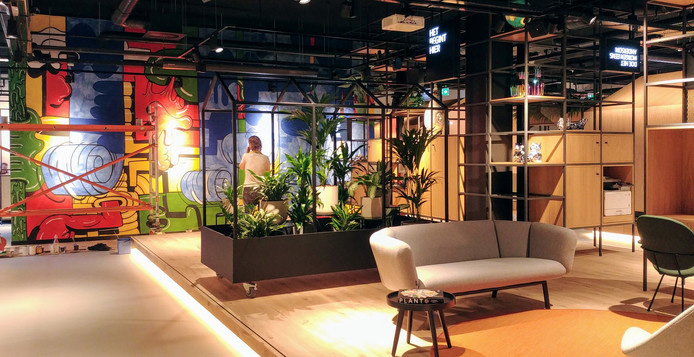
ING commissioned this work by Sarah Verbeek to decorate its office in Tilburg, Netherlands
In the Netherlands, by contrast, ING’s collection has already shrunk from around 25,000 works before the 2008 crisis to about 8,000 today. Its collection of mainly contemporary art used to be one of the biggest in the world. But since 2008 ING has been through a dramatic restructuring, pulling back from insurance and shifting to a digital-first culture. The cull has continued over the last two years, as it has staged a new transformation push.
Almost 2,000 of ING’s art works went to the insurance arm, NN, which it spun off earlier this decade. It also left behind paintings by Diego Rivera and Frida Kahlo when it sold its Mexican insurance business.
“Art works came back from all over the globe, into stock,” says Sanne ten Brink, the ING collection’s head curator. “ING became smaller and the interior-design guidelines changed.”
ABN Amro has been through a similar process – although its art collection of several thousand works remains a throwback to its past as a global investment bank. RBS has also reduced its art collection since 2008 and certainly stopped any art acquisitions since its nationalization. Both RBS and ING have had to put more art in storage over the last year, following their latest efforts to streamline and digitalize their businesses.
To their credit, these banks say they try not to keep a lot of art in storage in the long term. ING has already given a lot of less valuable Dutch pieces to local schools and hospitals. It also gave a 200-year-old Barings family portrait by Thomas Lawrence, a legacy of its 1995 Barings Bank purchase, on long-term loan to Amsterdam’s Rijksmuseum.
“Art needs to be seen,” says ten Brink.
Collections
Inevitably, banks build up collections fastest when they are at their most confident. Linked to that, they often acquire art through acquisitions – or unwittingly, in repossessions of collateral. Intesa Sanpaolo has perhaps the most important collection of Russian icon paintings outside Russia thanks to a defaulted loan to a predecessor bank in the Venice region.
Bank of America’s collection is particularly valuable as a store of regional artistic heritage in the US, especially photography and American impressionism, due to its formation through the mergers of hundreds of local banks. Hugh McColl, who oversaw this growth in the 1980s and 1990s, said the bank was not a collector of art but of banks. It still buys art, though infrequently.
By contrast, individual bankers with passion and influence in art lie behind both JPMorgan and UBS’s still-growing collections. Even today, they command enough art world respect to make them attractive buyers for artists keen to make a name for themselves.
Don Marron’s interest in New York’s contemporary art scene, when he was chief executive of US investment bank Paine Webber in the 1980s and 1990s, laid the core of what is now UBS’s collection. He is president emeritus at New York’s Museum of Modern Art, having gifted a large portion of the Paine Webber collection to the museum. David Rockefeller was also chairman of the same museum for many years, forming a Chase art committee with links to Moma.
Banks tend to get more involved in the younger and emerging artists, possibly due to budget, but partly because it makes them feel like they’re putting something into the art world – Bridget Brown, art consultant
Even if a collection’s vision may come from a prominent banker, art world insiders still argue that the most successful collections are those that hand the keys to an art specialist. Chase Manhattan’s appointment of Jack Boulton to be its first in-house art director in 1979 seems especially well-judged. Chase acquired all 10 of the banks’ works by Jean-Michel Basquiat, who died in 1988 aged just 28, during the artist’s lifetime, when art critics did not rate his work as highly as they do now.
Today Basquiat, partly because of the rarity factor, is one of the most expensive artists on the market. A Basquiat painting sold at Sotherby’s in 2017 for $110.5 million, the highest ever for an American artist.
Raffaele Mattioli, who made Banca Commerciale Italiana a cornerstone of Italian business after the Second World War, was also a passionate collector, amassing much of what is now Intesa Sanpaolo’s collection. He took a liking to the Caravaggio, for example, and bought it for BCI when its attribution to the painter was less established than it is now.
Purchases like this can make a bank look more rounded, perhaps more international, and – when it is contemporary art – forward-looking.
“Artists themselves are innovative,” says Eyerman. “They have their eyes and ears to the world.”
Rozell agrees: “Contemporary art is a reflection of what’s going on in the world.”
Buying art has been a way to boost social standing for as long as capitalism has existed, especially among those newly wealthy but relatively weak in political power. Private museums are popping up all over China, although the big Chinese banks do not seem to be taking up the art collecting baton.
The danger for banks is that when they suddenly have less money to throw around, the purchases on their walls might draw attention to their past rashness and present decline. If they are forced to sell art, they might seem on the point of failure. Moreover, if art is there to make them look modern, they need to keep it up to date. Who knows how the next generation of corporate leaders will judge a bank by its ownership of a Hirst?
Banks, at least in Europe, are no longer in growth mode. At the same time, mainstream culture is changing.
When they do buy art, it is ever-rarer for banks to look for established artists and buy in the secondary market. They will spend thousands not millions.
“Banks tend to get more involved in the younger and emerging artists, possibly due to budget, but partly because it makes them feel like they’re putting something into the art world,” says Bridget Brown, a London-based art consultant who advises financial institutions on collecting.
Banks, especially nowadays, are at their happiest participating in the recent art market shift away from white male artists to new or previously overlooked work by women and minorities. They are also happy, up to a point, to buy popular artists who stir social and environmental debate.
Eyerman says JPMorgan was at the forefront of the rise in interest over the last year or two in Kwame Brathwaite, whose photography popularized the ‘Black is beautiful’ slogan in the 1960s.
(© Kwame Brathwaite, Courtesy of Philip Martin Gallery, Los Angeles)
“The art world is bigger and more diverse today than when our collection started,” Eyerman says.
Since joining from Sotheby’s in 2015, Rozell has also sought to rebalance UBS’s collection, making at least half of acquisitions work by women, including artist-poet Etel Adnan, who is in her 90s, and Sheila Hicks, in her 80s and known for using materials like wood and thread.
“There’s a real recognition in the art market of overlooked artists of African descent, as well as women,” says Rozell. “We’ve become a global bank and we’re very conscious about increasing the number of women in the collection.”
Rozell points to the recent meteoric rise in the value of paintings by abstract expressionist Sam Gilliam, whose work featured prominently in a 2017 exhibition at London’s Tate Modern on black artists active in the US in the 1960s and 1970s.
The same year, UBS acquired a more recent painting by Gilliam (whose work is a longer-standing part of JPMorgan’s collection) for its Seattle office.
Similarly, ING acquires art through its Unseen Talent award for European photographers, generally those in their late 20s or early 30s. It sets general themes for entrants to explore such as the environment or diversity. According to ten Brink, the banks’ art – if it is dynamic – will remain helpful, even if there is less of it for less office space.
“The more digital you become, the more important art becomes,” says ten Brink. “A truly unique experience becomes hard to find. This remains one of the few differentiating factors. It’s important to have something that’s real, that opens your eyes.”
But this means buying edgy photo installations by young artists, to adorn trendy new regional private-banking branches, not swanky pop art and boardroom oil paintings. Due to their size and the legacy of the crisis, any whiff of old-world banking excess will draw public ire in countries such as the Netherlands, which have spent so much on bailing out banks.
If the golden age of corporate collecting was the 1980s, a younger and brasher era in banking when societal perceptions were lower down the list of priorities, the question today is how to manage the legacy better – especially how to make it available to a wider public.
“There’s a stronger sense of responsibility to share assets,” says Loa Haagen Pictet, who runs the Pictet & Cie’s art collection and chairs the International Association of Corporate Collections of Contemporary Art.
Exhibitions
Banks want to avoid the kind of negative publicity RBS has suffered since its nationalization about its perceived lack of progress in putting more art on public display. It reputedly has the UK’s biggest corporate collection.
|
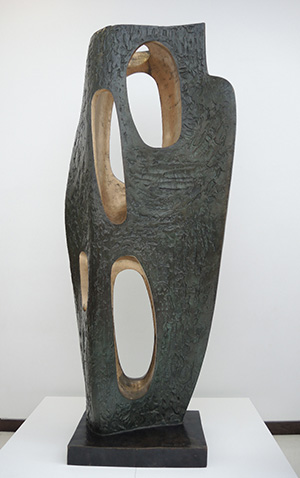
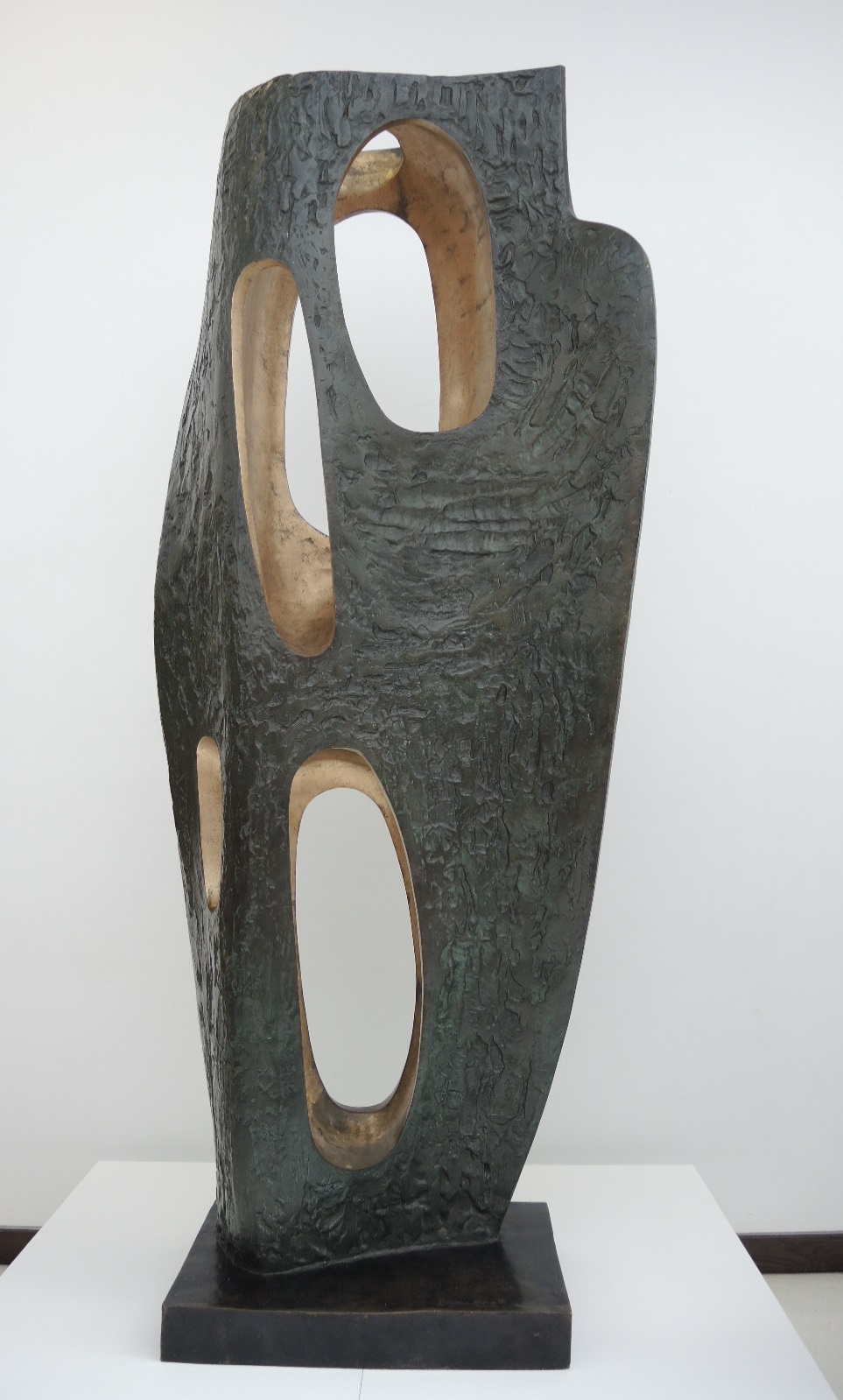
RBS-owned Rock Form,
by Barbara Hepworth, sits in a Wolverhampton public library, awaiting transfer to the city art gallery |
UK banks, in fact, have relatively small and parochial collections, probably worth much less than their big international peers. HSBC and RBS have about 2,500 works; the latter mainly portraiture, Scottish art, British 20th century art (including Hockney) and 19th century landscapes.
RBS suffered a further hit to its reputation in 2014, when ‘Rock Form’ – a large and much-loved sculpture by Barbara Hepworth, probably worth at least £1 million – disappeared from Wolverhampton’s Mander shopping mall, where it had featured prominently since the 1960s. As the mall had by then fallen into the hands of RBS’s notorious non-core Capital Resolutions Group, local campaigners feared it was being sold off.
After several months, RBS pledged to make the Hepworth sculpture a long-term loan to the city. It is now in a public library, pending a delayed refurbishment of the city art gallery.
After the 2008 crisis, Bank of America also faced the question of what to do with its art, as much of it lay in storage. It turned it into a resource, offering ready-curated exhibitions to museums – including paid-for shipping and a stipend for marketing and education.
BofA now does about 10 of these exhibitions a year, as part of a global art sponsorship and restoration programme. Participants include smaller museums, such as the Northwest Museum of Arts and Culture in Spokane, Washington, as well as bigger ones such as Boston’s Museum of Fine Arts.
“What we do is a boon for them,” says BofA’s executive for arts and culture, Rena DeSisto, who oversees the new approach. “In many cases, they’ve broken attendance records, and whatever revenue they get through the door, they keep.”
In Europe, the biggest banks have also started doing more of their own exhibitions.
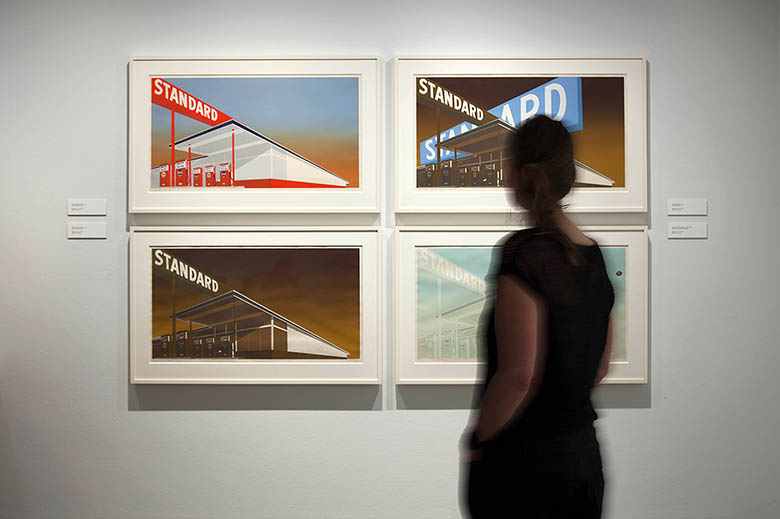 |
Last year’s exhibition on American pop artist Ed Ruscha at Denmark’s Louisiana Museum of Modern Art consisted entirely of work from UBS’ collection |
One difficulty is that banks may be least able to invest in publicly exhibiting their art just when they need to do most to bolster their image. RBS only took a curator back on staff in 2015, and even then it was part time. Deutsche has recently reduced the number of touring exhibitions of its art from about three a year to one, as part of its wider cost cutting, though the bank opened a large new space in Berlin last autumn in a former royal palace to display its art and that of partners such as the Tate.
UBS can also point to recent exhibitions solely featuring UBS-owned pieces, including one at Denmark’s Louisiana Museum of Modern Art last year on American pop artist Ed Ruscha and a Lucien Freud exhibition at Berlin’s Gropius Bau in 2017. Both artists’ works are among the most-treasured parts of UBS’s collection.
“It’s not our objective to hoard all the art to ourselves,” says Rozell. “We are not just the owners but the stewards of these works. It’s our duty to show and take care of them. We see ourselves as a quasi-museum.”
Santander – faring better than most European banks – hopes to increase public viewings of its collection by as much as 10 times, as it turns its historic headquarters in the northern Spanish city of Santander into a cultural centre. When it announced this €40 million project last year, it said it would transfer the bulk of its collection – including the El Greco – there from Boadilla, where it only gets about 20,000 visitors a year.
In addition to its free temporary exhibitions, in 2014 Itaù opened a new permanent exhibition in São Paulo with works from its collection relating to Brazilian history.
Intesa Sanpaolo is doing even more. One of the few Italian banking groups in robust health, it has opened three museums in the opulent former headquarters of banks that were subsumed into the group in Milan, Vicenza and Naples. These hold permanent exhibitions of its own art and frequent temporary exhibitions of art borrowed from museums – such as Saint Petersburg’s State Hermitage and London’s Estorick Collection of modern Italian art – that have a relationship with the bank.
Intesa’s museum in Milan is in the former BCI headquarters adjacent to the Scala opera house; it gets about half a million visitors a year. The corporate collection has therefore become the main building block of Intesa’s more structured corporate social responsibility programme in art and culture, which involves not just its own museum exhibitions and art loans but also a restoration programme for publicly owned art.
This programme is particularly pertinent in Italy, where collectors are subject to strict rules on exporting historically important works, yet struggle to find anyone to take their art when they want to sell. Public museums barely have enough money to manage existing collections, let alone take on or buy more art. Donating assets worth €250 million to a business such as Intesa Sanpaolo might sound strange, but that is exactly what the Agrati family did last year with its art collection from the second half of the 20th century.
Resources
Italy’s cultural ministry is like an old family spending all its money on maintaining an ancestral castle, says Bocconi University adjunct professor in cultural management, Guido Guerzoni, who helped advise on Intesa’s revaluation.
“Italy has an incredible cultural heritage, but to guarantee this you need to invest a lot of money,” he says. “The public budget is comparable to the UK or Germany on a per-capita basis, but it’s not enough to guarantee the churches, the palaces, the paintings.”
After privatization in the 1990s, Italian bank foundations – often with links to local politicians – took on the role of artistic and cultural patronage previously played by regional governments. But they have been unable to keep up with banks’ ever-increasing capital calls over the last 10 years – including at MPS, whose own collection at its headquarters is also only rarely open to the public (just the three days of Siena’s Palio horse race and one other).
Despite its troubles, MPS retains its treasures. The collection has not disposed of any works since the 2008 crisis, or since its 2017 bail out and nationalization.
But the destiny of its collection and headquarters may too be as a museum, after a merger.
Italy has an incredible cultural heritage, but to guarantee this you need to invest a lot of money. The public budget… is not enough to guarantee the churches, the palaces, the paintings – Guido Guerzoni, Bocconi University
Like Italy, Spain faces a drastic shortage in public museum resources, similarly strict laws on art exports and a similar recent failure of regional banks with political links. But like Intesa, CaixaBank is performing better than the small regional banks. La Caixa is still its biggest shareholder, with 45%, and the foundation’s work has spread as CaixaBank has bought up former savings banks across Spain.
Over the last two years, La Caixa has expanded its group of CaixaForum museums to Zaragoza and Seville, in line with the mergers. These museums stage temporary exhibitions with the foundation’s own art and alongside museums such as the Prado.
One of the world’s largest philanthropic givers, La Caixa has for decades played a vital role in Catalan cultural life, including a long-standing collaboration with Barcelona’s contemporary art museum (Macba). La Caixa’s chairman Isidro Fainé sits on Macba’s board. La Caixa’s own contemporary art collection started in the 1980s, preceding Macba’s creation, buying works by Basquiat and German conceptualist Joseph Beuys.
“Culture was a way to contribute to democracy,” recalls Nimfa Bisbe, who heads the collection. “There was an expansion of art, of museums. La Caixa contributed to this.”
Today, La Caixa continues to make acquisitions for its contemporary collection, including six last year. Recent acquisitions include well-known artists Doris Salcedo and Shirin Neshat, women who address Colombia’s guerrilla war and Iranian gender relations, respectively.
“We don’t want to be encyclopaedic, but we look for works to complement a period, subject matter, or artist,” says Bisbe. “It should be relevant to what we have.”
| |
Art-backed lending booms
Art-backed lending has grown as the art market has reached new heights and art has become a recognized asset. These loans are pricey, but it can be a way to draw in new clients to other services of a private bank.
Not all private banks lend against art, especially for living artists – although many advertise some kind of art advisory service. That is partly because art is so illiquid and its price hard to predict, particularly given the unregulated state of the art market.
Citi is one of the biggest art-backed lenders, with a loan book growing in the region of 15% to 20% annually and average sizes reaching $45 million (per collector, not art work). The business is expanding in Asia.
“As the art market becomes more global, more people become collectors,” says Suzanne Gyorgy, head of art advisory and finance. “The number of people using art as collateral has grown and the size of the loans has grown.”
On the advisory side, the aim is to try to bring more transparency for clients to the murky world of art dealing, as well as help with after-purchase work like conservation, transport and storage.
It is the job of Gyorgy and her peers to try to see where art is overvalued or being played up by market manipulators – for the sake of the clients and for the loan book.
The Fine Art Group in London provides art advisory and finance for its private banking partners in Europe and elsewhere that do not have such services. This includes art-backed loans offered on a referral basis to banks’ clients.
“We advise our clients not to buy things and we recommend what’s the appropriate price,” says Freya Stewart, who runs the Fine Art Group’s art-backed lending. “Of course, they can pay more.”
Stewart’s firm will typically lend up to 50% of what it thinks is the value, for up to two years, at around 6% or 7%.
Its competitors include New York’s Emigrant Bank and Athena Art Finance, and Sotheby’s Financial Services, which has extended about $4 billion.
| |
Keeping art on message
When Chicago artist Theaster Gates bought a flooded former bank building from the city for $1 earlier this decade, he sold old tiles from the toilets as what he called bank bonds. Inscribed with a logo – ‘In art we trust’ – they fetched $5,000 each and funded the renovation of a South Side landmark into a new community centre, library and gallery.
This growing post-crisis trend for socially engaged and politically contentious art offers new thrills and dilemmas for banks and their wealthiest clients, as they try to keep collections up to date and avoid being bland.
It also adds piquancy, as the art market ramps up street artists such as Banksy and artists like Jean-Michel Basquiat, who have an antagonistic attitude to the establishment.
A work by Argentina-born Rirkrit Tiravanija reflected a more combative zeitgeist in late 2018 at the Art Basel Miami fair. It consists of a large white canvas standing on two plywood boxes, with the words “RICH BASTARDS BEWARE” stencilled in large capitals.
Gathering art for offices in China, Asia and the Middle East, is more problematic. These are the places where banks are expanding most rapidly today and art could help global firms show a local touch. Given the importance of state-linked clients in countries such as China, however, it is hard to hang art that is overtly critical of the government.
“We have to be sensitive to the environment of the workplace; that applies to violent art works too, but at the same time we don’t want to sanitize the collection,” says UBS’s global head of art Mary Rozell.
There is little if any work by the vocally anti-government Chinese artist, Ai Weiwei, in the big banks’ collections, despite his international fame. Nor does UBS own any Theaster Gates. That might be in part because their work is relatively hard to hang on walls. UBS does have recent work by American Doug Aitken, who makes statements on issues such as the environment, albeit in a less targeted political manner than Weiwei.
Charlotte Eyerman, chief curator at JPMorgan Chase, says her team must always ask if the art could go in any of its offices. It does not acquire art that is critical of a particular government or that involves nudity. She argues that there are plenty of other engaging questions around the environment and gender.
“Our collection is not boring, nor conservative,” she says. It is growing its collection of non-Western artists, even if it is similarly bereft of works by Gates and Weiwei. “We don’t feel constrained.”
Meanwhile, artists that fall into personal disgrace can also create difficulties for banks. Deutsche Bank decided to clear out the ninth floor in its Frankfurt HQ dedicated to Zwelethu Mthethwa – known for his portraits of South Africa’s working class – after he was jailed in 2017 for brutally murdering a sex worker in Cape Town four years earlier.
Another big name South African artist, William Kentridge, who also engages with political topics such as colonial liberation, took Mthethwa’s place.


