|
|

To say that a bank whose shares fell by almost a third last year had a good 2018 would be a stretch. But monetary policy and political problems are outside Société Générale’s control.
France no longer appears the liberal beacon it briefly became after the 2017 election of president Emmanuel Macron. Countrywide protests over a fuel tax rise among other issues have weakened the scope for market-friendly reform in France.
SocGen’s shares underperformed European banks’ as a whole by about 7% in the 12 months to mid December, according to Berenberg. But shares in BNP Paribas – its closest French rival, which it underperformed markedly in 2017 – did worse than SocGen in 2018, underperforming European peers by 14%.
In fact, SocGen made some positive steps forward in what was the first year of its new strategic plan. In June, it announced a $1.3 billion settlement with agreements with French and US regulators over a Libyan bribery case and Libor rigging. Then in November it announced a $1.4 billion settlement with US authorities over sanctions busting.
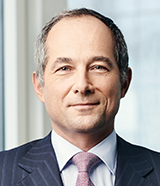 |
| Frédéric Oudéa |
These settlements give closure and allow it to look ahead. On the other hand, the departure of Didier Valet, former deputy chief executive and investment banking chief, presaged the Libor settlement. Valet was seen as the most likely successor to chief executive of 10 years’ standing Frédéric Oudéa, who is now set to begin a new four-year stint in May. Unfortunately, Valet’s departure also coincided with weak first-quarter results, particularly in the investment bank and, above all, in equities – by far the strongest part of its markets business. Yet the investment bank posted healthy growth in revenues in the second and third quarters, particularly in equities, and against a more disappointing showing at BNP Paribas.
Meanwhile, in July, SocGen committed more to its businesses in derivatives, investment products and exchange-traded funds, with an agreement to acquire Commerzbank’s equity markets and commodities business.
It has also been busy repositioning in underperforming central and eastern Europe countries where it lacked retail critical mass.
An agreement to sell its Polish retail arm, Eurobank, to Portuguese-owned Millennium in November coincided with the August sale of its banks in Bulgaria and Albania, and then Serbia in December, to OTP.
It makes international retail revenue growth harder, but should boost return on equity, with the freed-up capital further offsetting the Commerzbank purchase.
Although questions have now focused on Russia, sanctions there might need to get a lot worse to force the bank to pull out. Deputy chief executive in charge of international retail, Philippe Heim, says SocGen has sufficient scale in Russia, even if its share of lending in areas such as car finance (12.5%) is much bigger than its 3% overall.
“We are seen as a safe haven in Russia,” Heim tells Euromoney. “We have the capacity to connect large Russian financial institutions with global markets.”
Africa, by contrast, could more than double to 10% or 12% of SocGen’s group net banking income by 2030. This is partly thanks to digital banking efforts to get within reach of two million retail clients by the early 2020s, double the number today.
The bank’s Africa revenue growth continues to surpass expectations, and in November it said it would increase lending to African small and medium-sized enterprises by 60% over the next five years. It is already Africa’s top syndicated loan bank outside South Africa, according to Dealogic, but it also said in November it would double its African structured finance workforce by 2019 and increase financial commitments to African structured finance by 20% in the next three years.
“There’s an acceleration of growth in Africa,” says Heim. “You can be amazed by the need to develop infrastructure in line with demographic trends.”
Overall, SocGen’s international retail and wholesale banking activities outperformed analysts’ expectations as the year drew to a close.
French retail was less encouraging, although no worse than expected.
But SocGen is doing less well in reducing its costs – even excluding legal provisions – than growing revenue. As a result, analysts still doubt it will get close to its 2020 return on tangible equity target of 11.5%. Consensus ROTE for 2019 at 8.5% is markedly behind BNP Paribas’ 9.4% and lags most other big European banks outside Germany and Italy.
On a more positive note, one advantage of SocGen’s greater enthusiasm for investment than for cost-cutting is a stream of interesting digital initiatives: whether it is the rapid growth of Boursorama in France, a new blockchain commodity trade finance partnership or mobile money in Africa.