|
|

Santander’s shock announcement in September that Andrea Orcel would take over as chief executive in early 2019 certainly took the market by surprise.
Given his reputation as a financial institutions adviser, naming Orcel to lead any retail-focused bank would always have turned heads. It is especially so at Santander, given its size, tendency to promote insiders and how active it has been (often with Orcel alongside) as an acquirer of banks.
All sorts of theories have emerged about what Orcel’s arrival from UBS might entail. His first job, however, will be to help devise and defend a new medium-term strategic plan after the full-year results. This will offer clues about his style at Santander, although the substance of his tenure may not become clearer until well into the 2020s.
Orcel’s appointment is even more intriguing as the chief executive position at Santander has traditionally been more akin to a chief operating officer elsewhere because of the executive chairman role (currently occupied by Ana Botín). Although Orcel had a more managerial role as head of UBS’s investment bank, he is best known as a frontline dealmaker. By contrast, Santander’s former chief executive, José Antonio Álvarez, is best known as a trusted financial and operational manager.
Álvarez, who will become executive vice-chair and chair of Santander Spain, can rightly claim that the legacy of his four-year stint as chief executive leaves Santander having regained some initiative – in its digital standing and in bringing its capital more in line with European norms.
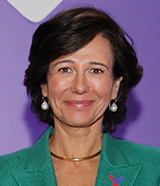 |
| Ana Botín |
In 2018, the bank’s Superdigital project for low-income clients in Latin America was rolled out in Chile, following an initial launch in Brazil in 2015 and then Mexico (as Tuiio) in late 2017. In 2019, Santander expects to start the international expansion, initially in Latin America, of Openbank, the Spanish online-only lender it relaunched in 2017. Openbank’s cloud-based back office could be the germ of a successor to its Parthenon IT platform, which helped build its reputation as international bank consolidator.
In terms of results, Santander generally did better than the market expected in the first three quarters of 2018, including on capital. Even applying IFRS 9 accounting standards, it was on the way to achieve its 11% common equity tier-1 target in the fourth quarter, despite gloomier global and European economic conditions than when it set that target just under three years ago.
Its CET1 ratio on a transitional IFRS 9 basis came out at 11.1% in the third quarter, compared with 10.9% expected and 10.8% in June. This was thanks to rising profits and a reduction in risk-weighted assets.
“It shows how good our model is at generating capital,” says group chief financial officer José García Cantera. He expects a move towards a 12% target in the new strategic plan.
Spain may at last see a return to loan growth in 2019 after years of post-crisis deleveraging, especially in the mortgage market. Cantera expects system-wide loan growth of between 1% and 2%, compared with a contraction of a similar magnitude in 2018.
On the other hand Spain’s GDP growth is tending towards 2% in the late 2010s after the 3% levels it saw mid-decade. Santander will also have to deal with a government decree in November to change the practice in the Spanish mortgage market so that banks pay taxes on registration instead of borrowers.
In the UK, Santander has been among the more cautious banks heading into Brexit.
“Out of prudence we have decreased our market share in those segments that could be affected by Brexit, such as high-risk mortgages, and we have curbed the growth in consumer lending,” says Cantera.
A better macroeconomic outlook in Brazil after the election of populist right winger Jair Bolsonaro should also allow it to continue to grow rapidly there, as in its other emerging market businesses, notably Mexico and Poland. Finally, bulking up or exiting the US – the main market where it is not in the top tier – is a key strategic choice Santander faces under Orcel.
Already, it sees a chance to revitalize and grow in the US after years of local regulatory constraints. As lower provisions and costs more than offset lower revenues in the first nine months of 2018, the US grew underlying attributable profit faster than any other Santander division.
“We need a few years to demonstrate that we can be profitable in the US now we are able to compete normally,” says Cantera.
News in May that Fiat Chrysler is to set up its own consumer financing business led to talks about the auto maker exercising its option to buy out Santander’s part of their consumer finance joint venture, although the two sides had not reached an agreement as 2018 drew to a close. The death of Fiat Chrysler’s former chief executive, Sergio Marchionne, in July cast further doubt on the issue.