Awards for Excellence 2018
|
|

There are two types of chief executives. The first are managers content simply to run and nurture businesses that are already strategically well-tuned. The second set are revolutionaries that pursue radical change.
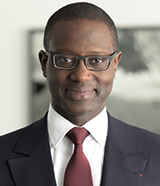
Tidjane Thiam is the second type.
At Prudential, he was criticized for pursuing the large acquisition of AIA early in his tenure as he sought to re-position the UK-headquartered insurer for Asian growth. Investors grumbled about what they saw as the high cost of that deal. It slipped away and with it their chance to enjoy the enormous value creation that duly followed after AIG floated the business instead.
But it is in recognition of this passionate, intellectual and driven chief executive’s bold overhaul of Credit Suisse that Euromoney picks Tidjane Thiam as our banker of the year for 2018.
Some might say we are a little early. Credit Suisse still has two quarters left to run of a three-year turnaround plan. Quarterly pre-tax income is only just coming back to the level it stood at on the eve of Thiam’s arrival.
But the bank is now wringing this from much lower risk. In the first quarter of 2015, Credit Suisse had a common equity tier-1 ratio of just 10% and daily value at risk (VaR) was SFr46 million ($46.3 million). Fast forward to April this year and CET1 was up to 12.9%, while daily VaR had come down to SFr29 million.
Its people now share a clear sense of the bank’s identity and mission.
Plenty of critics outside the bank questioned Thiam’s appointment, asking if the former chief executive of an insurer understood banking. Some insiders clearly decided to test his mettle as well. There was at least one big revolt about investment bankers’ pay at the end of his first year. Thiam faced this down.
But he did not bring in a new executive team, choosing instead to see how those in place coped with the initial phases of his restructuring. Most of his senior reports today were already at Credit Suisse when Thiam arrived, although some have moved around and a few have moved out. He is not one to copy John Cryan’s mistake of being so honest about Deutsche’s shortcomings as to forget the chief executive’s responsibility sometimes to be a cheerleader.
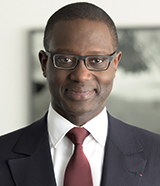 |
| Tidjane Thiam |
“This is a fabulous bank,” Thiam tells Euromoney. “It has always had a fabulous bank within it. It’s just that some people inside it didn’t see the full potential of our wealth management franchise.”
When he arrived as chief executive in March 2015, Thiam already knew that change was essential.
Credit Suisse had initially come through the financial crisis better than most, running down risk-weighted assets earlier than its rivals. But it had then lost its way, perhaps believing too much in its own trading prowess and doubling down in markets businesses. These came to dominate group RWAs and earnings.
“Credit Suisse has always had a fabulous bank within it. It’s just that some people inside it didn’t see the full potential of our wealth management franchise” – Tidjane Thiam
Thiam saw what some insiders could not or did not want to. The bank had taken on too much risk. It had placed most of its chips on markets businesses that were subject both to low volume growth and margin compression. Costs were too high. Even more worryingly the bank still needed to settle with regulators for the sins of the past. But its leaders had repeatedly told investors that Credit Suisse did not need more capital.
In fact, raising capital was essential. So was changing the business model. Thiam came in and announced that all this must change. It was a distinctly unpopular message.
In essence, Thiam has put wealth management at the centre of Credit Suisse instead of markets trading. Thiam and his team have also decisively shifted the focus of wealth management much more towards ultra-high net-worth clients. The reasoning is that Credit Suisse can bring its markets trading and investment banking capabilities to bear on a customer base whose wealth is growing fast and that craves to be treated with the kind of professionalism normally reserved for multinational corporations and institutional investors.
Thiam discusses one key lesson from releasing this potential.
“One thing I have learned when doing a restructuring is start with a three-year plan. You cannot do this kind of radical restructuring incrementally, otherwise you will fail. We set out to do 50% of the cost cuts and other changes in year one, 30% in year two and 20% in year three. The first year was very tough, but then you can tell your people the pain will be 40% less in the second year. After that at the beginning of the third year, the message becomes: ‘Come on guys, we have already done 80%, we only have one last push to go to do the final 20%. Let’s not become distracted and blow it now.’”
He will admit to having some luck. First, that Credit Suisse had the makings of a great private bank already and, second, that markets have let it run down problem legacy assets at smaller losses than first feared.
But make no mistake, this could have been another Deutsche Bank.
Instead the signs of a brighter future are already becoming clear. Pre-tax income for the first quarter of 2018 was the highest for 11 quarters and marked the sixth consecutive quarter of year-on-year profit growth.
At the first executive committee meeting in July, Thiam will have reminded his team that the third quarter of 2018 is the most important in the history of Credit Suisse.
They should be getting to know him by now. He says the same thing at the start of every quarter.