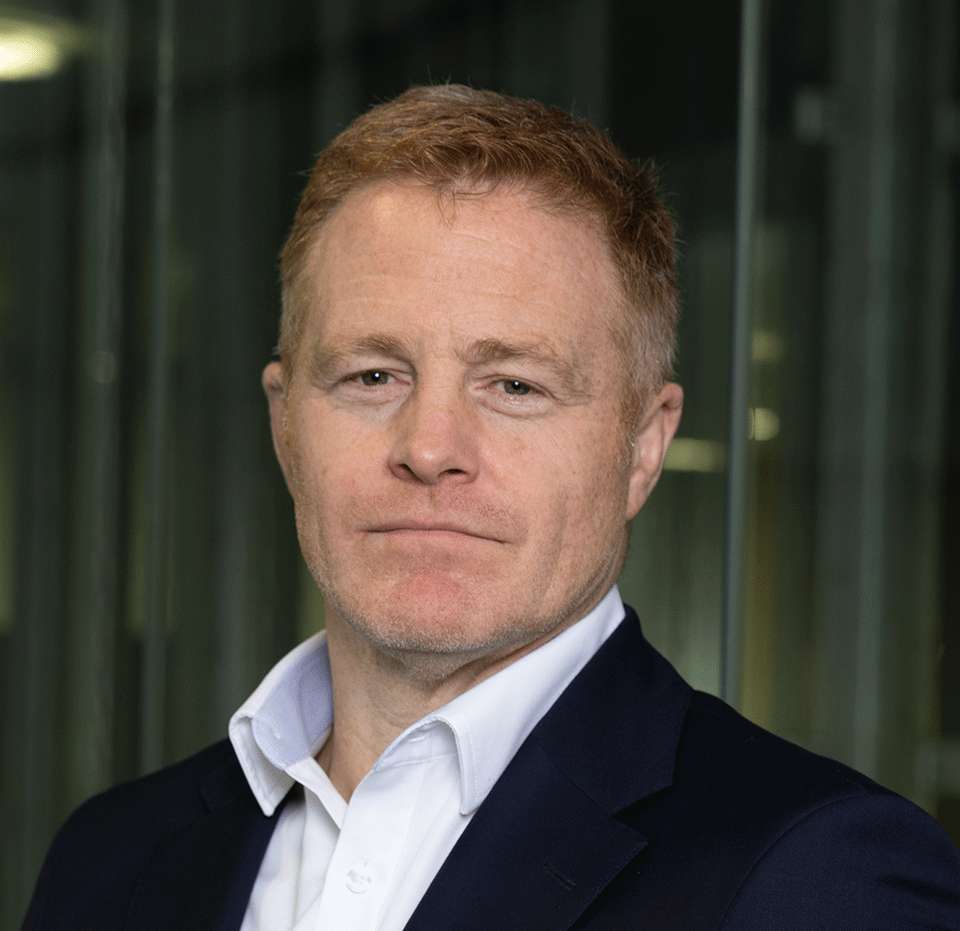
Niall Ferguson has a call in a little over half an hour, he warns, after the introductions are done. He needs to call his immigration lawyer ahead of a naturalization examination he faces in the US on his return. As a professional historian at Stanford, he points out, it would be more than a little embarrassing if he failed to answer questions on the US constitution, for example.
“I know about the first and second amendments for obvious reasons, but I need to find out what the third one is,” he says, presumably joking. (Or perhaps not: Euromoney checked it later and it places restrictions on the quartering of soldiers in private homes without the owner’s consent, forbidding the practice in peacetime.)
 |
| Niall Ferguson |
Ferguson is in São Paulo in early April to deliver a keynote speech to Itaú’s annual MacroVision conference, which in 2018 has the theme of technology. Ferguson delivers a talk derived from the content of his new book ‘The Square and the Tower’, which, among other things, deals with the role of social media and the various models of interaction of these technologies with those who hold the power in nation states.
Whoever at Itaú invited Ferguson to address the conference couldn’t possibly have known that he would be speaking on the same day that Mark Zuckerberg faced questions from a panel of US senators.
His speech focuses on the US, Europe and China. Afterwards a Q&A session saw the historian pulled a little off his main theme; there was a question about Brexit and one about the Brazilian elections.
On the latter, Ferguson predicts that the use of social media will favour right-wing candidate Jair Bolsonaro, who has most followers. This goes against the local consensus that TV time and the machinery of the big parties’ local networks will still be more decisive than social media, given the relatively low influence of the internet across the country.
Mostly, however, he sticks to the US, China and Europe.
Experience
Euromoney meets with Ferguson later that day, a little uncertain about Ferguson’s range of knowledge and experience of Latin America. Such concerns were laid quickly to rest with Ferguson’s response to the opening question, which picked up on a point that he had made in his speech about the relative speeds of adoption of mobile payments in Asia (and China in particular) compared with the US. Could emerging markets in Latin America reach Asian levels of near-universal adoption of new payment technologies?
His answer revealed that he is on the board of directors of Argentinian financial technology firm Ualá, which already has 130,000 users of its mobile app that links to a pre-paid MasterCard, enabling payments and building credit histories for the large unbanked population in Argentina.
The reason, he says, that the US has been slow to adopt mobile payment apps is that the US system was good enough not to need urgent replacement, whereas in many emerging markets – and Asia is leading the way – the banking systems have evolved leaving large sections of the population behind.
He points out to another specific example of M-Pesa in Kenya.
“Any system of electronic, digital banking that lowers the entry barrier [for individuals] is likely to take off faster in emerging markets than in developed markets. We see this very clearly in Asia today, with Alibaba and Wechat; in different ways, these create very attractive and effective payment platforms that most Chinese people use. Even beggars take money on smartphones,” he says.
It’s not that I think there will be a China crisis, but at some point China is just going to slow down, like Japan did – Niall Ferguson
As an interviewee, then, Ferguson has range. And if the sheer breadth of his argument seems implausible, he peppers it with personal experience to back up the expansive oratory. In January he was in Hangzhou meeting the people from what he calls “financial Alibaba”, and he believes their technology is attractive to deploy in other emerging markets, in large part because it is a benefit to the many small businesses in these countries that are not being well served by the traditional banks.
“I think this is a huge deal,” he says, “and it gives China a large edge in EM. And that’s already becoming apparent in India and parts of southeast Asia.”
He says Chinese companies have been quick to partner with local fintech startups to enable these domestic firms to scale up effectively.
“This is happening in India and then these markets get drawn into the Chinese fintech empire,” he says, which could end up being a problem.
“The obvious unintended consequence of getting involved in Chinese platforms is that there is just no data privacy at all,” he adds.
Unfortunately for Silicon Valley companies, the recent Facebook data scandals have weakened their ability to contrast themselves favourably in terms of privacy: “But there is still a counter argument to be made that, ultimately, the US will do better than China on this front – though we are not there yet. As long as the platforms that the US produce are less effective for e-commerce then China is likely to win this global competition.”
However, presumably Ferguson will be wary of Ualá getting involved with any Chinese partner. “You have to look very carefully about what you are getting involved with,” he says.
Warning
One of Ferguson’s warnings in his book is about the technological and data-driven infrastructure the Chinese government is building to monitor its own citizens. This is not only interesting as a Chinese phenomenon but has important implications for the many countries in Latin America that are reliant on the continued growth of the Chinese economy. The region’s annual trade, both exports and imports, with China grew 211% in the 10 years to 2016. It now stands at $234 billion.
“We should not build our futures on the assumption of unflagging demand for Latin American commodities – that might turn out to be a very bad bet,” he says. “It is unknowable whether China will risk radical reform, but my hunch is that they won’t and the evidence is this massive surveillance system they are building.
“It is costing more than their defence budget – it’s what I call a domestic defence budget. And you only build this if you really fear your own people – as they do. I sense that the reality of this centralization of power is not the prelude to a reform era. It’s a defensive strategy to make the system more resilient to the sort of exogenous shock that Trump is administering.”
Ferguson thinks those in Latin America trying to understand the growth path of one of the region’s biggest customers should look to what happened to Japan in the 1980s.
“It’s not that I think there will be a China crisis,” he says, “but at some point China is just going to slow down, like Japan did. At some point the arithmetic just doesn’t add up and the debt burden has reached a very high level of GDP. Even if you make quite friendly assumptions about growth and interest rates, there is still a scenario in which China must slow down, whether it does reforms or not, because the demographics just dictate that.”
Ferguson says changes to the rule restricting Chinese parents to one child have come “too late” to impact fertility rates and address the country’s rapidly ageing demographic profile.
“My guess is that there won’t be any great radical reforms in the next few years,” he says. “They will try to keep the show going – to keep the growth rate above 6% – and that will just get harder and harder because you have this very dynamic tech sector harnessed to a very undynamic state sector. At some point, the latter will weigh on the former.”
Standoff
Ferguson also believes China’s position in the face of president Trump’s increasingly belligerent standoff in terms of trade and protectionism is weaker than most appreciate. He points to Xi Jinping’s surprisingly conciliatory speech to the Boao Forum for Asia as proof of the Chinese leadership’s understanding. “They are pretty nervous, especially if the US can get Europe on its side.”
Ferguson argues that even vociferous critics of Trump are increasingly conceding that he has a valid point about trade and China.
“If you look over a 20-year horizon, China has been the main beneficiary of a global order that was tilted in its favour. US and European manufacturing has been significantly impacted. It’s not just American intellectual property that is being stolen – it’s European too. So there ought to be a common interest between Europe and the US, although it must be said that Trump is not the man to build that consensus.”
Ferguson thinks that China will not build an anti-US bloc easily.
“If you talk to European businesses, especially the big ones, they quietly agree with what [Trump] has been saying. Resentment of Chinese manufacturers has been there for quite a while in Germany or Italy, but the political elite allowed themselves to be played off against each other. The Chinese love to deal with the Europeans as if the EU doesn’t exist. So they deal with France, the UK and Germany, and those governments have been very tempted to fall for that [approach] and compete in Beijing for Chinese favour. But I think people are wising up now and realizing that, much as they hate to admit it, Trump was right.”
However, Trump was not right to abandon the Trans-Pacific Partnership (TPP), according to Ferguson, and days after his visit to Brazil, press reports surfaced that the US was seeking to re-enter the trade agreement – not least because it offers a counterweight to Chinese trade ambitions.
In Latin America, Chile, Mexico and Peru are signatories.
“It is hard to see why the candidates in the [US presidential] elections in 2016 both went against the TPP,” says Ferguson. “After all the effort that went in to the deal, it was pretty stupid. Both candidates represented it misleadingly as a measure that was harmful for American workers, which it wasn’t.”
Ferguson says the TPP became a proxy for Nafta and trade issues generally. He also says that he does not believe Nafta will be torn up after meeting with Steve Bannon, one of Trump’s key advisers during the election campaign and the formative months of his administration.
“I was very struck when I first met Steve Bannon after the election in late 2016 he said: ‘Oh, we’re not getting rid of Nafta. We’ll renegotiate it.’”
Ferguson, often described as contrarian, takes a different view to those that believe some Latin American countries could become beneficiaries of a Sino-US trade war. His view is that China is more than likely to accommodate Trump’s desire to lower the bilateral trade deficit.
“How will that work?” he asks. “Well, the Chinese will increase imports from the US; guess which countries will lose out if they boost purchases of American soy?”
Everyone is waiting for a Macron figure to pop up and there won’t really be one – Niall Ferguson
Meanwhile Trump cancelled what would have been his first visit to Latin America. What does Ferguson think is the US approach to the region and is it in danger of losing influence to China?
“I think that, for the time being, the region is being left to its own devices. It probably hasn’t done any harm for the US to be less interventionist and less involved in the region. I am in the middle of writing a biography of Henry Kissinger and it reminds me of the extent of US involvement in the time of authoritarian regimes. That is to understand why people in Latin America are quite hostile to the US and react quite strongly to any sign of its intervention – so it’s not been a bad idea for the US just to lay off.”
Meanwhile Ferguson does not agree with those who believe that recent Chinese activity in the region is driven by a strong strategic imperative.
“My impression is that [Latin America] is a low priority,” he says. “For Chinese business it’s a fertile and attractive market and the kind of trade that has been going on is pretty logical – they are hungry and need to import food – but I don’t think anyone in Beijing is thinking about their master plan for dominance in Latin America.”
This, according to Ferguson, is a good thing for the region. “One reason that [president] Maduro is still in power [in Venezuela] is that the Chinese have been cutting him cheques. That’s one of the negative aspects of Chinese involvement. They are among those keeping that regime going. That’s very cynical and indefensible.”
He also thinks that if China turns its focus to the region and some countries come under its influence as part of the Belt and Road Initiative then: “People in Latin America might start to feel nostalgic for the dreaded north because, for all of its faults, the US may look rather preferable compared to the Communist Party of China.”
And to finish on trade blocs, what future does Ferguson see for Mercosur? If a market-friendly president is elected in Brazil can he or she reinvigorate the alliance along with Argentina’s president Mauricio Macri?
“There’s a big ‘if’ there,” he responds in relation to the hypothesis that Brazil will elect a market-friendly president.
“Looking at social media, the populist possibilities on the left and right look pretty powerful. The centre ground, in contrast, has no strong candidates. You need to be a real optimist to think that a pro-markets centrist candidate is going to magically acquire five million followers on Facebook and win.”
Ferguson is referring to Bolsonaro, who has 5.2 million ‘likes’ on the platform, in contrast to the market friendly candidates Geraldo Alckmin (920,000) and Henrique Meirelles (124,000). The imprisoned former president, Luiz Inácio Lula da Silva, has 3.4 million.
He references a Samuel Beckett play and the France’s youthful president for an answer.
“I sense a certain kind of ‘Waiting for Godot’,” he says. “Everyone is waiting for a Macron figure to pop up and there won’t really be one.”