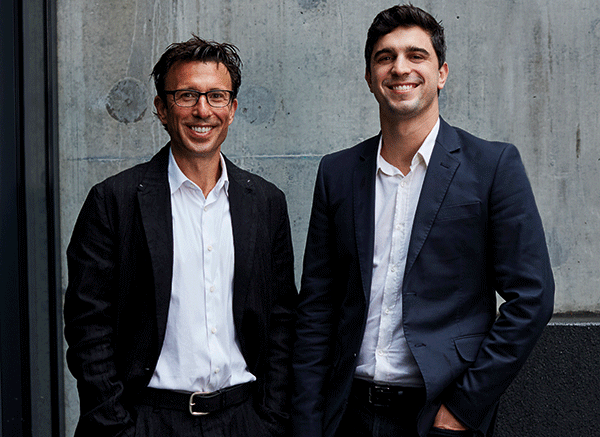
Afterpay’s Anthony Eisen and Nick Molnar
It was a ‘Rear Window’ moment that brought together two would-be fintech billionaires, the creators of a payments system that is changing Australians’ spending habits.
During 2010, Sydney businessman Anthony Eisen often worked late at night from his home office in leafy Bellevue Hill.
As director of London-listed investment house GPG PLC, formerly known as Guinness Peat Group, Eisen kept unsociable hours in Sydney to connect with his British colleagues a dozen time zones away. But he wasn’t the only one awake in the middle of the night.
From his study, Eisen could see into the bedroom of his neighbour Nick Molnar, a Sydney University commerce student. Eisen was intrigued about what the young student was doing, lights blazing, long after the neighbourhood had bedded down, and wondered if he might be privy to some sort of international racket.
“I saw him near every night,” Eisen says. “I thought I was the only maniac who worked so late. There were these late nights on the phone and at his computer, then packages moving in the morning, all this sort of stuff. I thought there was something going on.”
Eisen’s imagination got the better of him and then his curiosity. Putting out the rubbish one day, he approached Molnar’s father at the bins.
“I asked him: ‘I don’t mean to be rude, but what the hell’s going on up there?’” laughs Eisen.
It turned out that there was indeed something going on at the Molnars. The answer was far from Hitchcockian but no less fateful for Eisen and Molnar. The moonlighting Molnar was transforming the back end of his father’s jewellery business, turning it into Australia’s biggest online jewellery trader in his downtime, all while completing college.
Eisen became a kind of business mentor to Molnar, whom he describes as “ridiculously entrepreneurial”, and provided introductions to some of Australia’s savviest investors and bankers.
Thus began a relationship that, seven years on, has blossomed into their joint leadership of one of Australia’s hottest fintech startups, the Afterpay Touch digital payments system.
At a time when Australians have ratcheted up worryingly high levels of household debt through mortgages and credit cards, Afterpay claims to also provide a means of financial discipline when it comes to consumer spending.
It is a relationship that has made both men very wealthy, with the prospect of more riches to come as Afterpay is rolled out beyond Australia.
Eisen, now 46, is Afterpay’s executive chairman, while 27-year-old Molnar is its chief executive. They each own around 12% of the stock, stakes that are now each worth more than A$120 million ($94 million).
Afterpay was conceived and founded around Eisen’s kitchen table three years ago, and is run today from the heart of Surry Hills, Sydney’s hipster area. Since its initial public offering at A$1 a share and ASX listing in May 2016, Afterpay’s shares have more than quintupled, making it a near A$2 billion company.
“We pinch ourselves,” says Molnar. “It’s a once-in-a-lifetime opportunity.”
Targeted at the millennial market of 18- to 35-year-olds, which is Australia’s biggest retail demographic, Afterpay’s business is payment processing.
The model is simple, boiling down to a digital variation of buy now, pay later; a virtual utility that enables Australia’s voracious consumer appetite and – Afterpay argues – promotes its self-regulation.
It’s the opposite of how traditional finance worked with retailers – Anthony Eisen, Afterpay
Australians have traditionally used cash, credit or debit cards when shopping. Other time-honoured purchasing methods are lay-by and hire purchase, which allow customers to secure a product with an initial deposit and pay off the remainder in instalments as their future funds allow.
With lay-by, the product is set aside and stored by the merchant, taking up valuable retail space. Lay-by can be an elongated process, whereby the product is only delivered to the customer after payment in full.
Generally interest-free, lay-by denies the buyer the product at the point of purchase. If instalments are not made, the store keeps the deposit and can re-sell the product, but it will have missed the chance to move it sooner.
Hire purchase provides immediate consumer gratification but comes with interest-bearing instalments, a de facto personal loan to the customer, which adds to the cost.
Afterpay offers another payment method, digitally combining point-of-sale purchase gratification with a variation of lay-by.
“It’s the opposite of how traditional finance worked with retailers,” says Eisen.
Afterpayers coveting, say, a A$200 pair of shoes, make an initial digital payment of A$50 through their Afterpay app, and can take the item from the store immediately. The day after the transaction, Afterpay remits the full A$200 to the retailer, minus a fee that averages around 4%.
Two weeks on, Afterpay notifies customers by text and email that an instalment is imminent before it automatically deducts three fortnightly payments of A$50 from the shopper’s credit or debit card. Crucially, the customer pays no interest (but late payments do incur charges), while the merchant can move more volume.
With Afterpay, Eisen and Molnar explain, the consumer gets the purchase satisfaction of being able to take the item home and do so interest-free, while retailers get sales.
“The whole purpose was driven by how to make the customer experience from a retailer better, to help retailers sell more product,” Molnar says. “Then we built it in a way that was unashamedly customer-centric. We shifted the economics in favour of the customer because we charge the retailer a small commission, which they are happy to pay because they shift a lot more product.”
So is it like the pre-authorization security that a hotel, for example, takes against a guest’s card at check-in? Yes and no, says Eisen.
“We don’t hold the funds. But we are making the assessment that the customer will have the funds available to be debited on the due instalment date,” says Eisen.
“What we are not is a finance company that looks at someone and thinks they are good for A$5,000 or A$10,000 of credit,” he adds.
“We test what we think is your capability to do the presented transaction each and every time. It’s not a line of credit. The assessment is made on each and every transaction.”
Afterpay carries a credit risk for the transactional period, but Eisen says the risk is limited to the single transaction.
“Yes, we’re trusting you as a customer, and yes, we are deploying good science and analytics in that decision,” Eisen says, “but if you don’t abide by the system, then it is closed to you. The real utility the customers get is they can use it as a budgeting tool that works within their lifestyle.
“If you want to use the service again, then your account must be up to date,” he adds. “If you have a late payment with us, you cannot physically use the system again.”
It is here, Eisen says, where technology is key. Merged into the Afterpay system is real-time transactional technology of another Australian startup associated with Eisen called TouchCorp, which handles payments for big corporates, including mobile carrier SingTel Optus and 7-Eleven.
Afterpay has capped limits for customer shopping sprees, as the flexibility for those purchases is assessed by in-system analytics based on customer history and trust.
Eisen says Afterpay’s net transaction margin after costs including bad debts is around 2% for 2017. While the average merchant fee is 4% per transaction, Afterpay favours higher-volume merchants with smaller fees.
“The key to our model is not to grow the biggest loan book as finance institutions do,” says Eisen. “Our receivables book, what customers owe us, the weighted average duration of that is less than 30 days, so our capital is turning over more than 12 times a year. Instead of making that amount as big as possible for as long as possible, we are happy to keep turning it over in a risk-managed way while making a small margin on the way through.”
Fintech hotshop
Afterpay presents itself as the quintessential fintech hotshop. Its funky space in trendy Surry Hills, well away from downtown Sydney’s financial centre, with the inevitable fixie bike in the entrance foyer, certainly advances that vibe.
Eisen says the average age of its 200 staff spread between Sydney and Melbourne is around the mid 30s. Many of the employees have at least a decade’s experience in banking, finance, marketing or technology; several have joined from PayPal.
“We try to make it that everyone is an owner” of the company, he says.
Melbourne-based Eisen is one of two senior suits at Afterpay’s helm, alongside veteran Sydney banker David Hancock, formerly with Australia’s CommBank and JPMorgan.
In Sydney, Molnar is largely responsible for sales, encouraging retailers to market the service by integrating Afterpay with their online and app offerings as a payment option for customers.
Molnar’s sales effort is evident on the glass wall of his office, adorned with the logos of Afterpay’s merchant partners, who include some of Australia’s biggest household and high-street brands such as surf wear giant Ripcurl, fashion chain Country Road and boot maker RM Williams.
“They push it because we help them sell more stuff,” Molnar says. “We build our relationship with the retailers, and the network is very self-fulfilling because they in turn acquire our customers.”
Despite its funky fintech image, Eisen says Afterpay is not an industry disruptor.
“We’ve never told any of our customers to rip up their credit cards, their debit cards, their banking relationships,” he says. “Use what you’ve already got in your wallet, but just let us sit over the top of that. And make life a little bit better. We are about enjoying life’s little extras, about the customer who doesn’t want to use credit.”
Payments used to be really boring, now it’s really sexy – Nick Molnar, Afterpay
Afterpay has few competitors in this specific payment space.
ZipPay, owned by ASX-listed zipMoney Ltd, offers a similar service, while the traditional retail finance providers that offer hire purchase might see Afterpay as a rival. Peers in Europe and North America are the Swedish firm Klarna, Affirm from San Francisco and PayPal.
“We are there for the retailer and the customer,” Eisen says. “We are not about financing the one-off purchase, the A$4,000 TV, the traditional retail finance thing, that’s not us.”
Since launch Molnar says 1.3 million customers have used Afterpay at more than 10,000 retailers. Or as the company likes to put it: “Afterpay processes an order on average every time someone blinks.”
Since the launch of Afterpay’s app in the middle of 2017, it has been downloaded around 500,000 times, Molnar claims, adding that within 48 hours of the launch, its app topped Apple Australia’s most-downloaded chart.
Afterpay says it has processed more than 10 million transactions, totalling more than A$1.7 billion, since its launch.
The company claims to process about 20% of online fashion purchases in Australia; Molnar says that within about 24 hours of going live with a new retail partner, Afterpay is processing a quarter of its online orders.
Melbourne retailer Adrian Letty, who owns the MotoHeaven motorbikers’ supply store, has been using Afterpay since March. He likes the service and says his sales have increased about 20% since he introduced it. He says about 30% of his sales are processed through Afterpay.
Afterpay is mostly deployed for discretionary buying, Molnar says, for the must-have items rather than everyday needs.
“My wife can afford a A$200 dress, but she just can’t justify it,” says Molnar. “But when it’s A$50 she’s like: ‘I can bring myself to do it and I’ll buy a pair of shoes too.’”
Indeed, Afterpay’s merchant partners are overwhelmingly in consumer goods, particularly fashion. Budget airline Jetstar has introduced the option to book and pay for flights, but customers cannot yet buy the weekly groceries, meals or services on Afterpay.
Millennial shoppers
The company initially identified millennial shoppers as its market and, as the business has scaled up, it has become something of a retail laboratory for that emerging demographic’s spending behaviour.
Molnar has noticed that 85% of Afterpay’s transactions are via so-called funds-available debit cards, which he describes as a millennial consumer preference. He cites his own experience as an 18-year-old during the late 2000s financial crisis as characteristic of millennials.
“It was about: ‘Spend money that you have,’” Molnar says. “Debit-card growth went through the roof. There was this mindset that they preferred to link the payment to their bank balance because that was spending money that was in their possession. Millennials actually want to feel really responsible, to spend their own money.”
As Australians splurge on credit, this plays to the emerging political debate about national indebtedness and bank charges.
Australians owe a collective A$1.7 trillion on their mortgages, a market anchored in part by some of the world’s highest property prices and a booming economy that has been recession-free for an unbroken 25 years. Mortgages have been a highly profitable sector for lenders, with low default rates in the soaring property market.
But it is credit cards that have provided political cause for concern, prompting federal treasurer Scott Morrison to crack down on bank charges and to promote the protection of consumers from predatory credit practices.
Credit card penetration in Australia is among the highest in the world, with 17 million cards in a population of 25 million. Australia’s federal treasury says Australia’s credit-card holders owe an average A$4,200, or a collective A$32 billion in interest-bearing debt, one of the highest personal debt burdens in the world.
The IMF warned of the risks of such high indebtedness in its ‘Global financial stability report’ last October. While the average household debt-to-GDP ratio reached 63% in advanced economies in 2016, the IMF pointed to wide differences among those countries, ranging from about 30% in Latvia to more than 100% of GDP in Australia, Cyprus, Denmark, Switzerland and the Netherlands.
“High household indebtedness can cause significant debt overhang problems when a country unexpectedly faces extreme negative shocks,” the IMF warned, adding: “The experience of the global financial crisis suggests that high household debt can be a source of financial vulnerability and lead to prolonged recessions.”
With an average order of A$150, Afterpay believes it is an antidote to Australia’s growing debt headache, helping consumers to manage their spending more carefully.
“That’s been what has driven our business. It costs them [consumers] nothing extra, but they can be really responsible and spend money they’ve got,” says Molnar.
“Our core customer base, millennials, are moving away from credit cards; global statistics illustrate this,” adds Eisen. “Most Afterpay customers use a debit card and very clearly use Afterpay as a budgeting tool over a short instalment period. They are not entering into a traditional loan or credit arrangement. The Afterpay system is designed to encourage responsible customer spending and paying items off in full, rather than subsisting in a debt situation.”
That may be easier said than done.
“It was very handy to be able to pay for things bit-by-bit, especially when you’re a student and don’t exactly know when the next payment will be coming through or you have to pay bills, etc, at the same time,” says Sydney drama school graduate Laura Macdonald, who has used Afterpay.
“One thing I realized after using it twice though, on two rather expensive things, was that I kept forgetting about the payments, and every time another came up it seemed to be more of a hassle than just paying and getting it done and dusted,” Macdonald says. “It kind of got rid of the instant gratification you get from retail therapy. It has actually made me think twice about what I want to buy. Also, if your instalments aren’t in within 24 or 48 hours, you get charged A$10, so you may end up paying more than you would up front. It’s definitely one of those too-good-to-be-true things.”
Profit and loss
For earnings, and in common with startups, Afterpay’s management likes to stress the upper line over the more eloquent bottom line. Earnings before one-off items, depreciation and amortization in the year to June 30 came in at A$5.8 million, against a loss of A$1.4 million the previous year.
“I guess we are not cool because we make money,” says Eisen.
But the net figure after tax in the year to June 30 tells a different story.
Afterpay lost A$9.6 million in the period, nearly three times the A$3.6 million loss it made the previous year, which it blamed on clearing a one-off, onerous A$13.6 million contract holdover from its merger with TouchCorp.
Things improved later in the year. Afterpay took a loss of A$700,000 to December 31, the first half of the financial year 2017/18, as earnings before tax, depreciation and amortisation came in at A$12.1 million, better than analysts had expected.
About 80% of its revenue comes from fees charged to retailers, the rest from late payment fees to users. Afterpay claims only 0.07% of its customers withhold funds until their last payment.
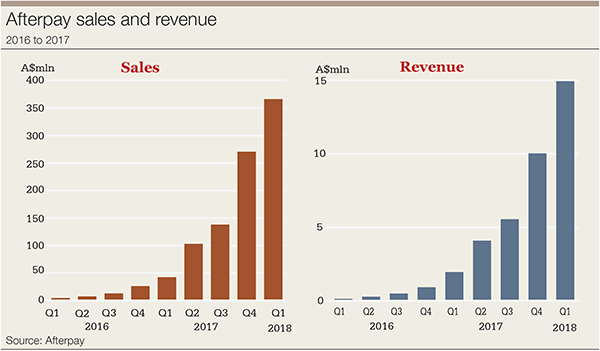
Investors see Afterpay as a way to play the fast-emerging millennial demographic and the stock was one of the Australian stockmarket’s best performers in 2017. It has traded up from its A$1 float in 2016 to burst through A$8 in January 2018 when it announced an expansion in the US.
That is a profitable ride for Afterpay’s backers, who include the legendary octogenarian Kiwi asset trader Ron Brierley, as well as the fund management group Eley Griffiths, Thorney Investment Group (which is associated with the family of one of Australia’s richest men, the late packaging tycoon Richard Pratt) and Ellerston Capital (which is part-owned by the Packer family).
“We believe that Afterpay has only begun to scratch the surface of what is possible with the technology and potential partnership arrangements,” says Melbourne stockbroking house Bell Potter in a recent research note, designating it a buy and forecasting a net profit of A$40.3 million in 2020.
A common criticism levelled at Afterpay is that it is a ‘good time’ company; that it has only ever known a buoyant consumer market in booming Australia.
Anchor investor Geoff Wilson, chairman of Sydney-based fund manager Wilson Asset Management, says he likes the company and management but adds a truer test will come during an economic downtown.
“How will they do in a recession or tougher economic times?” he asks, rhetorically. “It hasn’t yet traded through a full economic cycle.”
Bell Potter agrees in its October research note: “A prolonged recession, economic crisis/shock, or other factors that may lead to a sustained weak market environment have the ability to increase the levels of defaults and adversely affect the earnings potential of the company.”
Eisen counters, saying the company is nimble enough to respond quickly to changing conditions.
“Because our payment terms are very low value and very short duration, there is no long tail risk in our book of receivables and the book itself is massively diversified,” he says. “Because our system is entirely rules-based, we have the ability to instigate changes at short notice to moderate our activity levels. We believe this provides for an agile and dynamic capability with respect to responding to changes in underlying economic conditions.”
Still, there are wobbles. Afterpay shares took a sharp 5% one-day drop in mid-November when, in the lead up to Christmas, the corporate regulator Australian Securities and Investments Commission (Asic) announced it would be probing buy-now, pay-later systems such as Afterpay.
Consumer rights activists have also warned that Afterpay’s no-interest model helps it avoid consumer protection legislation.
The company was quick to address the Asic probe, saying it “welcomes any industry review by Asic. In fact, Afterpay has already engaged with key regulators and industry stakeholders to establish best-practice principles and processes for the emerging industry. Afterpay is proud to have pioneered an innovative product which clearly fits within the regulatory framework and is designed to encourage responsible customer spending.”
Investor Wilson says he sees the Asic probe as a pre-Christmas catching up to a burgeoning sector.
Afterpay operates at the pleasure of retailers who can and – rarely – have denied the service to customers, setbacks that Molnar describes as daily life in a startup.
“You go up and down every single day,” he says.
After a career as a traditional banker-investor, Eisen says he is constantly learning from his new startup life. “We have our crises, we have our issues… but it’s made the journey good. It feels like I’ve done my career in reverse.”
Afterpay has launched in New Zealand and plans to expand internationally through its retail partners in Australia.
“We are trying to work off the back of relationships we have with retailers here,” says Eisen. But investors and analysts see plenty of scope for expansion overseas.
“I haven’t seen anything like Afterpay in China,” says Molnar. “They are leading the way in mobile payments. The whole payments landscape is interesting. Where it ends up, I don’t know. Payments used to be really boring, now it’s really sexy.”