|
|
|
View the Euromoney 25 |

Was 2017 the year Santander returned to form?
Three years after Ana Botín’s succession, Santander struck a bargain of which her predecessor and late father, Emilio, would have been proud. In a lightning deal with the ECB’s Single Resolution Board in June, the bank paid just €1 for Banco Popular, after equity and subordinated debt holders were wiped out.
It took less than a day – showing resolve and an appetite for acquisitions, despite Santander’s repeated recoiling from a purchase of Williams & Glynn in the UK.
The deal puts it ahead of CaixaBank as the biggest domestic bank in Spain, where organic growth in lending is hard as households continue to cut debt. Crucially, it more than doubles Santander’s market share in Spanish small and medium-sized enterprises, the country’s most sought-after banking segment.
Santander is pursuing SMEs globally. Popular has a market-beating domestic SME share of 14%.
In other respects, too, Santander and its chair are having a promising run. At the beginning of 2017, the share price rose on the back of better-than-expected 2016 results, along with hopes for a boost from rising net interest margins in Spain.
The bank then gave investors more good news at a strategy update in New York in October, when it increased its 2018 target for return on tangible equity from 11% to 11.5% due to better-than-expected UK performance.
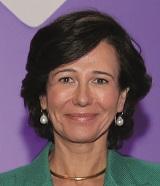 |
| Ana Botín |
Like other European banks, Santander’s share price hit a trough in mid 2016, but it rose by around 20% in the year to mid December 2017, compared with a sector-wide rise of less than 10%. Its price-to-book value, about 1.27 times consensus for 2017, according to Berenberg, is higher than any other top-tier eurozone bank, including its closest peer, BBVA, whose 2017 share-price trajectory Santander also outperformed.
Risks remain, however, as populists make waves from Mexico and the US to Poland and the UK. Brexit is a danger of which the bank is well aware, although it hopes its markets remain sufficiently diverse to prevent a downturn across the network.
After years in which Brazil balanced a crisis-hit UK, then a strong UK recovery balanced a crisis-hit Brazil, now the tables are turning again. As a Brazilian recovery gathers pace, Santander’s bank there is gaining market share in loans, particularly consumer credit.
“One of Santander’s key strengths is our diversity, with around half of our profit coming from developed markets and half from developing markets,” says chief executive José Antonio Álvarez.
One of its key weaknesses, Euromoney might add, is its tier-1 ratio, although Álvarez says the bank is on track to reach 11% CET1 in 2018, up from 8.2% three years ago.
During the weeks of clashes between Madrid and Catalonian separatists in the early autumn, Santander’s shares continued to rise, as Spain’s economy powered ahead of most of the rest of the eurozone.
Meanwhile in the UK, because RBS could find no other buyer for Williams & Glynn, Santander will benefit from the authorities’ alternative method of cutting RBS’s SME market share – getting it to pay rivals to take its clients. Santander will consequently have none of the headaches of integrating an RBS spin-off but some of the benefits.
The bank also got back on the front foot in digital banking. In Spain, Santander relaunched OpenBank as a full-service digital-only lender, using a cloud-based IT infrastructure.
Its asset-gathering franchise is similarly entering a new chapter, following the decision in late 2016 to call off a joint venture with UniCredit’s Pioneer and buy back a 50% stake in its own asset management business. In the autumn, it announced a new wealth management division to house asset management and private banking.
“Our aim is to take advantage of the scale and technological capabilities of the group to create a new service model for clients, with a new digital platform to manage their financial needs accompanied by an extensive network of offices and managers around the world,” Álvarez says about the division’s launch.
Finally, the bank is making progress on its biggest problem market, the US. Its Boston-based holding company can now pay dividends again and it passed the Federal Reserve’s 2017 stress tests, ending three consecutive years of failure.
There was also a legal settlement in November with Thomas Dundon, the founder and former head of its Texas-based car-loans subsidiary, Santander Consumer.
Looking to 2018, the US remains a blot that Santander must clear: not just regulatory hurdles but the franchise as a whole. There is the question of its bulk; whether or not it should grow through acquisitions. Botín seems uncomfortable with a US market share of only 3%, compared with much bigger and mostly top-three positions in the bank’s other main markets.
But Santander can offload businesses just as well as it gains them – as a December agreement to sell Popular’s Florida subsidiary Totalbank to Chile’s BCI showed.