|
|
|
View the Euromoney 25 |

There may not be a large financial institution that has faced more trying circumstances in recent months than Qatar National Bank.
In 2017, QNB, the financial champion of Qatar, had to contend with the most severe crisis in the country’s recent history: a sudden and heavy-handed isolation campaign orchestrated by a group of countries that were once its closest allies.
The blockade – imposed by Saudi Arabia, the UAE, Egypt and Bahrain in June and still in place now – represented a huge blow to Qatar and tore at the fabric of the Gulf Co-operation Council, which had been the most tightly knit union of countries in the Middle East since its formation in 1981.
In the financial community, all eyes naturally turned to QNB. Not all is well for the bank. As of the end of September, its net interest income was down slightly year on year; and the diplomatic crisis potentially complicates its ownership of QNB Al Ahli in Egypt. Still, while it suffered some setbacks, the bank has emerged largely unscathed from the crisis.
For that, QNB can thank Ali Al-Kuwari, its chief executive for the past three years, and Christian Eichner, its head of group strategy for nearly a decade. Both have long sensed that QNB’s opportunities lay beyond the bank’s home in the Gulf and have been deft at delivering rapid expansion in Turkey, and north and sub-Saharan Africa.
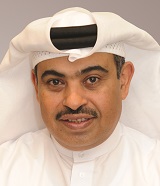 |
| Ali Al-Kuwari |
As Al-Kuwari told Euromoney in 2012, when he was the bank’s chief business officer: “The opportunity is in the virgin markets.”
This vision is now helping QNB weather the political crisis. Because of it, QNB has good reason to remain optimistic as it looks past the blockading states, where prospects for business have suddenly turned bleak for Qataris.
During the summer, a defiant QNB covered the broad facade of its central Doha headquarters with the image of Tamim bin Hamad Al Thani, the emir of Qatar, and the words “Tamim the glorious” – a symbol of Qatar’s resistance to the blockade.
But more than its patriotism, the source of QNB’s strength is its capacity to look beyond its base in Qatar.
Thanks to its internationalism, QNB’s profit rose by 10% in 2016, to QR12.4 billion ($3.4 billion), even as the price of oil spent most of the year below $50 a barrel. As much as 37% of QNB’s net profit derived from its international operations across 30 countries, up from 31% the year before. Meanwhile, business in the blockading states represented only a small fraction of the bank’s total revenue.
With tensions running high in the Gulf, many Qatari businessmen are looking to Turkey for opportunities. Again, QNB’s forward planning means it is a step ahead of the rest; the bank bought Turkey’s Finansbank in 2016.
As QNB was dealing with the early days of the crisis, it still managed to beat forecasts for its half-year results, reporting an increase of 7% in net profit for the period, to QR6.7 billion ($1.84 billion). Its claim that it had seen no large outflows may have been an exaggeration – the entire Qatari banking sector suffered outflows during the summer, compensated by $9 billion of central bank support – but its liquidity position has stayed “robust”, it claims.
The bank’s strategy is not only to deepen its presence in the Middle East and Africa but also to expand in southeast Asia. During the summer, it obtained authorization to start fully fledged banking operations in India. It has also applied to enter Hong Kong. In mainland China, QNB is transforming its representative office into a full-service branch.
“MEASEA markets will continue to be the focal point of global growth for the coming years,” Al-Kuwari says, aware that the Middle East and Africa are now no longer sufficient markets for the bank he leads.
With the fragmentation of the Gulf’s Arab states into opposing factions, and the emergence of a credible local rival in First Abu Dhabi Bank, QNB will have a harder task maintaining its position as the leading bank in the Gulf. But if it continues its expansion across the rest of the Middle East, Africa and Asia, it may not need to.