|
|
|
View the Euromoney 25 |

Capital-boosting asset sales in the autumn of 2017 were welcome news for BBVA’s investors, especially given its exposure to the new geopolitical hotspots.
The bank certainly has an unusual array of political headaches.
President Donald Trump’s revision of trade and immigration policy could hurt its biggest business in Mexico and along the border, where BBVA’s US operations are concentrated. In Turkey, where it increased its stake in Garanti to almost 50% in 2017, politics is also shaking relations with key trading partners. Finally, the bank is more exposed to Catalonia than close peer Santander.
Nevertheless, Mexican unit BBVA Bancomer saw profits increase by 15% during the first nine months of 2017. Garanti’s profits saw an even bigger jump.
“Mexico, Spain and Turkey have all delivered results in line or above our expectations and those of the market,” says CFO Jaime Sáenz de Tejada.
Despite the Catalan separatist crisis, Spain remains one of the fastest-growing economies in Europe. The timing and extent of new loan growth in the country may still be uncertain, but brighter economic prospects helped BBVA offload its remaining €13 billion Spanish real estate portfolio for €5 billion to a joint venture, 80% owned by private equity firm Cerberus, in November.
Perhaps more than anything else in 2018, the bank will be closely watching Mexico’s presidential elections and Trump’s efforts to renegotiate the North American Free Trade Agreement.
In Turkey, rapid economic growth may be more a result of short-term stimulus, including new state guarantees for loans to small businesses, than structural measures. Inflation rose well into double digits in 2017. Strain between the Turkish government and its German and US counterparts have driven the lira to record lows.
Currencies, indeed, are the most immediately relevant aspect of these political risks for BBVA, as its businesses in Turkey and Mexico are profitable enough for the prospect of domestic losses to be remote.
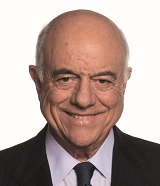 |
| Francisco González |
BBVA, with Francisco González as executive chairman, now hedges slightly more than 70% of the impact of currency on its tier-1 ratio, compared with 50% in 2015. A 10% drop in the peso would now cost the bank three basis points of CET1, while a 10% drop in the lira would only cost it 1bp, according to de Tejada.
Between 30% and 50% of its profit and loss account is hedged for currency movements; for emerging markets it is over 60%.
Meanwhile, the $2.2 billion sale to Scotiabank in November of its 68% stake in BBVA Chile will give a 50bp boost to its CET1 ratio.
After buying the Chilean bank in the 1990s, BBVA failed to gain what it considers an adequate market share. The top four banks in Chile control more than three quarters of the market, de Tejada notes, and enjoy higher returns than the rest (including BBVA) because of funding advantages.
The Spanish group’s market shares elsewhere in Latin America are generally higher – with the notable exception of BBVA Frances in Argentina. Its locally listed Argentine lender completed a $400 million capital increase in July and is looking to tap new growth opportunities.
The Chile sale will push BBVA’s CET1 ratio above 12%, according to KBW, well above the bank’s 11% target. BBVA has not sold out of Chile for any specific capital need, says de Tejada. It was an opportunity to realize value for shareholders, giving a capital gain of around €650 million from a valuation of around twice book.
“It shows we are committed to efficient capital allocation,” he says. “We only want to grow profitably and be the best possible owners of our banks.”
The announcement of the real estate deal, the day after the Chilean sale, was coincidental, but it will also be slightly beneficial to the capital base, due to the release of risk-weighted assets; its residual 20% stake of the venture will allow for deconsolidation.
While BBVA is not studying M&A opportunities, de Tejada remains enthusiastic about recent bank consolidation in Spain.
“Banks need a minimum market share to be profitable, and that’s going up in the world, especially in Europe,” he says, positing a figure of between 15% and 20% of loans and deposits.
Today, its share in Spain is about 14%, up from 10% in 2007, about half of which has been achieved through acquisitions.
“With rates so low in Europe, it’s very difficult for banks to grow revenues,” he says. “Clearly, domestic M&A can generate cost synergies.”
Regulation is making life especially difficult for smaller banks, which also struggle to fund IT investment, he notes. In the third quarter, BBVA’s own focus on technology yielded a 24% year-on-year increase in digital customers and a 43% increase in mobile customers – “amazing numbers”, in de Tejada’s view.