![]() |
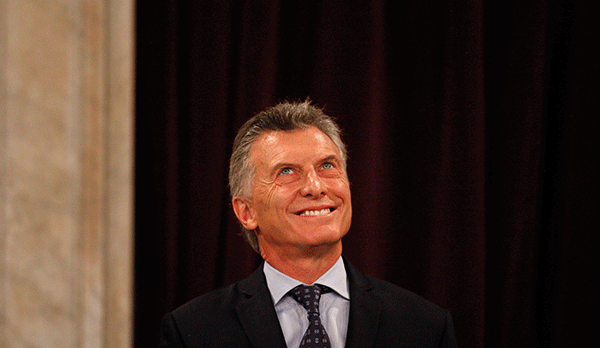
| The broader picture is positive for president Mauricio Macri |
Let me answer in the words of a financial investor I was talking to last month,” says Rodrigo Park, head of economics research for Santander Rio.
“He asked me why FDI [foreign direct investment] was so low and I said: ‘You should tell me.’ And he did, and I agree with what he told me. ‘One reason is fear. And the other is the fiscal deficit. If there is no fiscal consolidation there is no stabilization in the economy. These are the two main reasons why there has been no significant increase in FDI.’”
That is why direct investment has failed to materialize – abroad or domestically, Park tells Euromoney. And that investment is critical for Argentina. Without it the economy will, at best, stutter along in low-but-positive growth and will fail to attain the level that is needed for economic rebalancing and for the government to reduce its sizeable financial deficit (currently close to 7% of GDP).
But, as Park points out, many investors are waiting for a fiscal adjustment before committing capital. Solving this economic contradiction will need skill, patience and luck. And as ever in Argentina, politics will make the government’s attempts to untangle the economic mess it inherited difficult.
Former president Cristina Kirchner will win a seat in the senate in the coming mid-term elections on October 22. But the broader picture is positive for president Mauricio Macri to the point where Cristina’s presence in the senate should become almost an irrelevance.
The country held primary elections on August 13 that effectively serve as a national opinion poll for the mid-terms; Macri’s Cambiemos party did better than had been predicted. Macri won the important province of Buenos Aires by a whisker, but there are many reasons why Cambiemos should fare better in October.
First, the economic recovery is finally being felt in the industrial, employment-heavy industries that are prominent in Buenos Aires.
Second, higher turnout in the proper elections should favour Cambiemos (historically Peronists are more likely to vote in early-round or primary elections).
Third, the low recognition levels of the leading Cambiemos candidate, Esteban Bullrich, will be less of a factor after two more months of electioneering. And, finally, the distant third place of Sergio Massa of the Judicialist Party in the August poll is likely to encourage his supporters to vote tactically and more of Massa’s supporters are expected to drift to Cambiemos than vote for Kirchner.
Beyond Buenos Aires, the government won in 11 of the 24 districts, including some that have historically been controlled by the Peronists, like San Luis, Cordoba and Santa Cruz. Citi projects that Cambiemos will win 12 out of the 24 Senate seats up for grabs, taking it to a total of 24 out of 72. In the House of Representatives, local newspaper La Nacion predicts it to rise to 104 from 86 (of 257).
Macri will only control a minority in both chambers but, if these predictions are correct, he will strengthen his position in both, win an increased share of the vote nationally and demonstrate momentum for the next presidential election in 2019. This in turn will make it easier to secure agreements with others in congress and the senate as they see voters backing Macri’s reforms. It will also consign Kirchner to history and a divided opposition will not coalesce around her presence in the senate. Macri’s political capital will be replenished after a bruising couple of years and there will be renewed hope for passing reforms.
Fiscal target
Whatever happens, no one is expecting an acceleration in the fiscal consolidation process. The government has explicitly stated that it will not increase the speed of its fiscal readjustment. This year’s primary fiscal target is an unambitious 4.2% of GDP (add another two percentage points on for debt payments and a provincial deficit of close to 1% of GDP) and receipts have been boosted by a successful, one-off amnesty. Next year, the target is 3.5%, and hitting it is only a little less difficult than it is important for the financial markets.
![]() |
This gradualism is simply a political reality. Economists who have called for quicker fiscal reduction – for example, by quicker and steeper reductions in the subsidies of the public services that were built up under Peronism – are likely to have written their economic notes from an office on Wall Street. Their arguments are rational from the perspective of modelling a quicker economic turnaround, but they are based in a political vacuum. Had Macri’s government pushed more quickly, he would have probably failed the political test that he is now likely to pass with surprising comfort in October.
But this gradualism means that the government needs to achieve economic growth of at least 3% of GDP in the coming years if it is to offset a slow or nonexistent reduction in nominal fiscal expenditures.
|
|
|
Delfina Cavanagh, |
“As long as the economy grows, it will be easier for the government to deal with the fiscal issue and it will have more margin to correct the large imbalances that characterized the beginning of the government as part of what the previous government left the country,” says Delfina Cavanagh, sovereign analyst at Standard & Poor’s.
Is this possible? With investment, certainly. Without, probably not.
Without an increase in investment, the rebound in economic growth will probably peak this year at around that 3% mark and then slow again.
Analysis from Citi points to a gloomy scenario. The investment bank argues that the strong growth seen in the first quarter of 2017 (up 1.1% on the previous quarter) has been tempered by May’s annual growth of 3.3%, which in itself is a result of strong statistical carryover from the fourth quarter of 2016.
“Since then, growth has been quite low,” says the Citi report, which also points out that volatility in Argentine economic data means recent strong performance is “not unprecedented, even if we compare only with the last few years of stagnation”.
Worse, the report says: “The data show that activity still remains 1.7% below the pre-recession peak [and] compared to previous recoveries, the current one has actually been softer.”
Fernando Diaz, Citi’s Argentina economist, believes the potential growth rates offered up by the other banks – typically around 2.5% and 3.5%, absent structural reforms or shocks – misread the output gap, which he says “is only slightly negative”.
Also, analysis of the employment market (with low unemployment that links strongly to the output gap), backed by intuitive signals such as the economy being ranked 112 out 134 in terms of investment by the IMF, means that Citi believes the economy’s potential growth rate is 1.8%.
![]() |
According to Diaz’s models, it would take nearly a decade to reduce the fiscal deficit to a sustainable level of -2% of GDP using a gradual approach to fiscal consolidation, coupled with a sub-2% GDP growth rate. (Citi’s model assumes current spending is constant in real terms and capital spending increases a real 5% a year until it reaches 6% of GDP). Even with benign external conditions that kind of performance would see a quick increase in government debt levels and it would test the patience of international investors, who would need to finance the decade-long adjustment.
Monetary policy will also work against economic growth in 2018. The central bank is in the midst of a valiant fight with inflation and it looks like it will have cut the annual rate to somewhere a little over 20% by the end of this year, from a peak of 40% in the first year of the Macri administration. It is an impressive performance, but it is still some way short of its target of 12% to 17%. Next year, the central bank has set itself an even-more aggressive target of 8% to 12%.
“The central bank is likely to fail to hit its inflation target, not only this year but next year,” says Diaz. “That puts the bank in a difficult position. If they don’t change the targets, they may become too unrealistic, and if they are perceived as too unrealistic then the targets are useless. But if they constantly change the targets, then they are not effective in anchoring expectations.”
The president of the central bank, Frederico Sturzenegger, has stated that he thinks the targets themselves are also a tool and inflation would have still overshot targets at higher nominal levels. Not everyone agrees with this assessment, but there is certainly a consensus that reducing inflation from moderate levels (as opposed to hyper-inflation) is notoriously hard. Probably the most successful comparable case-study to date is Chile between 1989 and 1993, when it got inflation that peaked at 27% into single digits in four years.
Argentina is trying to achieve more or less the same feat in less than four years and it has the added complication of the misalignments in relative prices and the exchange rate shock at the beginning of the inflation-fighting regime. In the face of inflation that is remaining obdurately ‘sticky’ the central bank is likely to be hawkish for longer than the market is expecting, especially as the monetary policy transmission mechanism is weak, with credit at just 15% of GDP. This will not help the economy achieve at least 3% growth. And, importantly, higher interest rates will be a disincentive for local investment as the discount rate used to model returns for projects increases the cost (in today’s terms) and lowers returns.
|
|
That is why there is so much hope that the mid-term elections will lead to a positive investment shock. Those who back this scenario say that a strong performance by Cambiemos will point to six more years of a market-friendly administration. This will see investment begin to flow – both domestically and from abroad – into the real economy, boosting jobs and growth. Productivity gains from capital investments will lift potential long-run GDP growth to between 4% and 5% and generate positive momentum. The government can maintain current levels of expenditure, while cutting some subsidies as real wages rise, to minimize political fallout ahead of presidential elections in 2019.
Martin Castellano, deputy chief economist for Latin America at the Institute of International Finance, is cautiously upbeat about president Macri’s chances after his strong showing in the primaries.
“Making significant policy advances after October will be as important as winning the election,” says Castellano. “A good performance in the elections will provide an opportunity to use the regained political capital to improve the fiscal position by overhauling the tax system, as well as passing other reforms that reduce the regulatory burden and improve the efficiency of government expenditures. These are things that investors will be looking for and that will be key to sustain growth beyond 2017.”
However, even here the outlook is sober. Santander Rio’s Park says that if total investment rises to 24% of GDP from under 20% today, the sustainable growth rate is still just 3% – well short of the 4% to 5% long-term rate that some talk about under the ‘FDI scenario’.
But the main problem with the FDI scenario is that we have been here before – very recently. When Macri won in 2015 there were confident expectations of FDI flowing into Argentina. In reality those flows were, if not a trickle, rather modest, and certainly not sufficient to increase long-term potential GDP growth rates.
As FDI failed to materialize, the reasons for this were sought. Political risk was a frequent explanation, but there were others: the fiscal deficit, the need for labour reform and tax reform. And if Macri felt that he did not have the political capital in the first two years of his administration to tackle these issues, is his position now much stronger?
We will see, but, given his need to secure agreements with political opponents for every reform, the speed and final shape of these reforms may not meet investors’ renewed expectations. And they will take time.
Even if Macri starts on across-the-board reforms early next year, given procedural issues and delays, that takes the Macri administration towards 2019, which is a presidential election year. And around Argentina goes again.
The challenges to economic management of facing elections every other year would be debilitating in any democracy. In a country that is trying to shrug off populism and change its fundamental financial and economic models, it is a crippling flaw.
Expenditure
If investment does not come, either from home or abroad, and economic growth disappoints at under 2%, the government has another option – cutting expenditures.
At first glance, the economy would seem to have the fat to cut. Between 2005 and 2015, government spending rose 17.9 percentage points to hit 47.1% of GDP; of this, only 4.6% was capital spending in 2015. In fact, since 2005, Argentina’s government has only increased capital spending by 1 percentage point of GDP (from 3.6% in 2005).
Government revenues increased but failed to keep up – reaching the equivalent of 41% of GDP and therefore the fiscal balance deteriorated.
![]() |
|
Gabriel Torres, Moody’s |
Surely there could be room to reduce some of this public consumption? However, according to Moody’s sovereign analyst Gabriel Torres, that is not going to happen.
“Some people think Argentina can get spending back down to pre-Kirchner levels, but when countries get richer they always demand more. I don’t expect much in the way of cutting expenditure. What they need to do is catch up on the revenues to balance those expenditures.”
Torres also points out that while the government is making some progress on the subsidies issue, it has also increased spending on pensions, which is “sticky, if not bordering on impossible to reduce”.
Also, Macri’s government has shown that you do not need to be a populist to resort to spending in election years. This year, the gap between revenues and expenditures has risen. If the same thing happens in 2019, it would threaten the legitimacy of the new economic model and could lead to a return to economic stop-and-go. Dismantling the biennial election cycle would be a beneficial for the economy but, at least to date, such reform is not being seriously discussed.
Maybe this explains why Torres has much more realistic goals for the Argentine economy.
“If Argentina grows again next year at around 2.5% to 3%, it might not be a great level for a developing economy, but it will be the first time since 2011 that it has grown for two years in a row. If it manages to grow in 2019, that will be the first time it has grown for three years in a row since 2008.”
Repatriation
No one said this economic test was going to be easy for Macri’s government. And there are other issues to add to the seemingly intractable problem of which needs to precede the other: fiscal consolidation or investment?
Take the exchange rate. The peso is over-valued. It can be argued to what extent – most economists say around 20% – but taking a walk around Buenos Aires is reminiscent of São Paulo in 2011. The reasons are pretty clear: according to Dealogic, over $53 billion has been raised by Argentine issuers in the international markets since Macri became president; these heavy inflows have been added to by a successful tax amnesty that saw the repatriation of billions of dollars more.
|
|
However, the government and the central bank are not going to seek to push the peso lower because they do not want to unleash pass-through inflation. No one knows what these pass-through forces would look like, but, given the population’s long association with pricing domestic goods in dollars due to the inflationary environment, they are likely to be large. Therefore a lower peso will complicate the hugely difficult job of bringing inflation down, while the theoretical benefits for the export sector would probably evaporate in rising domestic prices.
Juan Cerruti, head of public policy and external communications at Santander Rio, thinks this is one of the biggest challenges facing the central bank.
“The most important task of the central bank will be if they can break the mental link that is embedded in the public’s psyche between the movement in the exchange rate and inflation. That would be a crucial development,” he says.
Bankers and economists in Buenos Aires seem to think the government and central bank will want to prioritize exchange rate stability over the benefits to the productive sectors of the economy in the short term, by which most mean about three years.
That should be long enough to lower inflation to mid single-digits and re-anchor domestic inflation expectations to movements in the peso rather than the dollar.
Last year, in a recession, imports rose by 4% and exports fell. The trade balance is deteriorating this year – a $2.6 billion deficit in the first half of 2017, compared with a $689 million surplus in the first half of 2016 – as Argentines look abroad to use their peso-spending power.
To some extent, the strong peso also frustrates FDI as the price of local assets is inflated in dollar terms.
Daniel Marx, executive director of Quantum investors, says valuations in dollars are problematic: “Some deals are getting done, but the gap nowadays between bid and offer has increased. It was very high in 2015 and then after the FX liberalization, it reduced until around the first quarter of this year, but it is now widening again.”
Economy
Investment-led economic growth is key, according to Sergio Grinenco, chairman of the board at Banco Galicia.
“The issue isn’t that we need to reduce the absolute size of the government, rather the relative size, which is why we need growth. We need to see a significant improvement in the growth of not only FDI but also local investment, and this is where things haven’t gone as fast we expected.
![]() |
| Sergio Grinenco, chairman of the board, Banco Galicia |
“The whole thrust has to be more skewed to investment and exports and opening the economy and becoming more competitive. There is some pain in the process and it’s difficult for a government that has come into power without a majority – it’s going to be a continuous balancing act,” says Grinenco.
The problem with balancing is that the slower you go, the more likely you are to fall. And with the government committed to a gradual fiscal readjustment, the improvement to the Argentine economy is likely to be slower than many still expect.
Investment is likely to continue to disappoint.
The government will likely need to borrow more for longer to finance its fiscal deficit, which could take debt projections towards the levels that start to worry investors.
Throw in any negative externalities – rapidly rising US treasuries or a China-driven emerging markets shock, for example – and these financing vulnerabilities could become problematic.
Argentina’s dollar-denominated debts and liabilities are now back up to around 20% of the system – which is not an issue now (and most credit is extended to producers with dollar revenues). However, the erosion in investor confidence in the government’s financing sustainability as dollar debt rises as a proportion of GDP (Citi predicts it will be up to 55% of GDP next year) could lead to financing challenges.
That is the downside risk, plausible but still not likely. Given another six years, Macri should be able to finish the job he started, albeit arriving in 2023 with higher financial deficits and higher debt-to-GDP than he envisaged in 2015.
At some point in his second term, the foreign investor that told Santander Rio’s Park he was waiting for fiscal consolidation and the end of political risk may decide the time is right to invest. A flood of FDI might come and secure Argentina’s new economic model.
But, until it does, nothing about Argentina’s economic turnaround can be taken for granted.