 |
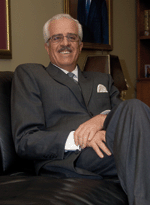
Antonio Acosta, Banco del Pichincha: confident about Latin America |
Antonio Acosta, the co-president of Banco del Pichincha, the largest bank in Ecuador, is confident 2009 will be a good year for the bank. He tells Euromoney why he is so positive about prospects.
How has your bank fared through the financial crisis?
The bank has done well. The bank’s assets are safe and diversified because it works with all the segments of the economy and so in terms of profitability the impact has been minimal. Also last year the bank had some extraordinary profits from the sale of its subsidiary in Colombia.
How are you managing your liquidity needs?
Fortunately, we had a very small dependence on foreign loans and issues on the capital markets when the international crisis hit hard. The funding from Banco Pichincha basically comes from a well-diversified base of deposits. Deposits showed a decline at the beginning of the year but now they have almost recovered to the level of the end of last year. We also had to collect some of our loan portfolio but now the situation is almost normal for us again.
What is the level of your core equity and do you have plans to raise that level? If so, how and when?
The core equity of Banco Pichincha at the end of December 2008 was $461 million, up from $389 million at the end of 2007. The main source of capitalization for Banco Pichincha is the reinvestment of profits. This has been on average 80% of previous years’ profits and we expect to maintain this proportion given the commitment that the shareholders have to the bank.
What’s the biggest challenge facing your bank over the next 12 months?
Ecuadorian government policies could affect financial intermediation and bancarización. [Policy changes that slow bancarización] represent our biggest challenge because it will slow down the rapid growth of credit and deposits in the financial system. We have made large investments in technology recently to push bancarización. Policy changes will also limit the possibility to work with new segments of our economy like microfinance and other agents that cannot access formal financial institutions.
Do you think the financial crisis is past its worst?
Yes, it seems that the worst is over and that will help the Ecuadorian economy and us. One of the main positive signs for Ecuador is the recovery in the oil price. This will help to close the external and fiscal gaps.
How do you think Latin American markets will perform over the next 12 months?
I am optimistic. Latin America in general has followed sound policies and macro reforms that have helped to minimize the impact of the crisis. Now that the global economy is recovering, I believe that the region will be among the top performers.