| 2009 Awards for Excellence | ||
BLACKSTONE GROUP: The US house has demonstrated the benefits of geographical and business area diversification
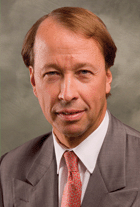 |
“Our investment model is to hold existing investments until markets are favourable”
Tony James, Blackstone |
Last year was one of the sleepiest on record for private equity deals. Funds were still being raised but the lack of M&A activity as companies sat tight, combined with a general lack of confidence in company valuations, meant that private equity firms were reluctant to put investor money to use. So investors are predicting that many private equity shops will close down. Those that have successfully navigated the dry spell are houses that have a broad service offering, and that have had the global reach to be able to find opportunities when in domestic markets there are perhaps none. Blackstone wins this year’s award for best global private equity house. Established in 1985 as a mergers and acquisitions boutique, the firm has evolved into one of the largest private equity investment firms globally. By the end of March 2009 its corporate private equity operation had raised approximately $44 billion in capital, with $25.5 billion of fee-earnings assets under management.
Despite the decreased opportunities for private equity firms, the strong relationships Blackstone has developed with investment banks and financial intermediaries have enabled the firm to continue to conduct business in private equity. Indeed, of the 40 deals announced through to the end of March 2009 for Blackstone Capital Partners V, 34 were exclusive to Blackstone or related to situations where Blackstone prevailed despite a higher bid.
The Apria deal highlights Blackstone’s ability to do business even in difficult markets. Blackstone bought the healthcare company last year for about 4.5 times ebitda. Tony James, president and COO of the Blackstone Group, says: “We got great support from three banks even in the dark days of the credit market, borrowing 60% of the capital structure on a no-covenant basis. And our operating and new management team has identified improvements that should almost double ebitda.”
As the true success of a deal is not realized until its exit, James also points to the recent sale of Stiefel Healthcare Company to GlaxoSmithKline. “At the time of the sale, Stiefel was marked at 0.7 times our cost, or a 30% loss under FAS157,” he says. “Glaxo agreed to buy Stiefel at a price that is approximately 1.4 times our cost, which is twice the current mark. We outperformed the market and the healthcare industry significantly since this company was purchased in August 2007.”
Despite discussion of a dearth of private equity opportunities, James says there is much to be positive about. “We have been steadily active in the past year, closing on 10 new deals and putting to work about $3 billion in capital. This is a lower volume of activity than at the height of the market in 2006-07 but we are looking at much higher internal rates of return today. Our limited partners seem happy with this level of activity. No one is eager to write mega cheques in this uncertain time. Our fund is 70% invested and we have three more years left in the investment period, so there is no pressure to invest.”
Similarly, James says there is no pressure to sell at inopportune times. “Our limited partners understand that we are patient, long-term investors. Our investment model is to hold existing investments until markets are favourable. Our fund life is 12 years and our average holding period is more than five years.”
In testing times, however, Blackstone has proved it is necessary to have a diversified business. Revenues were down in both Blackstone’s private equity business and real estate business for 2008 but were up in the alternative asset management space and in financial advisory. James says the firm was built to have such a balance so that in tough times, the balance sheet would remain sufficiently strong to enable the firm not only to survive but to grow. “Historically, severe economic dislocation has yielded many of the best investment opportunities,” says James. “While many financial institutions must now focus inward on rebuilding capital, we are able to focus outward on capturing opportunities for our investors.”
One such opportunity to grow in private equity was the launch of Cleantech Energy Group last August. This pursues opportunities in alternative energy sources. It has already made two investments.
As private equity has dwindled, restructuring has grown in importance, proving that diversification works. Blackstone’s financial advisory business has enjoyed record growth in the past two years. In 2008, the group advised on 160 deals and generated record fees of $411 million. Among those deals were advice on high-profile situations such as AIG, GM, Ford, Northern Rock and several monoline insurance companies. The firm advised on 61 distressed situations. James says: “In an era of distressed debt opportunities, having the world’s leading restructuring group is a huge asset.”
The acquisition of credit specialist GSO Capital Partners in early 2008, adding to Blackstone’s alternatives business, has also been a help in testing times. James says: “With credit markets largely shut down, being able to access debt capital from our GSO credit group can be a compelling advantage. The real power of these synergies comes into play in times of turmoil like this.”


