| 2009 Awards for Excellence | ||
GOLDMAN SACHS: The concept of restructuring may have changed but Goldman remains the market leader
|
Also shortlisted in this category: |
Until the crisis hit, the concept of restructuring had largely been limited to discrete corporate entities. That has all changed. Any institution claiming to have a holistic practice in debt restructuring must now incorporate approaches that can efficiently deal with products such as structured investment vehicles (SIVs) and also securities – especially, but not only, securitizations. Asset-backed securities and collateralized debt obligations are at the core of securities restructurings mainly because of the rapid deterioration in residential and commercial real estate assets. Market valuations have suffered as the underlying assets have declined, leading to dramatic implications for investors in SIVs, securitized debt and other securities. This dramatic weakening has not only shattered the confidence of investors; it has also established a new asset class for the well-positioned institutions. There is no doubt that there is a large amount of work to be getting on with.
|
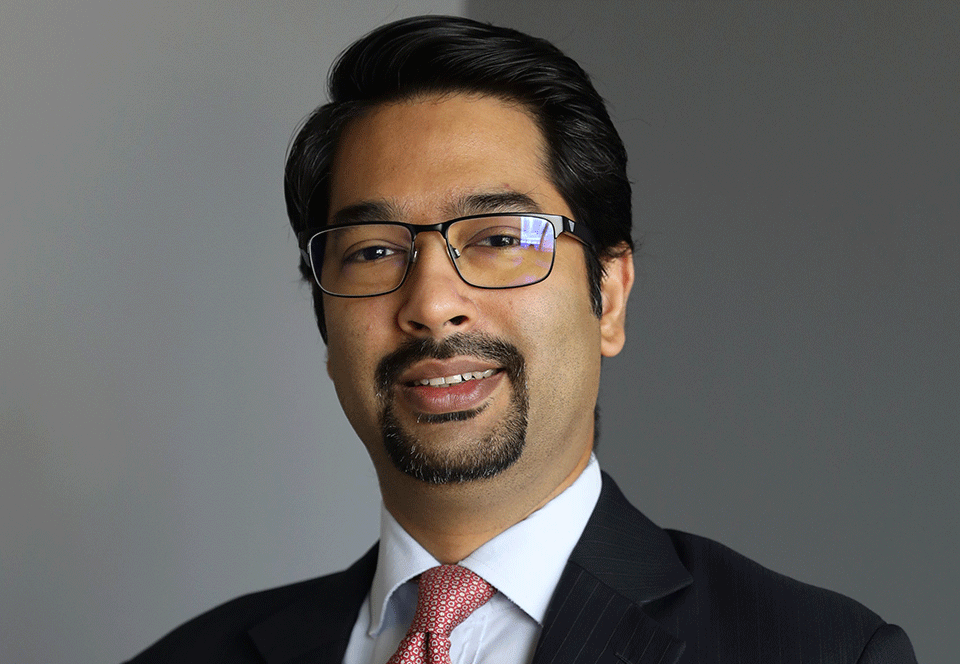
“At the heart of this is giving investors the option to cash out or roll into a new security”
Andrew Wilkinson, Goldman Sachs |
 |
“The process of restructuring securitized product has some way to go,” says Andrew Wilkinson, head of European restructuring at Goldman Sachs. Nevertheless, Goldman has successfully restructured more than $14 billion of defaulted SIV assets in four diverse transactions since 2008. Market value structures, such as SIVs, were highly vulnerable to a decline in their net asset value. The US firm formally established its restructuring group in the summer of 2007, although initial discussion started in 2005. Following the collapse of the shadow banking system in 2007, the European restructuring group’s work began in earnest.
“We came at this problem very much from a traditional restructuring perspective, where we look at security enforcement, default, cram-down,” says Wilkinson.
One key issue with restructuring SIVs is the sheer number of interested parties that have to be consulted. Furthermore, there were hundreds of assets in SIVs whose valuations were constantly changing. The solution that Goldman Sachs established brought together expertise across the firm, including restructuring, structured finance and trading, to develop a scheme that gave the receivers and senior creditors an alternative to a fire sale into a distressed marketplace.
“Many of our competitors were trying to get all the creditors into a room and offer some sort of underwriting,” says Wilkinson. The approach that Goldman took was to work with court-appointed receivers to provide a clearer solution for SIV noteholders.
Especially important was the use of the receivers’ right of sale on the portfolio, as this did not require the consent of creditors.
There were several advantages to the method the US bank chose to restructure SIVs. All the preferences of senior creditors were incorporated into the proposal. Its execution did not require capital commitment from a third party and it worked even when markets were highly volatile.
“At the heart of this is us giving investors the option to cash out or roll into a new security,” Wilkinson explains.
The restructuring proposal involved various phases. Senior creditors were given various alternatives that would give them access to the SIV assets. Then there was a restructuring of individual holdings for senior creditors that elected to maintain exposure to the SIV’s assets as part of the first-phase restructuring. Those that did not maintain exposure as part of the first phase were able to take their cash through the Goldman-administered auction.
Goldman Sachs has maintained a leading role in the restructuring of SIVs subsequent to the Cheyne transaction, including Rhinebridge, Mainsail II, and Whistlejacket Capital, totalling approximately $14 billion (including Cheyne).
Goldman is a market leader in re-remics (resecuritization of real estate mortgage conduits). The bank settled four distinct resecuritization transactions with multiple collateral tracks of underlying RMBS bonds. The structuring achieves several goals, including (but not limited to) ratings stability and loss protection.
It is also active in liability management (debt buyback, tender, retirement or restructuring) for structured finance clients. During 2009, the bank executed more than $650 million of debt repurchases on behalf of Huntington National Bank, Emerson Reinsurance, DineEquity and other ABS issuers. Benefits of early retirement of debt include reduced financing costs, improved balance-sheet ratios, reduced refinancing risk and deferral of tax gains on repurchases.