| 2009 Awards for Excellence | ||
Morgan Stanley: Experience and long-term relationships combined with physical trading and financing capacity were more important than ever in a year of unprecedented commodity-price volatility
|
Also shortlisted in this category: |
Recent events have made ever more obvious the growing importance of risk management in commodities. Indeed, one of the biggest private companies in the US, Semgroup, had to file for bankruptcy last summer because of trading losses in the oil futures market.
Values of commodities peaked at record highs last year, had a record crash, and then rapidly climbed back to levels that would have seemed extortionate in previous decades.
Deutsche Bank, Barclays Capital, and JPMorgan have continued to build their capabilities in commodities rapidly, even as some of their competitors fell away. Nevertheless, Morgan Stanley has had a big, market-leading commodities operation for far longer than these newer contenders for the top position in the market.
Morgan Stanley’s long-term relationships in commodities have given it trust from its client base. It has a more established, tight-knit team, and a physical trading capacity it has been building for a quarter of a century.
Over the past 12 months, these qualities were vital.
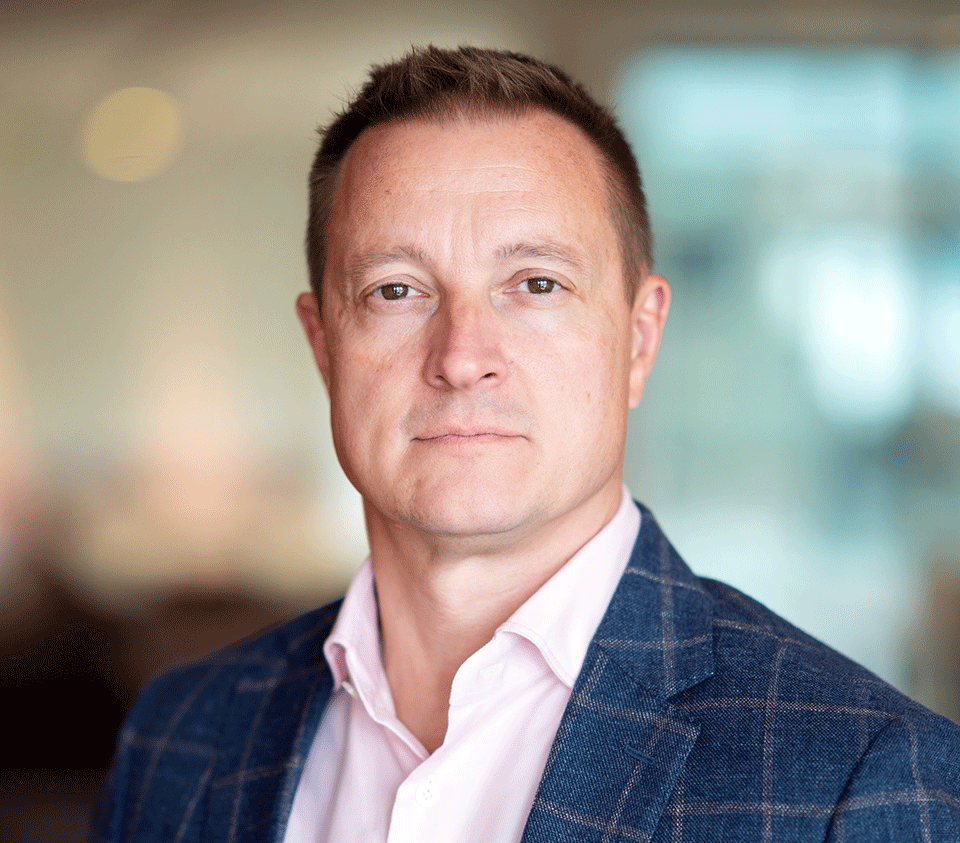
“We have very good client reach and as a result we have good risk appetite to do large hedging transactions, because we can place that risk with other clients,” says Boris Shrayer, global head of commodities marketing at Morgan Stanley.
This spring, as an example, Morgan Stanley helped transfer assets in a large loss-making trading account for which FC Stone, a US commodities risk management firm, provided clearing and execution services. Within a few days, Morgan Stanley analysed the value and provided a bid to take the entire book – which included more than 700,000 option contracts.
|
“Markets have been so volatile that your position may be deep in the mud one day and deep under the water the next day”
Boris Shrayer, Morgan Stanley |
|

Morgan Stanley’s growth in staff is more of a drip-drip approach than the wave of new hires completed by such banks as JPMorgan and Barclays. But this is not to say it is standing still. In September, for example, Morgan Stanley became the largest shareholder in Atlantis, a developer and manufacturer of electricity-generating wave turbines, based in Singapore.
Furthermore, Morgan Stanley has become better at combining its trading capacities with the power to provide credit – something other banks have had to forgo, even as clients were needier than ever.
“In the past 12 months financing has been a core issue,” says Shrayer. “Clients needed help restructuring their positions. The markets have been so volatile that your position may be deep in the mud one day and deep under the water the next day.
“Companies are thinking of their financing and balance sheet needs at the same time as thinking of their commodity risk management needs,” he says.
An example of Morgan Stanley’s increasing tendency to fuse financing and commodities trading is seen in the work it has done for Topaz Power, a Texas electricity company owned by private equity firm Riverstone. Morgan Stanley structured and financed a $1.2 billion improvement of gas-fired generators owned by Topaz. As part of the deal, which reached financial close in May last year, Morgan Stanley will deliver gas to and take power from the company until 2014.
Perhaps the biggest growth story has been JPMorgan, whose commodities business has ballooned to a size that now dwarfs the operations of most other global banks. The firm now has about 480 front-office individuals dedicated to commodities – partly the result of its acquisition of Bear Stearns’ energy business in March 2008 (which gave JPMorgan important storage facilities, especially for precious metals). JPMorgan also acquired carbon-credit firm Climate Care, and UBS’s commodities business in Canada. Aside from these acquisitions, JPMorgan has added more than 100 front-office individuals over the past year – hires that focused on oil, agriculture, and Asia.
Similarly, Barclays Capital grew its headcount in commodities by about a third over the past year through organic additions as well as the acquisition of Lehman Brothers’ north American investment banking and trading business. Barclays also bought UBS’s oil and gas, power, and base metals business in the US. It now has one of the biggest commodities franchises of any global bank.
Deutsche Bank is also in the midst of a drive to become a market leader in commodities. This year it established an alliance with Stemcor, the world’s largest independent steel trader. It also bought a 49% stake in London Dry Bulk, an iron-ore broker.
With competitors such as these, Morgan Stanley cannot allow itself to become complacent. However, as the asset class has become more prominent, Morgan Stanley’s long-standing investments in commodities have served it well.