| 2009 Awards for Excellence | ||
HSBC: The crisis showed up which banks the markets thought were safest – and HSBC came out firmly on top
|
Also shortlisted in this category: |
Geoghegan appeals to banks and governments
August 2009
The past 12 months has been traumatic for every financial institution in the world. At times it felt as if the entire financial system was on the point of collapse. One bank, in conversations, was always singled out as being in a special position: “If HSBC were to go under, we can all pack up and go home” was a common refrain.
Such comments were a reflection of HSBC’s size, its global nature and the fact that it has survived the credit crunch relatively unscathed – the disaster of its purchase of Household in the US notwithstanding.
 |
|
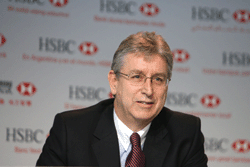
Michael Geoghegan, HSBC: well-placed |
But the reality went deeper than that. To many in banking, HSBC was the safest of all financial institutions – to the extent that many senior investment bankers admitted at the height of the crisis that they were transferring large chunks of their personal deposits to their competitor.
That perception of safety was founded in a strategy that was often roundly criticized by analysts, investors and competitors. HSBC played it too safe, they said; it did not take advantage of its many strengths. Now, perhaps, HSBC’s management feels vindicated by the strategy.
HSBC is by no means the only big bank to come out of the credit crunch in a relatively enhanced position. BNP Paribas has had the lowest write-downs of any firm with an important investment bank, continues to build share in its key European retail markets and was not drawn into making the costly acquisitions in emerging markets that are now haunting some of its competitors.
JPMorgan Chase has consolidated many of its market-leading positions, gaining critical mass in the US with the bolt-on of Washington Mutual, while continuing to push many of its banking and capital markets businesses to the top of the league tables. It vies with HSBC for the position of number one global universal bank.
Santander had yet another stellar year, despite difficulties in the Spanish banking market. It is now highly diversified, and made huge inroads in the UK market by adding Alliance & Leicester and Bradford & Bingley to its Abbey franchise, while maintaining leadership in Latin America.
But this year HSBC deserves the accolade of best bank. After a period in which banks suffered for putting too many eggs into too few baskets, one of the things that stands out at HSBC is the diversity of its business. It is a truly global bank. In 2008, HSBC made $10.9 billion in Europe, $5.5 billion in Hong Kong, $6.5 billion in the rest of Asia-Pacific and $2 billion in Latin America. That broad spread of business means that no single market accounts for more than a quarter of HSBC’s revenues. And it meant that HSBC was still able to make a profit for 2008 of $9.3 billion, despite losing $15.5 billion in the US because of Household, which is now in run-off and will not be such a drag on earnings in future years.
The breadth of HSBC’s client base is also important. Although personal financial services accounted for slightly more than half of operating income in 2008, commercial banking and global banking and markets were the biggest contributors to HSBC’s profits.
HSBC has adopted a clear policy of focusing expansion on emerging markets and placing the bank in a position to focus on the international connectivity of those markets with the developed world. It is scoring a number of successes. In mainland China, profits reached $1.6 billion in 2008, up 25%; in India, profits were up 26%; and the bank’s leading franchise in the Middle East posted profits of £1.7 billion ($2.8 billion), up 34%.
But perhaps HSBC’s most impressive achievement was its rights issue in March this year. The deal came at a time when equity markets were all but shut. Banks looking for new capital had few choices left: wealth funds were getting weary of their investments, and government money had become almost the only remaining option.
HSBC knew it needed to raise capital, but was determined to stand on its own two feet. So it went out into the market with a £12 billion rights issue, and sought to raise the money from existing investors. The bank achieved almost full subscription to the rights issue. No other bank could have raised so much money in this way at that time. The market had made a judgement on HSBC.
That judgement continues to be seen in its market capitalization, which at around $140 billion is the highest of all the big global banks. The rights issue has also shored up the bank’s capital, with a tier 1 ratio of 9.9%. Now it looks well placed to benefit from the weakness of some of its rivals as well as the growth potential inherent in its chosen strategy. As chief executive Mike Geoghegan says: “The rights issue enhances HSBC’s signature financial strength and this, together with the start made in 2009, means we are well positioned to ride out the economic uncertainty ahead, and to take advantage of opportunities to grow.”