Insurance survey 2009: Insurers take cover to avoid capital crunch
 |
“The attack on our people and our business has been unprecedented. I have never seen anything like it” Nicholas Walsh, AIU |
LAST MONTH THE US government was forced into a debt-for-equity swap on its bail-out loans to AIG, reducing outstanding balances on its $60 billion credit line by up to $26 billion in exchange for preferred shares in new holding companies for the troubled company’s US and foreign life insurance operations. AIG had been trying to sell these but could find no buyers as life insurance competitors around the world struggled with collapsing investment portfolios, earnings, share prices and market capitalizations.
AIG’s corporate restructuring, the largest and most complex ever attempted, will clearly take much longer than the US Treasury and the Federal Reserve naively hoped last autumn.
And a third new division is now being carved out. AIU Holdings will comprise AIG’s foreign general insurance businesses, commercial insurance and various other property and casualty insurance operations. It will be run by an executive management answerable to a separate board of directors and have its own brand identity. Plans are under way for an initial public offering of up to 20% of the stock of AIU Holdings, possibly by the end of this year or early in 2010.
Management, led by president and chief executive of AIU Nicholas Walsh, now also vice-chairman of AIU Holdings, faces a race against time.
The furore over the AIG bailout and the rage in Washington and across the US at bonuses being paid out to personnel at the AIG Financial Products Group, which brought the company low, threaten serious harm to the leading insurance business in the world.
The 404 risk managers and chief financial officers at many of the world’s largest companies who voted in Euromoney’s poll named the business now operating as AIU as the top insurance provider in the world, and ranked it number one in each category of our global poll – as the best for innovation, price, product range and claims resolution.
Can AIU distance itself from AIG quickly enough to preserve the value of this extraordinary franchise?
Walsh says: “It’s been a particularly testing time, where as much internally as externally it’s very good to see how well we have done in your poll results. How have we been so successful? We have kept doing, all through these miserable times, exactly what we did before. The market has always seen AIU as a very innovative company, capable of originating new products in one jurisdiction, usually the US, and fitting those products to local laws, regulations and customer requirements around the world.”
The company brought in $14 billion of net premium revenue last year by giving its corporate customers what they wanted.
Walsh says: “We also have a tremendous reputation for claims-paying from the smallest customer to the largest. If there’s a typhoon in Japan, our people will be out there in the field dealing with customers while the rain is still falling and our competitors are still watching on television.” He continues: “That is what differentiates a business like ours, built up over decades, with people on the ground everywhere we operate, from a mere provider of large wholesale capacity from London or Bermuda that customers can’t reach out and touch.”
Walsh understands that competitors will seek to take advantage of AIG’s woes and snatch away customers, market share and staff. But even he has been surprised. “In my experience the attack on our people and our business has been unprecedented. I have never seen anything like it.” He is in the mood to fight back. “It seems that all our competitors can actually beat us on is underpricing. They can’t beat us on claims servicing and products. And if that is all they’ve got to throw against us, well, they’re going to have to try harder than that.”
He also believes that the impact of screaming headlines about AIG bailouts and bonuses diminishes with every mile travelled from New York and Washington. “It’s high profile in the UK as well and for some reason closely followed in Germany, but in Asia, for example, it is much less important. In Tokyo it barely registers.”
Walsh acknowledges that AIU has taken some hits as customers seek to make sure they are not wholly dependent on a single insurance provider. “There has been some reduction in policy count per customer as customers have been de-risking but there’s no reason why AIU should not also benefit from that trend as customers de-risk from other providers. In the first months of the year we have retained a very high percentage of clients and business.
“As to staff turnover: I have 40 direct reports and have lost only one to a competitor, a new start-up. At the underwriter level, staff turnover has been higher, but that’s something we have always faced because for a generation we have been developing our staff’s careers and producing rounded, entrepreneurial business people rather than narrow specialists. They have always been attractive to competitors.”
Walsh must place his faith in the company’s track record of innovation building a sustainable advantage in key areas of the insurance business. While AIU Holdings is split roughly equally between consumer and corporate business and does its fair share of volume in low-margin, mass-market products such as auto insurance, it has always pushed into new lines and hopes that in the process it will stay at the top of customers’ lists of preferred providers. This is its aim for retail customers, where it has designed new forms of insurance against new risks such as identity theft, as much as for corporations.
“If you look at lines that are increasingly important to many large corporate customers, such as directors’ and officers’ liability where we have such a big market share, our experience is enormously important and means that we can respond very well to the kinds of situations we now see arising around the world. We may have new competitors in that field that are large and long-established insurance companies in their own right, but they lack our depth of experience.”
Walsh must now manage through not just the bitter fallout from AIG’s taxpayer-funded rescue but also the recession of unknowable duration and severity now hitting retail and business customers around the world. The priority with retail customers has been to keep hold of them in some form, rather than worry unduly about the absolute amount or share of premium per customer. That has entailed some simplification of products.
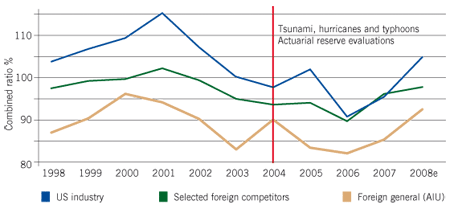
AIU’s combined ratio compares well |
The company makes profits even when claims rise |
 |
Source: AIU, AM Best, various market sources |
Some of AIU’s commercial competitors tell Euromoney that their key challenge in dealing with corporate customers desperate to conserve scarce cash in a recession has been convincing them of the wisdom of continuing to pay for insurance cover at all. Walsh agrees it is tough to sell new forms of cover and that customers are searching as never before for value for money but also sees an increase in corporate risk aversion as a potential benefit. “Companies that might previously have been prepared to take the potential hit from a large event and cope with it through their own earnings may now be much less inclined to absorb such a risk,” he says.
It is against this uncertain business background that Walsh must strive to establish AIU as the leading name in the general insurance world. It helps that American International Underwriters is one of the oldest parts of the AIG group of companies. It helps too that it comes into life as a business of great scale, with 44,000 employees, deploying 500 insurance products to 40 million commercial and individual customers in more than 130 countries and jurisdictions. If it was entirely separated from AIG today, it would rank 54th in the Forbes 500 list of the largest companies in the US, with shareholder equity of $43.4 billion.
Walsh says: “We’ve rung the bell on this so many times but it’s worth repeating that as a regulated entity our capital is separate from the parent company and protected. Regulators simply would not allow us to operate without more than enough capital and resources to settle claims.”
The disentanglement of the operating businesses from the rest of AIG is complicated, especially in countries where AIU shares premises, support staff and IT with other AIG group companies.
When Walsh spoke to Euromoney in late March, this disentanglement had been under way for just over two weeks. He says: “We can’t just flip this around in a few weeks or even six months. Our first step will be to deliver a plan around the divestment to the Federal Reserve so that when we do go public this will be a company we can be very proud of. As soon as practical, we will put together an independent board of diverse, high-level people from around the world to demonstrate a serious step towards full independence. And while this business will remain a part of AIG until the IPO, that board will be empowered to govern this company as an independent entity.”
No doubt prominent in the investment case the arranging banks will eventually put to potential investors in the IPO will be the 10-year track record of AIU’s combined ratio: a key profitability measure of the percentage of premium income paid out each year in settling claims and in the costs of running the business. This rises and falls in line with the incidence of catastrophes, notably hurricanes, but AIU’s is usually lower than that of its benchmark peers in the US and international property and casualty insurance sector.
Is that enviable outcome the result of judicious selection and pricing of risk, or scale efficiencies in managing other operating costs? “Very much the former,” says Walsh. “Different insurance companies set up their shops in different ways, some to emphasize premium income. We take a very serious, technical view of underwriting risk and have an absolute discipline so that by line of business, product, even every account, we must make a profit on everything we do. We made a $1 billion underwriting profit last year at a combined ratio of 92.5% and while I would not have been happy with that in previous years, I was for 2008.”
Last year, following a couple of benign years for insured losses since hurricane Katrina in 2005, in which capital was attracted into the insurance sector, storm damage inflicted heavy losses, forcing some of AIU’s US competitors into combined costs higher than their premium income.
Those underwriting losses at some insurers have coincided with capital losses and reduced income on many insurers’ investment portfolios. The outlook for the industry is troubled. Walsh says: “I don’t see a lot of capital coming into insurance, which is different from previous periods when rates have hardened – and the cost of insuring against catastrophe, especially in areas vulnerable to wind damage, is really ramping up now.” Even as he starts work on AIU’s eventual IPO, he senses that other insurers will be coming to the equity capital markets before he does and to an uncertain reception. “We will see more entities raising capital. If they have a good business proposition and respected management, they will be OK.”
As the long countdown to AIU’s IPO begins, what disadvantages does Walsh see to breaking away from AIG? “Given all that’s gone on in this past period, I don’t see any,” he says. “This is all positive for every one of our constituents, including staff and customers.”