When fund managers and property analysts tag property returns in the UK and some other European jurisdictions as the worst ever, it’s no wonder investors are seeking to cut their losses. Last year, UK commercial property values dropped by 26%, according to IPD. In the fourth quarter there was a record 14% decline. With the outlook for 2009 looking uncertain at best, some institutional and retail investors still in property have reconsidered and want out.
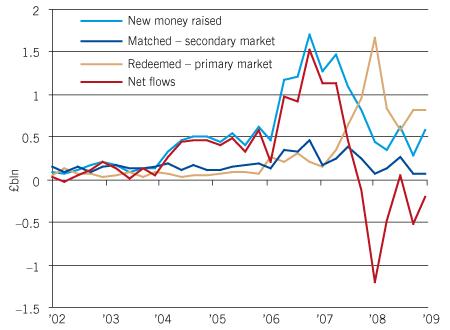
The rush for the exits started in late 2007 when in the UK alone £1.6 billion (then $3.1 billion) left commercial property funds. Fund providers moved to limit the damage by freezing redemptions for three to six months. The latest round of disheartening results has prompted some to renew this strategy. The FTSE Real Estate index was down 46.6% as of year-end 2008 and the IPD Balanced Property Unit Trust index was down 26%.
UK all-property total returns were the lowest ever recorded for a quarter at minus 12.8%, according to the Jones Lang LaSalle UK Property Index as of the fourth quarter of 2008. This translated into annual total returns of minus 21.2% for 2008.
Already this year large UK pension providers Scottish Widows, Standard Life and Aviva have announced suspensions to redemptions in some of their property offerings. Last year Scottish Equitable, Friends Provident, Morley, UBS, Schroders and Deutsche Bank’s RREEF introduced similar measures to stem outflows in a market where liquidity was scarce.
German funds ran into the same problems in the fourth quarter of 2008 when institutional investors in need of liquidity divested. Early in November nearly €30 billion-worth of German property funds, managed by such companies as Axa, Morgan Stanley and UBS, froze redemptions. German property experts say some of the panic has subsided and cashflows have turned positive.
Closing funds to redemptions might seem a drastic step. It’s a strategy that certainly generates negative headlines, suggesting investors are being locked into bad investments against their best interests. Halting redemptions is not ideal for those investors seeking immediate liquidity but it’s a way of managing outflows that balances the interests of those selling and those remaining in the fund.
“Redeeming investors want their money back as soon as possible,” says Rachel McIsaac, chief executive of the London-based Association of Real Estate Funds (Aref). “The manager of the fund has a legal duty to look after the interests of both exiting and remaining investors. Selling property as fast as possible to satisfy exiting investors’ needs is not always in the interest of remaining investors, and managers have done extremely well in the last 18 months to manage both sides of the equation.”
Especially now, when it’s a less than ideal time to sell properties to raise cash to repay investors, freezing redemptions buys fund managers time to liquidate assets in a orderly manner and even convince investors to stick with their fund.
“Some funds agreed to redeem investors, but said because we are not able to sell assets at the prices marked in our book, we will have to redeem at a price quite far below NAV,” says Julian Schiller, director and head of indirect investments at Jones Lang LaSalle in London. “They altered the bid-price mechanism of the redemption price to dissuade investors from selling and make it fairer on those staying with the fund.”
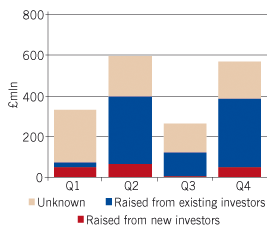
Property fund flows aren’t all one way. While fund outflows from member funds of Aref totalled £791.5 million in the fourth quarter of 2008 that was down on the same period in 2007 when £1.65 billion exited property funds. Aref’s 67 member funds took £568 million into pooled property funds over the fourth quarter of 2008, nearly double the previous quarter’s total and 33% more than in the fourth quarter of 2007.
Poor performance might be the main factor behind retail investors’ desire to leave property funds but for institutional investors it’s not as straightforward.
 |
“Some investors need their liquidity back under their own management” Timo Tschammler, DTZ |
“The motivation behind selling orders is different,” says Timo Tschammler, managing director and head of international investment at DTZ in London. “Some investors have their own liquidity issues. It’s not important to them if an investment is good or bad. They need their liquidity back under their own management because they might have lost liquidity elsewhere.” There are other reasons not necessarily related to performance that investors may cite for withdrawing funds.
“In some cases investors view cashing in units as the least bad option, not because they want to,” says Andrew Smith, chief investment officer at Aberdeen Investments in London. “They like to be able to reposition portfolios going through a cycle. Normally what would happen as the market starts to turn is they’ll want to cash out of one sector and buy into another. Lately they’ve been restricted from doing that.”
Poor timing
With so many investors redeeming, funds are faced with serious liquidity problems and in this market selling properties to meet redemptions is problematic. Halting redemptions and applying penalties to those investors cashing out allows fund managers to go out to investors on the fence and convince them that getting out now might not be such a good idea.
“Some investors believe that although they have given notice to the fund manager that they want to redeem that’s not a clever thing to do in this market,” says Smith. “What you’re doing is sending signals to the manager that they must sell at any price into a market at the deepest trough that most people in the industry have ever worked through. The fact that investors are tending to sit tight is probably a defensive strategy given the severity of the downturn.”
So ironically the depth of the downturn and the difficulty of disposing of assets might have gone some way to help fund managers cope with the rush of redemptions. They might be in a tight spot from a liquidity point of view but the argument against selling at the bottom of the market is compelling.
“Once the rush is over I’m sure you can go to a pension fund and say: ‘Look our investment is safe and this is why you should reconsider your position,’” says DTZ’s Tschammler. “The freeze of three months or so is a long time and circumstances can change.”
Property analysts have begun to speak of value in the sector, underscoring the opportunities available to those with cash to put to work. Especially in the UK, where values have dropped off so significantly, some believe there isn’t too much further to go before the market starts to turn around.
Fund managers also point to property’s performance relative to equities as another reason investors ought to stay put. According to Aref, pooled property fund total returns were minus 18.7% quarter on quarter as of year end 2008. Compare that with real estate equities, which returned minus 34.3% over the same period. Over the past decade ending in December 2008, pooled property funds have posted an annualized return of 6.8%, compared with 5.7% from gilts and 1.2% from equities. The numbers back up what fund managers say property investing is all about: steady, long-term growth.
“Investors have gone into real estate because of the diversification as well as lack of volatility,” says JLL’s Schiller. “Real estate will never be liquid in the direct market and therefore on the fund level it won’t be either.”
Requests for redemptions have hit closed-ended funds as well as open-ended ones, which has prompted some to suggest changes might be in order in terms of how vehicles are structured and managed. Closed-ended funds typically lock in investors over a period of up to seven years while open-ended funds can be bought and sold in units. Both fund types are unlisted vehicles.
Liquidity at a price
Closed-ended funds were never meant to be quick-trading vehicles. Liquidity was only meant to be available at a price. The perception of these vehicles altered during the boom time as investors rushed to deploy cash, thus creating an illusion that liquidity was readily available.
“There has to be a reassessment of expectations with closed-ended funds,” says Schiller. “They had been temporarily quite liquid because of the wall of money coming into the market. People changed their expectations slightly, then the market changed and there was no liquidity.”
AREF members: New money raised in 2008 |
 |
Net flows of AREF members |
 |
Source: AREF/ IPD |
The closed-ended fund industry needs to address the ways investors seek liquidity and the risks involved. This could be addressed through refining or redefining the processes investors have to go through before investing and better managing expectations around the ability to trade out of funds. “Most investors go into closed-ended funds knowing they will be in for the term, therefore the bumpy ride during the course isn’t that important: it’s that they are going in and out in seven years,” says Schiller. “What happens in the intervening time is important, but it’s less relevant, because investors know they’re in for the term.”
Closed-ended funds have tended to be more highly geared than open-ended funds, which in the downturn means the volatility on fund pricing has been magnified. Schiller and others expect new closed-ended funds to feature much less gearing, which could address return volatility and keep investors in the funds for the duration.
“Discussions about new fund launches at the moment are almost exclusively looking at 100% equity with no debt in the first instance,” says Aberdeen’s Smith. “Maybe funds would have the capacity to gear up when more normal conditions return but that would happen at much reduced levels.”
Another trend Schiller expects to see is an increase in joint ventures where there are fewer investors.
“It could be a joint venture between two or three large investors rather than a closed-ended fund with many investors. Where there’s a small group in testing times it’s easier to work together to solve issues,” he says.
In addition, some of the larger pension funds and life companies might seek to invest in more club-type vehicles that would feature a smaller investor pool. Some of the bigger investors that have done closed-ended funds might also look at investing on a separate account basis.
Open-ended funds also face the challenge of better managing liquidity and redemptions that might permit them to be more defensive in times like these. So far, the freezing of redemptions has helped fund managers stem outflows and handle the best interests of those exiting and staying in funds. Managers might, however, want to explore ways of managing fund flows on both ends of the equation.
“Once everything calms down the first talks about restructuring will be around the structure of your investors,” says DTZ’s Tschammler. “How many retail investors and how many institutional investors will you allow in the fund? Do you cap the maximum investment per investor? Do you operate with notice periods? This will be the big discussion around restructurings.”
To a certain extent funds’ challenges were born from the big increase in popularity for indirect property investing. Investors were drawn to these offerings to tap into the benefits of property without the hassle of direct investing such as illiquidity, large lot sizes and the challenges of managing physical assets. That could change, despite the battering that property values have taken.
“Contrary to the trend of the last five years, there’s been a lot more discussion recently that perhaps direct property investing isn’t such a difficult thing to live with after all,” says Smith.