Post-bubble Vietnam faces a maturity test

The liquidation of a prominent equity fund capped a tough year as the country’s stock index slid from one of the decade’s top performers in Asia to one of its worst. Lawrence White examines the market’s lack of depth and breadth, and how to fix it.

BEAT SCHURCH OFFERS a wry explanation about why he is running Indochina Capital Advisers’ equities division despite a background as a chief financial officer. “I’m the only one left,” he says. The office seems busy enough but Schurch is referring to the fact that the firm’s two senior equities investment officers departed after shareholders voted in September to liquidate Indochina’s equities fund.

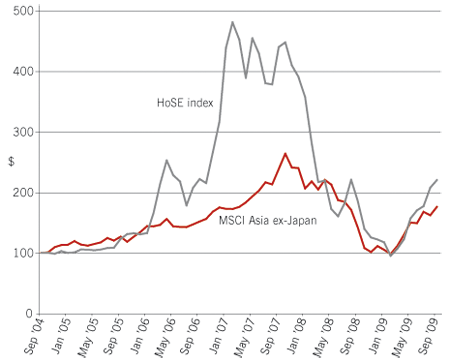
The decision followed a 12-month battle among shareholders of the London-listed fund over whether it should be saved – possibly in partnership with rival Dragon Capital – or liquidated, having suffered heavily as the country’s Ho Chi Minh stock index continued a plunge from its peak of 1,106 in October 2007 to as low as 242 in February this year.

The bubble bursts

Performance of Ho Chi Minh stock index vs MSCI Asia (ex-Japan), ‘04-’09

Source: Bloomberg/VinaSecurities

At the time of the interview in early October the index had recovered to about 580 and Schurch was quick to stress that Indochina’s real estate funds are still very much in business and performing well. He believes, as do most of the fund managers and bankers interviewed for this story, in what many of them call Vietnam’s “secular growth story”. The country is growing fast, its people are young, hard-working and increasingly keen to spend their earnings. Although there are still concerns about inflation, the government’s stimulus plan has got banks lending again, while most remaining foreign investors are, like Schurch, cautiously optimistic about Vietnam’s prospects. Why then did one of Asia’s best-performing stock markets over the past decade so quickly become its worst performer in 2008? If the country is still full of growth and opportunity, why are its equities markets in such a mess?

Two casinos

More than one market participant in the city’s hubs of Hanoi and Ho Chi Minh uses the word casino to describe their respective exchanges. Dominated by local retail investors chasing short-term profits, the markets are volatile and vulnerable to self-reinforcing trends sparked by gossip, data leakage and speculation. At the height of the recent bubble, the market’s ascent was boosted by an influx of foreign capital that has now largely gone, as Thomas Lanyi, a director at private equity fund Mekong Capital, explains. “A lot of the short-term money has left the country,” he says. “In its heyday, a long list of investors bought into Vietnam; it was an exciting frontier market, people had heavy exposure to the Bric countries [Brazil, Russia, India and China] and were looking for the next new thing. We had weekly meetings with hedge funds and private individuals wanting to invest in Vietnam. Now that what some people call hot money has gone, we’re left with the people with long-term strategies who view this as a perfect time to invest.”

Another investor describes those that have abandoned Vietnam post-bubble as “financial tourists” and says their departure is good for the health of the market. This steadier investment climate might make for greater stability in the longer term but most local bankers and fund managers agree that what the market really needs is an acceleration of the long-awaited privatization of the state-owned banks and utilities.

“Equitization of the state-owned enterprises is very important because it will bring much-needed breadth and depth to the market”

Tom Tobin, HSBC Vietnam

Tom Tobin, HSBC Vietnam

“Equitization of the state-owned enterprises is very important,” says Tom Tobin, chief executive of HSBC Vietnam, “because it will bring much-needed breadth and depth to the market. There’s a pipeline of around 1,000 companies wanting to go public in Vietnam; the banks and the larger state-owned enterprises (SOEs) are willing to go public… it’s just a matter of when.” Neither Tobin nor Mekong Capital’s Lanyi can provide confirmed dates for IPOs of state-owned companies. Lanyi says, though, that offerings of private companies are picking up, with at least two firms that Mekong invests in due to go public by the end of this year. The lack of a public timetable for SOE privatizations is a concern but Adrian Cundy, head of research at Ho Chi Minh City-based broker VinaSecurities, says the problem is more complex. “The big issue is the time between equitization and listing,” he says. “It’s hard for investors, even closed-end funds, to lock up shares in equitized companies for 12 to 18 months with no clear road map to listing. The process can consume a large amount of capital with no clear guide to the valuation of the asset.”

There had been talk in the local media, Cundy says, of the state-owned telecoms companies coming to market this year or early next year, possibly in a two-phase process whereby strategic investors would be brought in for pre-IPO funding.

“Word on that initiative has gone rather quiet of late,” Cundy says. “I think we might see the strategic investor initiative take a back seat in favour of a more go-it-alone approach.”

Painful lessons

Until then Vietnam’s stock markets lack the depth and breadth that might alleviate some of the extreme volatility they have experienced lately. The country has come a long way, says an experienced foreign manager operating in Vietnam, from the days when he had to pay his staff from suitcases filled with cash because they distrusted banks so much. But Vietnam is undergoing painful lessons in the transformation from frontier economy to emerging market, with the destruction of shareholders’ assets that accompanied the bursting of the equity bubble one stark example. What more can be done to make the stock market more accurately reflect Vietnam’s economy and the investment opportunities it offers?

“Vietnam needs to focus on getting itself included in the major regional indices,” says Cundy. “That would be an important catalyst for getting the long-only institutional funds involved, bringing more stability to the market. It requires reaching a certain market cap, greater focus on the protection of shareholder rights, and more emphasis on technology and infrastructure.”

Work has begun on the latter, with Korea Exchange (KRX) announcing on October 8 that it had won a contract to upgrade 13 systems on both the Ho Chi Minh and Hanoi stock exchanges. KRX claims the work will improve “trading, market surveillance, disclosure, sharing of information, clearing and settlement” among other areas.

That’s no guarantee of success, however. KRX has also worked on the Mongolian and Cambodian stock exchanges; the former is moribund and the latter still to open after multiple delays. Neither outcome is necessarily the fault of the Korean exchange but creating a healthy and useful equity market requires more than the latest technology.

Gold standard

One fundamental problem for Vietnam’s stock market is the perception among local investors that equities are a more speculative investment than, say, gold. Ly Xuan Hai, chief executive of Asia Commercial Bank (ACB), says: “Gold is the savings instrument in Vietnam, it’s a kind of currency, it’s used in property trading and is very popular as a hedge against inflation. In 2004 we became the first bank in Vietnam to allow paper gold trading, and since then it’s been a stable source of profits.”

During the recent stock market collapse, says Nguyen Duc Thai Han, head of treasury at ACB, “as the equity markets were in disarray a large number of investors jumped into the gold market. It’s also interesting to note that, while shorting of stocks is not allowed in Vietnam, it has been possible since 2007 on our trading platform [the first ever in Vietnam] to take a short position on gold without physical delivery being necessary.”

Investors in Vietnam buy into the stock market when it’s climbing but both locals and foreigners tend to move into other asset classes very quickly at the first signs of trouble.

“It’s not a good time for long-term equity investors in Vietnam,” says Pham Chi Quang, head of fixed income at Vietcombank, “because the market is pretty speculative. There’s a definite shift from stocks to other asset classes, mainly real estate, which is seen as being safer because it is supported by more sustained demand and is viewed as an effective hedge against inflation.”

As the demand for stocks wanes, issuing them becomes a less attractive means of raising capital. That’s not a problem for established companies in Vietnam at the moment, thanks to a government initiative to subsidize interest rates for qualifying borrowers. These companies are able to secure a 4% subsidy on the rate at which they borrow from banks.

Beat Schurch, Indochina Capital Advisers

“There’s huge potential for Vietnam’s financial sector. The biggest chance would be to kick-start the equitization of the banks. Government by proxy of the financial system is not efficient”

Beat Schurch, Indochina Capital Advisers

“We began lending again at the beginning of this year,” says ACB’s Hai, “and view the government’s stimulus package as a clever solution to the economic situation. Cutting interest rates would have put pressure on the dong to depreciate and have made the dollar shortage more severe; raising rates would have obviously harmed companies that need to borrow. The decision to subsidize borrowing has proved effective but the next step is of course to try to boost domestic consumption.” More bubbles?

The stimulus package has been effective in boosting borrowing but some market participants are worried that the money will find its way into the stock market, possibly creating another bubble. Local bankers say there’s no direct evidence of this happening yet but note with unease the high levels of credit being extended to retail clients and the heavy use that is being made of the borrowing subsidy.

When the manufacturers and exporters making use of the subsidy recover, the theory goes, they might continue to borrow more than they need and divert the excess funds into investments in stocks and real estate. There’s concern among Vietnam’s financial professionals about the possible return of high inflation as a result of these issues, and most agree that the solution lies in promoting real economic growth.

Indochina’s Schurch says: “There’s huge potential for Vietnam’s financial sector, a vast untapped consumer market, but people don’t fully trust the banks yet thanks to past government policies that claimed their cash or added zeros to the currency. The biggest chance for Vietnam would be to kick-start the equitization of the banks. Government by proxy of the financial system is not efficient.”