No big bank in the US and Europe has proven to be immune to the financial crisis. Some, though, are bearing up better than others. One such is Standard Chartered, the emerging markets specialist, which is quickly growing its wholesale banking business.
Since January, the bank has embarked on a hiring spree in both its global markets and corporate finance units, of a kind more commonly seen in times of economic boom than bust. Big name hires this year include Mohammed Grimeh from Lehman Brothers to run trading for the Americas; David Douglas, also from Lehman, to be global head of equity capital markets; Ronnie Potel from Citi to be global head of convertible bonds and equity-linked origination; Henrik Raber from UBS to head the European capital markets business; and Brent Eastburg, as the new global head of credit trading from Ravenscourt Capital Partners, where he ran a credit hedge fund.
Over the past six months Standard Chartered has also bought a number of portfolios and businesses around the world. In April, it acquired an aircraft-leasing portfolio from GE; in February it bought equities specialist Cazenove Asia in Hong Kong from JPMorgan; while in December it added oil and gas M&A advisory boutique Harrison Lovegrove to the group. Before that, in November, it acquired Lehman Brothers’ business in Brazil.
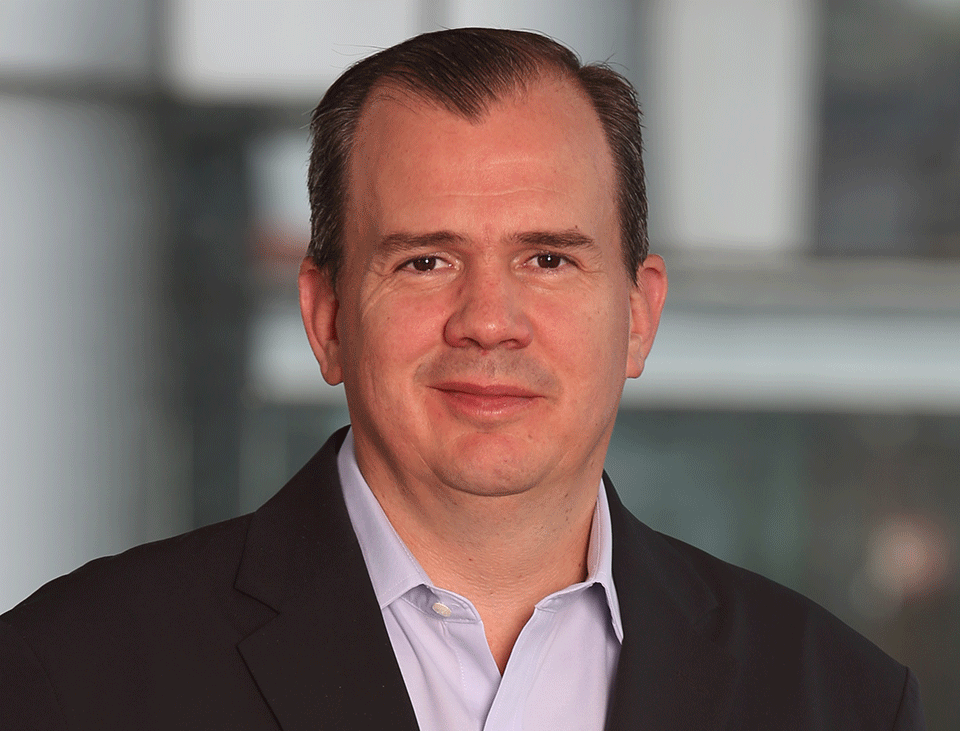
Mike Rees, chief executive of the wholesale bank, says this growth stems from good planning and a strong culture that’s developed over the past five years. “We’re the bread-and-butter bank,” he says. “We’ve got the basics and the discipline right and that creates opportunities.” In contrast, many other banks are struggling to keep hold of their best employees and are selling assets to raise much-needed capital.
Although the acquisitions might suggest otherwise, Standard Chartered’s main focus is on organic growth. Acquisitions only play a complementary role. “We’ve consistently said that organic growth is the key driver for us,” says Rees. “Therefore in wholesale banking the real challenge is: how do we accelerate organic growth?”
A large part of the answer appears to lie in hiring senior bankers. “If you get talent it becomes a magnet for more talent,” says Rees. “Winning teams attract talent, and we have the opportunity to make a difference and create a legacy.”
He says, though, that a hiring spree does not mean a spending spree. “We’re very focused on managing our cost growth in line with our income growth.”
In 2008, the wholesale banking division’s income jumped 43% to $7.49 billion while its operating profit before tax increased 28% to $3 billion (the group made a gross operating profit of $4.57 billion in 2008, up 13% on the previous year). “We can invest on the back of strong revenue growth,” says Rees.
One indication of the turnover within the wholesale bank is that, of its 13,500 employees, 30% have been there less than a year. That includes staff at its recent acquisitions.
Many of the bank’s latest hires have been in the cash equities, equity derivatives and commodities businesses. These are the areas where the global markets team led by Lenny Feder is focusing more of its attention. But Rees adds that core areas such as the foreign exchange and rates business will need more people too.
The bank’s growth is geographic as well as product-based. In April it opened an office in Frankfurt, which serves as the European clearing hub for the bank. It plans to open an office in Angola soon too.
This geographical spread provides its own challenges. “We are in 75 countries with 46 dealing rooms. So complexity for us is about location, it’s about cross-border. It’s not about doing the 28th-generation derivative,” says Rees.
One claim that rivals are making against the bank is that it could be forced into write-downs on debt exposures in Asia if economic growth in the region continues to stall. Rees, though, is confident. “I’m not going to talk about individual exposures,” he says, “but you don’t see me sitting on the edge of my seat. We’re comfortable with the relationships we’re in.” He adds that, while the group’s total assets rose by 32% last year, its risk-weighted assets only increased by 1.9%.
As for whether the bank will face any nasty shocks in the future, he says: “No one is perfect. There will be surprises but you have to anticipate as much as you can.”