Palestinian banks: resilient but underemployed
Palestinian stock exchange: ‘We never closed’
SUMMITS COME AND summits go but it was quite something to be at the first Palestine Investment Conference in Bethlehem in May. The investments committed at the event, which Palestine’s prime minister Salam Fayyad put at $1.4 billion, were significant but it was the conference’s very existence that held the real importance: 1,500 delegates, 500 of them from abroad, congregating on the West Bank to talk about investing in it rather than shunning it.
The world wants Palestine to work. That’s evident from the $7.1 billion of donor pledges to the Palestinian Territories (the West Bank and Gaza) made at meetings in Paris in December. The theory is that a stable and economically viable Palestine, eventually in the shape of an independent state, would defuse one of the most volatile flashpoints of the Arab world.
But what sort of economy could Palestine be? It has been in a mess since the second Intifada, the uprising that began in 2000, prompting the imposition of stricter security measures and a withdrawal of donor support and of any foreign private sector investor interest. Per capita GDP fell by 40% between 1999 and 2006.
There are, though, signs of a brighter future. The economy turned modestly positive in the second half of 2007 and is expected to continue to grow in 2008. The optimistic view is that this is the time to get in. “The Palestinian economy is like a coiled spring, a spring that has been pushed down and down and down and is ready to bounce back,” says Ronald Cohen, founder of UK venture capital firm Apax Partners but attending the conference in his role as chairman of the Portland Trust (and, as a Cairo-born former refugee of the Nasser administration, well disposed towards Palestine’s plight). “If you look at Palestinian GDP per capita over the last seven years, the curve goes down like this,” he says, motioning steeply downwards. “That is the spring that is capable of surprising the world economy.”
Portland Trust is an example of the vast donor goodwill that has risen for Palestine in recent years (and, as Cohen puts it: “I speak as someone who comes from the private equity world. We are not given to exaggeration in terms of results.”) One can barely move for big-ticket commitments from the developed world. The Department for International Development (Dfid, an arm of the UK government) is here in force; so is PEGASE, the new European mechanism for support to Palestinians, and USAid. Over here are the Danes, revitalizing agricultural services; over there are the Italians, with a credit line facility for small and medium-sized enterprises through soft loans. Even on Manger Square, where Christians come to see the place of Jesus’s birth, the Peace Centre next to the Church of the Nativity was funded by the Swedes.
From this part of the funding world, the message is powerful. “A growing economy able to provide opportunities and jobs for the Palestinian people must be at the core of a lasting peace process,” says World Bank group managing director Juan José Daboub. “While the difficulties of investing here must be acknowledged, the rewards can be significant.”
Robert Mosbacher, president and chief executive of Overseas Private Investment Corp, which is in for $250 million of a $500 million affordable mortgage scheme with partners including Dfid, is similarly enthused. “If you wanted proof of our commitment to this region you can’t get better proof than the fact that we are providing 25-year mortgages at fixed rates,” he says. “That says somebody is confident with what is happening. We are deeply committed and confident that these mortgages are good solid credits.”
Gulf money
It’s a big step from there to bring the foreign private sector in. But that $1.4 billion, which Fayyad says should translate to 35,000 jobs, includes landmark deals involving foreign money, chiefly from the Gulf. The biggest was the confirmation, after much delay, that Israel would free the frequencies for Palestine’s second mobile phone operator, to be set up by Wataniya Mobile. This company is owned by Wataniya International, which is majority owned by Qatar Telecommunications Company (Q-Tel). The project is expected to involve $650 million of investment over the next few years. Gulf money is also committed to construction, with Qatari Diar Real Estate Investment Corp signing up with a Palestinian group, Bayli, to build a planned community – Palestine’s first – north of Ramallah.
|
“The Palestinian economy is like a coiled spring, a spring that has been pushed down and down and down and is ready to bounce back” |
 |
Gulf liquidity is the prize Palestinians need to target: there is the affinity in language and culture, the widespread sympathy in the Arab world for the Palestinian situation, the abundance of petrodollars looking for a home and the scale of the Palestinian diaspora, much of it still in the Middle East. Consequently, most efforts to do something new start off by targeting the Gulf. Padico, a Nablus-based, offshore registered investment holding company set up after the Oslo peace accords in 1993 and with investments from finance to agriculture and construction, is setting up a landmark $100 million offshore fund to invest in infrastructure and real estate in East Jerusalem. Padico has put in a quarter, it has secured another quarter from local and regional banks, and there’s little doubt where the rest will come from. “I think we can easily raise funds for it from the Gulf,” says Samir Hulileh, chief executive of Padico. And they won’t be investing for charity. “Participants are expected to attain above average return on investments,” he says. “That’s my firm belief.” Prime minister Fayyad is adamant that real money, chasing returns, is coming in. “This is private sector, not funded by the PNA [Palestinian National Authority] or donors,” he says in a small briefing with Euromoney and other journalists in Bethlehem. “It’s based on the concept of investment.” He also rebuts the idea that investment in housing and affordable mortgages isn’t the sort of thing to boost economic growth. “It’s not just the immediate construction needs but all that has to come with it in terms of building materials. And we do need houses.”
Efforts to attract western funds are likely to start with the most frontier-spirited of venture capitalists. Walter Isaacson, president and chief executive of the Aspen Institute in the US, says he is working “very closely” with people who want to develop a venture capital fund to invest in the ICT sector in Palestine. Indeed, technology and communications are widely seen as the ideal sectors to invest in since they’re not impeded by freedom-of-movement restrictions in the same way that manufacturing is.
One would imagine that the investment framework would be in its infancy in this stateless, shell-pocked territory but according to the World Bank it stacks up surprisingly well. Daboub says it ranks 22nd in the world in terms of tax regimes for business, and 33rd in terms of the legal framework to protect investors. Earlier this year an amendment to income tax laws went through, giving cuts of up to 15% for people and businesses; there are further exemptions for investment fund projects. A money-laundering law has been passed, laws governing the banking sector are being drafted and a new corporate law is expected to be ratified soon. It’s certainly needed: corporate law today in the West Bank runs under Jordanian law dating back to the 1960s, and in Gaza, the law dates from the days of the British mandate in 1929.
Dispute resolution
But there are big concerns about dispute resolution. “Lawlessness has almost ridiculed or sidestepped the court system in Palestine,” says Kamel Husseini, adviser on international relations for Paltel Group, and something of a spokesman for Palestinian commerce. “Militias have taken the law into their hands. You need to bring confidence and respectability to the court system in Palestine, to rulings and their enforceability.”
 |
|
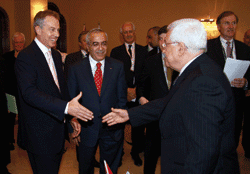
Political solutions: President Mahmoud Abbas (r) greets Tony Blair and MP Salam Fyad at the Palestine Investment Conference |
And there is a big caveat to all of this positive momentum. It’s a 360-square-kilometre caveat on the Egyptian border, and it’s called the Gaza Strip. Any Palestinian state will be made up not just of the West Bank but also of Gaza, and no matter how business-friendly and sophisticated the remarks of Palestine’s Fatah government in Ramallah on the West Bank, this government does not speak for Gaza. Hamas does and, ceasefire or not, that’s an entirely different proposition. Even in an ideal, peaceful world, Palestine would be a rather wonky state: two separate provinces, several hundred miles apart and separated by a country that fears and resents it. But without Gaza, with almost half the population, there’s no viable Palestine. The West Bank is landlocked, barring the Dead Sea, which doesn’t have a navigable waterway that goes anywhere else. Gaza is where the port should be, the inlet and outlet for goods and services. It’s where the only international airport is (or would be if the runway hadn’t been cut in half by bulldozers in 2001), and it’s the place from which Palestine can access offshore oil and gas reserves, a rare example of a saleable resource. Today, though, it is under a state of what Fayyad calls “complete siege”.
The impact on business is immense. Hundreds of containers are held at Israeli ports accumulating storage costs; unemployment is colossal and getting worse, with 80,000 workers laid off in 2007 alone; the skilled labour force is becoming more obsolete; machinery is not properly maintained and can’t be repaired because there’s no way of getting spare parts. Gaza suffers from being the exact opposite of the West Bank: a place of diminishing opportunities for a young workforce rather than credible alternatives, fuelling the sort of anger that drives people to endorse an openly hostile Hamas leadership.
Curiously, Gaza’s share of Palestinian GDP actually grew from 28.7% to 29.2% between 2000 and 2006 (even though per capita income fell from $1,166.90 to $861.68 over the same period, based on constant prices), and a recent white paper on Gaza puts required investment in Gaza construction at more than $1 billion in the next five years. But, once one gets past donor funding, who in their right mind from the private sector would commit their money here?
 |
|
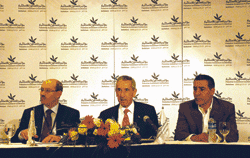
A fresh start: PIC-Palestine CEO Dr. Hassan Abu Libdeh (r); minister of national economy Kamal Hassouneh; and minister of information Ryad Malki |
“Palestine cannot thrive with its other half left underdeveloped and unattended, because it will always pull it down,” says Husseini. “You cannot assume a rosy picture in the West Bank and ignore Gaza.” Even in the West Bank, restriction of movement is a big issue. Mohammed Kamal Hassouneh, minister for the national economy, says business could increase by 30% with full freedom of movement. “Everything would be developed if we were free on crossing points,” he tells Euromoney. “All of our private sector suffers from the restricted movement of people and goods.”
All things in time, though: Israelis have fears for their own security and it is hoped that a viable West Bank will give Israel enough comfort to begin to ease the restrictions. Israeli investors did attend the Bethlehem conference and there are signs of some willingness among Israel’s business community, if not its political lobbies, to engage. “We are lobbying the Israeli business community, which is a vocal and important player,” says Husseini. “They will benefit from an environment where Israel is perceived as a neighbour rather than an occupier.”