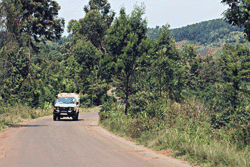
WITHIN MINUTES OF taking off and flying north from Johannesburg airport, people, houses and roads dwindle into fields almost the size of English counties. It is not long before the fields disappear altogether, and nothing is left but grassland, peppered with trees, occasionally rising hills, and long, meandering rivers. The empty landscape extends largely the same for thousands of kilometres, until the Sahara, or the rainforest, makes it even more remote.
Is this the world’s largest untapped banking market?
Economists estimate that less than 10% of the potential market in sub-Saharan Africa has a formal banking relationship. But despite the remoteness, sub-Saharan Africa is in the midst of an unparalleled baby boom. UN demographers expect the population to almost double to 1.5 billion by 2040.
As such, even with the difficulties, foreign and local groups alike in east, west and southern Africa are rapidly expanding their branch networks outside the metropolises where they have tended to huddle up to now. But how can commercial retail banks secure a profitable foothold in such undeveloped, sparsely populated areas?
Bear in mind that while India, for example, has around 250 million more people than all 53 countries of Africa added together, Africa’s surface area is around 10 times India’s. Many countries in sub-Saharan Africa have just one or two surfaced highways. Only a third of the population live in cities, and slightly less live in places with electricity.
It is hardly surprising, then, that outside South Africa, sub-Saharan Africa as a whole has only one or two bank branches per 100,000 inhabitants. India has around 10 times as many.
The fashion for microfinance in aid work might be one reason why commercial banks are waking up to this market. European banks in Africa must be seen to help the poor – as must democratic African governments, which foreign and local banks need to court. But with regional growth above 5% for the past four years, more Africans are using money. Microfinance outfits, meanwhile, have proved profits can be made from even the poorest borrowers.
From Barclays in Zambia, to Guaranty Trust in Nigeria, BCP in Mozambique, and Standard Bank in the Democratic Republic of Congo, commercial bankers are trying out new ways to open up these new retail markets. Radically innovative banking methods and technology are being used to service communities that have previously been completely ignored, and whose financial weight could not possibly provide adequate reward to more traditional branch-based banking.
Yet despite the advances in will, technology, and method, many questions remain. For example, is the chosen new method really so much cheaper? When, if ever, will people who have never had a bank account get used to using one, especially if the nearest branch manager might work hundreds of kilometres away? And most important: is there a true banking market out there at all?
Buried treasure
It is an amusing, if slightly absurd picture.
João Figueiredo is on one of his periodic trips to rural Mozambique. He is investigating the possibility of establishing the first bank branch in a cotton-growing district named Morrumbala, in the central province of Zambezia.
A cotton company employee takes Figueiredo to visit the farmers. Careful not to stretch his normally pristine suit trousers, Figueiredo sits down on the dusty dirt floor of the mud hut of a patriarch, who for his part is dressed in a loincloth.
After the necessary formalities, Figueiredo explains to the man that he is the chief executive of a bank, and what a bank is, and what a CEO is. Eventually he asks the man if he has any savings.
To Figueiredo’s great joy, the man digs out from the soil near his hut an old tin can that contains, on counting, $2,000 in local bank notes. “I never thought he would have so much,” says Figueiredo back in the comfortable headquarters of Millennium BIM, a subsidiary of Portugal’s BCP.
Figueiredo hopes there are many more such tin cans, and thousands of such farmers will learn to entrust their notes to the bank, rather than to the soil. He is not alone: BCI Fomento, the Mozambique subsidiary of BCP’s rival in Portugal, the government-owned Caixa Geral de Depósitos, plans to open 45 branches in the next three years, most of them in rural areas. BCI Fomento is opening 10 rural branches this year alone.
Such an expansion for a bank like BCI Fomento, which only has about 40 branches, is radical enough. But concentrating on rural areas might seem crazy when around three-quarters of the wealth in Mozambique is concentrated in the cities (as the head of a microfinance firm in Mozambique estimates).
Still, around three-quarters of Mozambique’s population of 21 million live in rural areas. Most of the country’s 300 bank branches are located in the main cities, with a disproportionate amount for the population in Maputo, the capital. Mozambique is slightly bigger than Turkey but fewer than half of its 128 administrative districts have any bank branches at all.
Millennium BIM, therefore, which is Mozambique’s biggest bank, plans to open some 30 new branches by the end of next year, and more afterwards – often in rural areas. With only about 20 of Millennium BIM’s 90 branches in rural or semi-urban areas today, 24 of its new branches for 2008 and 2009 will be out of town.
“We are the ones that address the needs of the lower income people. The turnover of the microfinance companies is nothing compared with what the country needs. They are complementary to our services,” says Figueiredo, when talking about a scheme that allows his customers to borrow as little as $100.
Banks, or payroll departments?
But it would be wrong to infer that Millennium BIM is chasing the poorest, most remote subsistence farmers. Like BCI Fomento, when it goes to rural areas Millennium BIM concentrates on farmers who are employed by, or at least sell to, corporate clients.
“Anchor companies provide a market and the communications, energy and water infrastructure that we would not be able to build on our own,” says a spokesperson for BCI Fomento.
Only one of Millennium BIM’s new rural branches will be on its own; 12 will be with anchor companies.
Another 11 will be in poor suburbs, where the aim is to encourage people in the informal sector to use banks (the central bank estimates that 50% of Mozambique’s economy is in the informal sector). These so-called semi-urban branches are usually prefabricated, using materials such as steel and wood, to keep the costs down. They are located in places such as markets, where informal traders congregate.
But do people in rural areas need banks?
Branches with anchor companies sometimes seem in danger of becoming little more than payroll departments. Last summer, for example, Millennium BIM opened the first branch in Xinavane, a southern Mozambique town of about 6,000 people, most of whom work for a sugar cane plantation. Xinavane Sugar Company has started paying salaries through bank accounts. But the branch manager at Xinavane says: “People don’t earn a lot. Normally they withdraw all the money the day after they receive their salary. The money doesn’t stay long in the bank.”
 |
|
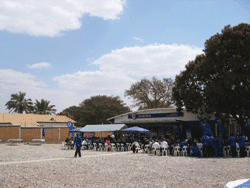
Stanbic, part of the Standard Bank group, offers low-cost access to banking for regular wage earners |
Both Millennium BIM and BCI Fomento reply that the strategy of going outside the cities is a long-term investment. People need to get used to banking, they say, but it is now that they are choosing their banks. “At the moment we are just building the infrastructure, both physical and human. We will do the balance in five years’ time,” says Figueiredo.
Grassroots banking
Barclays is eager to stress its commitment to the unbanked in Africa. But the reality is that the bank is focusing much less on rural areas in Africa than are Millennium BIM or BCI Fomento.
Nevertheless, the UK bank’s network in Africa as a whole has roughly doubled since 2006 to about 450 branches. In Botswana, Tanzania, and Zambia, Barclays has focused in particular on using cut-price, semi-portable Express branches, which can be built around shipping containers. It has set up about 70 Express branches across Africa since the beginning of 2007, including five in Zimbabwe.
In an effort to widen its customer base in Kenya, its biggest African centre outside South Africa, Barclays has reduced the basic monthly charge for a transactional account to less than $2. The bank has reduced the minimum monthly income requirement to $50. Two years ago, Kenyans had to earn three times that amount to qualify for an account with Barclays.
Similarly, in countries such as Malawi and Uganda, where Standard Bank has a large retail banking business, the South African group offers minimum account-opening requirements of as little as $7, monthly account maintenance charges of as little as $1, and loans as small as $150. But depositors must usually have a regular salary.
“We want to have a blend of lower- to upper-income customers,” Marius Wait, head of retail at Standard Bank Africa, tells Euromoney. But he adds: “We often reach the lower-income market through using our relationships with our corporate banking customers.”
Throughout sub-Saharan Africa, Standard Bank has about 2,000 schemes with large employers such as mines, hospitals or plantations, where salaries are paid directly into Standard Bank accounts, sometimes allowing payroll lending.
Wait is less keen to set up branches in plantations and mines. He prefers to open accounts through a temporary promotional desk, then install an ATM or give money through a point-of-sale terminal in a shop.
The South African lender is also experimenting with the use of semi-portable, prefabricated branches. It opened one in July in a provincial town in the Democratic Republic of Congo.
But it is perhaps inevitable that the banks most committed to servicing poor, rural clients – and the banks most successful at doing so – are often local groups.
 |
|
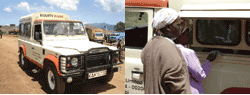
Equity Bank’s mobile banking service is heading into ever more remote areas |
Kenya’s Equity Bank, for example, has become something of a celebrity in the world of African banking. It took advantage of branch closures by Barclays and others during the 1990s and is now the biggest bank in Kenya by market capitalization – far bigger than Barclays Kenya. It is expanding regionally too. Unlike most foreign banks, which tend to start at the top of the market and work down in a fairly piecemeal manner, Equity Bank began as a rural microfinance institution. Now it is regulated as a commercial lender and has a growing number of corporate clients. It is becoming a universal bank.
Thanks to interest rates and transaction costs far lower than those of other Kenyan banks, Equity has some 2.6 million customers: 47% of all bank accounts in the country. Some 800,000 new customers joined the bank in the first seven months of 2008. But James Mwangi, the chief executive, is not overly grateful to charitable lenders, who he says have demonstrated that profits can be gained from small-scale rural borrowers.
“Using microfinance as a vehicle for aid is not a sustainable model. The charities can’t get the scale that is needed. They distort the market, and create dependency,” he says.
Cows as collateral
“Discipline and Hard Work” is the motto of Grace Primary School. It is one of the few scattered buildings that make up the verdant Rift Valley village of Kitiri, Kenya. But the main centre is a wooden barn where farmers’ milk is stored and sold, and where the cattle feed is kept.
No buses come to Kitiri. The nearest town is a two-hour walk away. During the rainy season, the road turns into a quagmire, forcing the farmers to pour away their milk, or transport it on donkey carts to town, through the middle of the night.
But even in the rainy season Equity Bank goes there, swapping its normal mobile banking car for a more powerful four-wheeled-drive vehicle.
 |
|
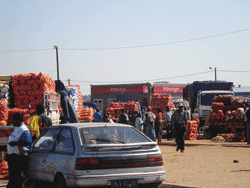
Millennium BIM has adopted a long-term strategy outside the cities |
In essence, Equity Bank’s business is not very dissimilar to that which Millennium BIM will do in cotton-growing districts such as Morrumbala. The main activity in Kitiri is to pay the farmers for the milk they have sold to the milk processors (the average monthly deposit in the area is about $30). But Equity Bank has some innovative approaches to lending. For example, it will buy a cow for a farmer, provided he or she can provide a fifth of the amount upfront (about $70). The farmer then pays back the money with the milk, with the cow acting as collateral.
Also, rather than simply dumping a shiny new branch in the middle of Kitiri, Equity Bank drives there around every other week to pay the farmers what they are owed. Two bankers go in one of Equity Bank’s 54 four-wheel-drive cars that have been converted into banks. Two armed guards and a driver accompany the two bankers. Inside the car are two windows to act as counters, a lockable drawer for the money, and a laptop charged by solar panels.
The car, which serves about 4,000 farmers, drives from the nearest main branch in Naivasha three days a week to a satellite branch set up two years ago in Engineer, the nearest town to Kitiri. It serves another satellite branch powered by car batteries at a small town nearby for the other two days, going to outlying villages such as Kitiri when the farmers need paying.
Equity Bank has about $335,000 in outstanding loans to farmers around Naivasha, with non-performing loans at about 7%, according to the Naivasha branch manager, Peter Karuga.
Five years ago, the car serviced Naivasha from a base in Kenya’s fourth-biggest city, Nakuru. But thanks to growing numbers of clients, in January next year even the Engineer outlet is to be converted into a six-days-a-week, permanently staffed, on-line branch.
Karuga says this will allow the banking car to spend longer in more remote areas: little by little servicing ever more isolated villages.
Crossing frontiers in West Africa
Mobile banking trucks in one form or another are becoming more common throughout the developing world, from India to Iran. Millennium BIM, in fact, was also considering using mobile banking vans to access rural customers (the chief executive rejected the idea because of the security risks, and other concerns). In Nigeria, Guaranty Trust Bank also distributes and takes deposits from the back of trucks.
By far the biggest sub-Saharan African country by population, Nigeria has the potential to be the most important retail banking market in Africa. But even in Kenya, whose population is 37 million compared with Nigeria’s 135 million, there has been more of a focus on retail banking than in Nigeria.
Sruti Patel, an analyst of Nigerian banks at Renaissance Capital, estimates that less than 10% of Nigerian banks’ lending goes to the retail segment, because of the rich pickings available in corporate banking. But, she says, the fast-growing middle class in Nigeria has fuelled higher demand for access to credit.
“There is a scramble for deposits in Nigeria,” she says. “Expanding the deposit base is crucial because many of the banks are fast approaching the 80% loan/deposit ceiling imposed by the central bank. Banks have increased their capital base by about $11 billion last year. That will enable them to move out of the traditional centres of Lagos, the capital Abuja, and Port Harcourt, in the oil-rich delta region. Now banks are looking at smaller cities, across Nigeria, for their branch expansion plans.”
Elsewhere in West Africa, however, another home-grown African institution has also developed, like Equity Bank, creative methods, adapted to difficult consumer-banking environments.
Ecobank has started deploying banking kiosks: shelter-like structures with a window, serviced by two people, which can be hauled on to the back of a truck, travelling as satellites from a central bank branch.
The kiosks often follow rural markets, which often operate in a local cycle, going to one town on one day, and another, 40 kilometres away, the next, and so on throughout the week.
“We have a strategy in the retail bank to take banking to the people. Thanks to the improving economic climate, there is an opportunity to reach out to the unbanked and bring them into the formal sector,” says Patrick Akinwuntan, Ecobank’s executive director for retail banking.
Ecobank, which was established in 1985 in the small francophone country of Togo, built its business on servicing the trade routes and people flows between West Africa’s many countries, most of which are within one of two single-currency zones.
Whether it is pineapples being traded from Benin to Niger, cotton from Burkina Faso to countries with seaports, beef from Chad to Lagos, or petrol from Nigeria to Niger, Ecobank now wants to service smaller as well as larger merchants, and more migrant workers too.
The bank already maintains branches on borders, and in truck parks. But with the banking kiosks, as well as other schemes, it wants to push deeper into West Africa’s trade belts, closer to the end producers and consumers.
Ecobank already has about 100 banking kiosks in operation, in 12 West African countries. The plan is to double the number of kiosks in the next few years, eventually extending their use to all 25 African countries in which Ecobank operates – and that now includes states outside West Africa, such as Malawi, Kenya, Rwanda, Burundi and the two Congos.
Banks in the air
It is not only in sub-Saharan Africa that technological advances have made serving poorer, remoter banking customers a more attractive option.
But even using banking kiosks on the backs of trucks might not be radical enough to bring more than a small minority of people in sub-Saharan Africa into the banking system. Indeed, in Kenya, one financial service provided by a mobile phone company, not a bank, has surpassed even Equity Bank’s reach.
M-Pesa, or mobile money in Swahili, has gathered 3 million registered users since beginning operations just one-and-a-half years ago. It enables customers to send and receive small amounts of money with their mobile phones.
 |
|
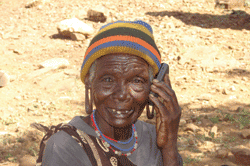
Cellphone banking could be the next step |
Sometimes people leave money on their mobile phone account – at any one time there may be around $40 million in the M-Pesa trust kept by Safaricom, the mobile phone company that runs the scheme. Normally people empty their phone accounts in two or three days; however, of the $2 million or so credited to M-Pesa every day, usually around 90% is transferred back straightaway. M-Pesa has not made Safaricom any profit yet. But UK mobile phone company Vodafone, which owns 40% of Safaricom, has helped set up similar schemes to M-Pesa in Afghanistan and Tanzania, and it plans to reproduce the M-Pesa model in India too. Unsurprisingly, retail bankers often mention mobile phones when talking about their efforts to reach potential clients in poor rural areas of Africa, a continent where mobile phone usage is growing rapidly.
Yet some bankers say M-Pesa should be monitored more closely by the Kenyan central bank. Mwangi of Equity Bank says schemes using mobile phones to bring financial services to poor people in rural areas are better when the customer has to have a bank account – such as in the joint venture between mobile phone company MTN and Standard Bank in South Africa.
Equity Bank is in fact the biggest external agent for M-Pesa money transfers. But Mwangi says: “M-Pesa has been done the wrong way round. We should have provided the product, and Safaricom should have provided the infrastructure.”
Satellite technology is ideally suited to sub-Saharan Africa’s undeveloped road system and huge distances between people. But M-Pesa in some ways illustrates the limits of banking here. Indeed, Michael Joseph, chief executive of Safaricom, says the success of M-Pesa is partly due to the very fact that it does not require people to have a bank account.
“Regulation would be the death knell for M-Pesa,” he says. “M-Pesa is for people who don’t have the wherewithal to open a bank account: the proof of address, the money for banking fees. A lot of people live from hand to mouth in Kenya. The banks probably wouldn’t lend to them anyway. M-Pesa is true banking for the unbanked.”