Financing the cities of the future
Cutting data centre carbon emissions
Masdar: Abu Dhabi aims for first zero-carbon city
Amman: An ancient city looks to the future
Dongtan: China firms up eco-city proposal
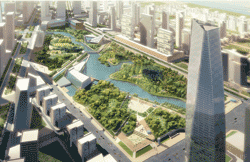
Are eco-cities for the future or of the moment? Originally conceived as a technology and media city, New Songdo City was supposed to position Korea as a centre for research and development. In the mid-1990s the tech boom was turning to bust and that, combined with the 1997-98 Asia crisis, during which the Korean economy nosedived, put an end to plans for a technology paradise.
The project was reborn in 2001 as a free economic zone aimed at keeping Korea competitive with China and Japan. But in the aftermath of Korea’s economic woes, the IMF required the country to accept more foreign direct investment – even in the property sector. That provision permitted the Gale Company to step in with ambitions to build a North Asian business hub to compete with the region’s established commercial centres, while reducing environmental impact.
On paper, New Songdo City appears idyllic from an environmental point of view. Its buildings will be constructed to a minimum silver old Leadership in Energy and Environmental Design (Leed) standard with a 100-acre park at its centre. The 1,500-acre site will feature several forms of public transportation – buses, a metro system and electric water taxis plying their trade on the city centre’s saltwater canal network.
“With any city that has an ideal city quality or aspiration to it, it’s going to be beyond what one can achieve within the acreage of the city; if it works it will be a paradigm,” says Jamie von Kemperer, principal at Kohn Pederson Fox, the New York-based architects responsible for the city’s master plan. “It’s a worthwhile effort because it will give us a living example of an experiment.”
Fitting with its ecological aspirations, the most current thinking is being applied to waste-water management. Water is a large part of environmental opportunity and cost, so having the advantage to build a system that conserves water and saves the energy it takes to clean it makes a huge difference to a city’s sustainability. Underneath the New Songdo City a network to recover grey water has already been built. It takes grey water from cooling towers and routes it to other grey water functions to be reused.
On top of transport and waste-water management, recent projects in New Songdo City are being fitted with cogeneration plants, which capture the heat released in the production of electricity for deployment elsewhere. It is argued that cogeneration also provides for more efficient energy delivery because it doesn’t have to be transported. For New Songdo City that adds up to a higher degree of carbon neutrality.
But will New Songdo City develop into a place where people want to work and live or will it become an environmental theme park?
“When designing a city which is built quickly, how do you avoid it becoming a sterile place? That’s a big challenge,” says von Kemperer.
The developer wants New Songdo City to be more than a bedroom community (it is 65km away from Seoul) or an office zone. So part and parcel of the grand plan will be cultural attractions, including an art museum, an opera house and an ecoterium. The school and hospital are being developed and branded through relationships with internationally renowned brands in education and medicine, Milton Academy and New York’s Columbia Presbyterian.
“The idea was to make a perfect small integrated city where you could find everything within only 1,500 acres,” says von Kemperer. “It’s the size of Greenwich Village and Chelsea, but in that small area you could find the best education, entertainment, business, culture, exercise, medical treatment – a fully fleshed out variety of functions.”
Beyond the technology aimed at limiting the city’s environmental impact, New Songdo City will change the way people live, which for some will mean leaving behind habits of a lifetime. Like billions of others around the world, Koreans prefer the car for commuting. It is hoped the public transportation network, which will include a bike-sharing programme similar to Paris’s Velibre, combined with a street plan designed to encourage walking, might lure inhabitants out of their cars.
The plan for the central park is also a radical departure for city planning in Asia, where the city centre is generally given over to business purposes or a public monument such as Beijing’s Forbidden City or Tokyo’s Imperial Palace. A green space created solely for communal usage is relatively rare in Asia’s cities, and Songdo City’s park will be a unique space where its inhabitants can seek recreation.
As for being a city for today, rather than the future, New Songdo City’s planners have already made provisions aimed at avoiding urban sprawl and overdevelopment. There are larger zones outside the city limits where complementary developments will be undertaken within the strict guidelines drawn up by the developer. And the Gale Company has the obligation to stay involved as master developer to oversee New Songdo City’s future.