Financing the cities of the future
Cutting data centre carbon emissions
Masdar: Abu Dhabi aims for first zero-carbon city
Amman: An ancient city looks to the future
New Songdo: Korea rethinks urban development
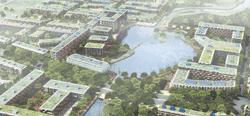
On January 19, UK prime minister Gordon Brown and Shanghai mayor Han Zheng watched the signing of a landmark memorandum of understanding in Shanghai. At stake is a model for building eco-cities in China: a step to bring environmental sustainability to the country that arguably presents the gravest threat of all to the local and global environment.
The focus of this ideal is a place called Dongtan, which sits on Chongming Island in the mouth of the Yangtze river near Shanghai. Here, the Shanghai Industrial Investment Corporation (SIIC), Arup, HSBC and Sustainable Development Capital (SDCL) have agreed a partnership to work out how such a city can be planned, funded and built – not just in Dongtan, but elsewhere in China and around the world.
SIIC engaged Arup in 2005, with HSBC and SDCL joining along the way, but it is the signing in Shanghai that really gives the clearest signal that Dongtan is actually going to happen. But what exactly will it be? And why is it being built?
“One of the things we were concerned about with Dongtan was who was going to go there,” says Jonathan Maxwell, chief executive of SDCL in London. “If you’re going to create a population, what is it that they are going to do?
“And the other question is: so what? So you put 10,000 people in a sustainable community with low carbon emissions and with quantum changes in efficiency. So what, if it can’t be applied to other cities? There are 10 million rural workers every year leaving the countryside for the cities of China.”
Maxwell’s challenge is to work out a way to make the city commercially sustainable rather than symbolic but ultimately impracticable. “There are two levels to that,” he says. “One is to look at it as a real estate and infrastructure development, and how to make that a commercially viable proposition that is attractive to investors and secondary developers. The other is to look at methods of financing that align the right sources of capital to the kind of project this is – a long-term development scheme.”
The solution the partners decided on was to centre Dongtan on education, devoted in particular to studying the links between the economy and environmental degradation (numbers as high as 12% have been quoted on the impact of this phenomenon on Chinese GDP growth, he says), and to the technological solutions to those problems. The model of Harvard and MIT in Cambridge, Massachusetts, is very appealing here: an economic cluster has grown around the business components of Harvard, while technology businesses have clustered around MIT. “And all of a sudden, Dongtan is there for something slightly bigger,” says Maxwell of the impact of this decision. “One, it’s an interesting investment proposition because you know who you’re building your assets for, and, two, it starts to have a resonance beyond itself.” This, in particular, was part of the appeal for the UK, an exporter of education and financial technologies. The January 19 memorandum of understanding followed one signed the previous day between China and the UK government to foster “collaboration and mutual learning” between Dongtan and the London Thames Gateway area, another area of planned development for environmental sustainability.
Each business has an important role to play in taking things forward: SIIC, an investment holding company owned by the Shanghai municipal government, has assets (HK$50 billion – $6.4 billion) and of course the ability to drive local momentum. Arup is the designing and engineering brains of the operation, long active in China, and involved in several Olympic Games landmarks in Beijing. HSBC’s overall credentials in banking are obvious, but less well known is the $100 million partnership it set up with four environmental charities to fund research and development on climate change. And SDCL specializes in building financial structures to make these projects workable.
The financing is what comes next, and today it’s at the question stage. “Is this going to be financed locally through local bank finance, through public sector finance, internationally through the capital markets? What types of institutions and lenders will be involved? That’s why we’re here for the next few years,” says Maxwell. He says it’s too early to draw any conclusions about likely structures but does say: “The cost of the first phase is in excess of a billion pounds, so you’re going to have a relatively open view of how you go about financing it. But obviously it’s going to be local capital and I would have thought there will be international capital.”
Dongtan today is secondary farmland, on an island dominated by environmentally important wetlands. Getting there is a tricky process involving ferries (a bridge and tunnel should open next year); nobody lives there permanently. It is hard to imagine that by the time the World Expo takes place in Shanghai in just two years’ time, the demonstrator phase will be up and running, with up to 10,000 people living in a city with a 60% smaller ecological footprint using 66% less energy than a typical business site of its size. And that’s just the start: by 2020 it should accommodate 80,000 people, and should have been joined by 50 new cities in China built with a new-found enthusiasm for sustainability. “Sustainable development has got to happen,” says Maxwell. “It needs to happen on a huge scale and it needs to be commercially viable.”



