Asset management in the GCC: A market worth watching
A compelling opportunity for asset managers
Saudi strategy: going it alone or finding a partner?
Three hubs to serve a thriving market
Fixed income, equity, local and international assets – a demand for all
Shariah-compliant market tests perceptions
It has long been accepted that the Gulf needs a financial hub. It’s an increasingly important market on a world scale, oil and sovereign wealth make it more relevant than ever, and it fits naturally within the European and Asian trading blocs. But the Gulf has not one potential hub, but three.
For 30 years this was Bahrain’s unquestioned role. “When I worked in Bahrain in 1982 there was no question it was the centre of finance in the Middle East,” recalls Daniel Smaller of Algebra Capital. Linked to Saudi Arabia by a causeway, and barely an hour’s flight from Kuwait, it benefited from the relative difficulty of accessing those far bigger markets directly, and acted as a convenient and well-regulated hub for those wanting to do business in or with the region. When turmoil hit Beirut in the 1970s, the business came to Bahrain and stayed.
Abdul Rahman Al Baker, executive director of financial institutions supervision at the Central Bank of Bahrain, believes there are several reasons for the country’s popularity. “One is our legal framework: it has been in place for 15 years and has proven it is able to cope with changes in the market,” he says. “There is investor confidence in the system here. We have been a financial centre for 35 years. And the standards that we use in our regulations and legal framework for collective investment undertakings [CIUs, investment vehicles such as mutual funds] are in line with international standards.” The lack of any taxation on investment products also helps. “What you earn is what you get,” he says.
Last year Bahrain introduced a new and updated regulatory framework for its mutual fund industry including rules for CIUs targeting professional investors. For investors with enough assets, this has allowed for the arrival of hedge funds and other alternative investment vehicles in Bahrain. It also categorizes investors by assets and experience, and allows different classes of products to be sold to each. This appears to have been a large part of the reason for the increase. “As a regulator you need to see what’s going on in the market, and try to revamp regulations to be in line with the changes,” Al Baker says. “We took the initiative by introducing these new categories. Previously most of these [hedge and alternative] funds were not registered in the region but outside. Our new regulations are attracting a lot of existing asset managers from the region to set up here instead.”
Bahrain, unlike newer competitors, operates under exactly the same legal code in its financial institutions as in the rest of the country. There is no designated plot of land in which separate laws and regulations apply (the Bahrain Financial Harbour, the gleaming centrepiece of the Manama waterfront, is simply landmark real estate rather than a separate regime), no separate regulator for the financial centre and no common law jurisdiction. Bahrain presents this as an advantage, suggesting that having two legal codes in one location can only be problematic; the alternative view is that Islamic law is impractical for modern commerce.
The truly distinctive thing about the Dubai International Financial Centre is that within that 110-acre plot, the legal and regulatory systems of the rest of the United Arab Emirates do not apply. Instead, DIFC is overseen by a separate regulator, the Dubai Financial Services Authority, closely modelled on the UK’s Financial Services Authority, under common law. The idea was that big global financial institutions had long had aspirations in the Middle East but had been put off by the lack of a legal code they could understand and trust, and a regulatory environment they were comfortable with. As with everything else in Dubai, the pace has been extraordinary: 30 pieces of legislation were enacted in the first three years, between them representing what one senior figure at DIFC calls “an entire body of Anglo-Saxon law”.
From an asset management perspective, many of the world’s biggest names are registered and set up within DIFC already, among them Franklin Templeton, Permal, Invesco, Man, Prudential and Schroders, and the asset management arms of international banks such as Deutsche Bank, UBS, ING and Barclays. However, very few funds are actually domiciled within the DIFC – the figure was just nine in late 2007 – which has led critics to suggest that all the DIFC has really done is become a conduit for money to leave the UAE, with foreigners simply posting sales staff in their offices rather than any manufacturing presence. In fairness, the collective fund law governing domestically domiciled funds only came into effect in mid-2006, and it will take time, and the arrival of custodial and fund administration services in Dubai, before it will make sense for many groups to domicile funds there. At the moment, there is no obligation for foreigners active in Dubai to domicile funds there, so most instead keep their funds in the Cayman Islands, Channel Islands or Bermuda as they always have done. There is some speculation, though, that in time foreign groups will be required to domicile feeder funds locally which then feed into offshore products.
From the outset the DIFC has been designed to offer domicile to a wide range of products, including mutual funds, exchange traded funds, listed investment companies, hedge funds (and fund of funds), and Shariah-compliant funds. The regulatory package allows for 100% foreign ownership of the funds, no tax, no restrictions on foreign exchange or profit repatriation, and of course the world class level of supervision and regulation from the DFSA.
It is important to noted tha the DIFC does not cover retail financial services, nor transactions in dirhams; those are covered by the central bank in Abu Dhabi.
|
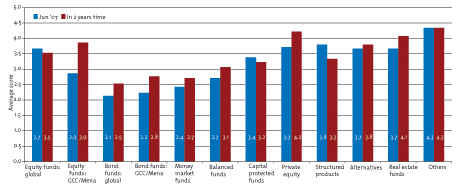
Rating of sales opportunities in June 2007 and predictions for opportunities in 2009 |
 |
|
Source: Cerulli Associates |
|
Note: Others refer to regional and specialist funds, direct investments in real estate and infrastructure and Islamic cash alternative (5 = high demand, 1 = low demand) |
Qatar has its own highly ambitious programme to build a financial centre, though its aim is rather different from that of Dubai. Its intentions are to build a centre that is very much onshore: it wants international financial institutions to establish operations on the ground in Qatar. In the Qatar Financial Centre’s own words, it wants them to participate in the long term and mutually beneficial partnership with Qatar. It is often explained in terms like these: that Qatar is not primarily aiming to become a regional financial hub, but if its structure enables it to become one, so much the better. The legislation to establish the QFC was enacted in March 2005. There are four distinct components to the Qatar model: the QFC Authority, which is responsible for commercial strategy and for developing relationships with the global financial community, among other groups; the QFC Regulatory Authority, which supervises financial services firms and financial institutions operating in or from the QFC; a civil and commercial court; and a dispute resolution body.
Initially, the legal model was similar to that in Dubai: the QFC operated on common law principles while the rest of the country had its previous, Islamic legal code. Also as in Dubai, the QFCRA tried to adopt best practice from regulatory authorities elsewhere in the world, and again bears a lot of similarity to the UK’s FSA. However in July 2007 it was announced that a single financial regulatory body would be established, bringing together the regulatory functions of the stock exchange, central bank, and QFC Regulatory Authority, and some regulatory responsibility for insurers that had resided within the Ministry of Economy and Commerce. A chairman and board for this new body should be announced soon.
The QFC aims to foster a number of centres of excellence, hoping that clusters of firms will develop in those areas, which in turn may develop into a regional hub. Insurance is one example, and another is asset management. Collective investment regulations for wholesale and retail funds have been enacted over the past 12 months. It is hoped that managers will domicile their funds locally, which has not happened at this early stage, but a new tax regime that came into effect on 1 May may help: it exempts any locally domiciled funds from tax. Many fund managers have in any event chosen to set up in Qatar. Among them are Axa Investment Management, Global Investment House, EFG-Hermes and Kuwait Financial Centre.
Axa was already in the region through the insurance arms of its business before selecting Qatar as the centre of its investment management advisory and client services for the region. Axa, like many others in the region, had historically managed its Middle Eastern business from London and Paris, and had reached a point where it made sense to be on the ground.
“Location was not the only issue; we did want to feel comfortable with a strong regulatory environment and we were very impressed by the QFCRA,” says Scott Callander, director, Middle East, at Axa Investment Management. “The logistics of moving around the region are very good, and by the nature and dispersion of our clients we’re not tied to any one city in the GCC.”
Some homegrown institutions are appearing too. One example is Qatar Capital Partners, formed last year with a focus on venture capital. “The opportunities are huge in Qatar,” says Mikko Suonenlathi, general manager at Qatar Capital Partners. “The things QFC is driving are corporate governance and transparency, and I think that’s exactly the right agenda. Once you get to the highest possible international standards it will make it into an even better investment environment.”
Qatar’s regulatory environment is still coming together, though much of the most important legislation is now in place. For example, the regulations for limited partnerships – vital for any private equity and venture capital business. “That’s a significant step forward,” says Mikko. But every step forward is a new one. “It’s pioneer steps that I’m taking,” says Mikko. “But with the overall environment here it’s a good time to take those steps. Three years ago it was too early; three years later is too late. Now is the time to enter a new market.”