SELECTING THE BEST company in Asia has never been an exact science. As the region’s main growth area moves away from export industries and increasingly towards service-based and consumer-driven markets, the performance of companies across a broad range of industry sectors reflects that trend. Although some will find their growth rates slowing and profitability harder to come by, others will benefit from increased demand and liquidity. Regional factors also enter the equation. The ever-swelling force of China is being felt across Asia and worldwide. Companies with a strong presence in China are feeling the benefits over those that lack it. The erupting numbers of technology users are providing a boon to those telecoms companies quick on the uptake, while the swiftly growing demand for housing and office space provides ample opportunity for property firms to get their fill. In December Nasdaq became the latest global exchange to open an office in Beijing, joining rivals such as the New York Stock Exchange in benefiting from recent rule changes. Nasdaq drew 19 initial public offerings of Chinese companies this year, double its 2006 figure.
In the light of the many factors beyond the control of the average chief executive, the Euromoney poll of Asia’s best companies attempts to seek out the companies that are the most effectively managed and investor friendly in all of Asia.
With that in mind, the poll reveals that the best company in Asia by a distance is Sun Hung Kai Properties. The Hong Kong property development company comes first in every category of the poll for which it is eligible. Across all of Asia, it has the most coherent and convincing business strategy, the most transparent accounts, the best corporate governance and the most accessible senior management. It even claims the title of having the most useful and informative website. Sun Hung Kai is cashing in on China’s expansion. It has some 45.8 million square feet of property developments in China, the vast majority still under development. The company has said it will invest a further Rmb33 billion ($4.5 billion) into mainland China in the next three years, bringing its total investments in the region to Rmb77 billion.
The money will be used to cater to China’s growing number of wealthy citizens looking for office buildings and residential apartments, and a large part of the funds is being raised through an offering of 72.5 million new shares at HK$150.75 ($19.40), raising up to $10.9 billion. Sun Hung Kai elected to issue shares rather than borrow from a bank because loan terms are high, making issuance cheaper than borrowing.
Although some have accused Sun Hung Kai of being late to the game of regional expansion compared with rivals such as Hang Lung and Henderson – and of missing a trick by failing thus far to structure its first real estate investment trust – Euromoney’s poll indicates that this is a minority opinion. “Sun Hung Kai’s delivery of business results has been consistent with the strategy the company sets,” says one analyst. Another praises Sun Hung Kai’s “good business focus and streamlining of existing operations to maximize returns”.
Transparency and access
Sun Hung Kai’s commitment to transparency is embodied in its five-year policy on land bank replenishment, allowing investors to inspect the business’s pipeline. This investor service extends to access to Sun Hung Kai’s senior management. Interestingly, the category of accessible senior management is one that other companies that have otherwise scored well in the poll have slipped up on. China Mobile, the world’s largest mobile telecommunications provider by subscribers, comes second to Sun Hung Kai in the categories of most coherent and convincing strategy, and most useful and informative website. However, the poll points to 138 companies that offer better access to their senior management teams. Similarly, PTT, the Thai oil and gas company, comes second for transparent accounts and corporate governance but falls well short in granting access to its own management.
|
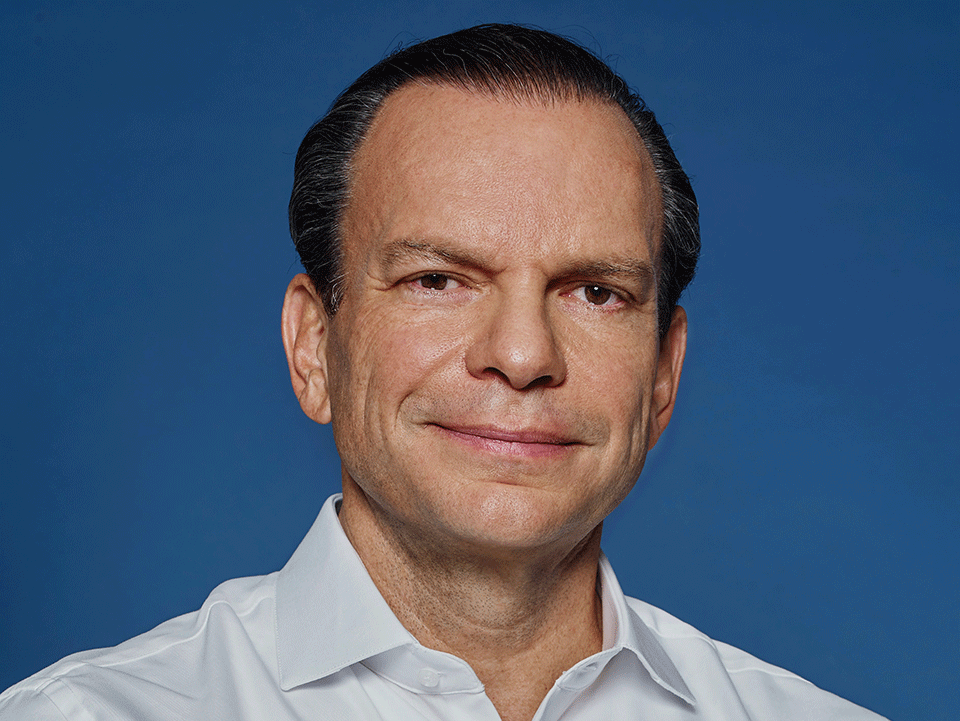
Analysts praise Walter Kwok’s Sun Hung Kai for consistently delivering on its promises, good business focus and maximizing returns |
 |
One company that does share Sun Hung Kai’s commitment to providing access to its upper echelons is China Telecom, which comes second in the category. The world’s largest land-line operator by subscribers holds two meetings with investors and a media conference every year, as well as a night-time conference call with its international investors. China Telecom regularly roadshows across Asia, and even holds its annual shareholder meeting in Hong Kong rather than Beijing, to cater to its larger investor base there. “[China Telecom] has an excellent and responsive investor relations department,” says one investor. “It has a transparent and professional management with a clear strategy.” That strategy is being tested. The growth of China Telecom’s traditional business as a fixed-line operator is slowing. This is partly because of market conditions but is also a result of the company’s changing business model. The company is aggressively transforming itself into an integrated communications service provider. “For the past two to three years, the company has undergone a strategic transformation of its model,” says William Li, senior manager at China Telecom. “We must transform ourselves, or our financials will suffer.”
It would appear that the change is going well. China Telecom barely featured in last year’s poll of Asia’s best companies; this year it is one of its stand-out performers. New business already accounts for 35% of the company’s overall revenues, and its swift growth rates cover the slowing fixed-line business and then some more.
Sky the limit
China Telecom’s new business includes internet access provision. Overall broadband usage in China remains low, at around 4% of its population. But that still means 60 million users, second only to the US. The growth potential is beyond immense, and China Telecom stands to receive a further boost when the government makes its expected announcement to endorse fixed-line companies operating mobile services.
China’s mobile subscriber base is already the largest in the world, at more than 450 million, and is set to multiply further. To enter it means taking on China Mobile, which itself has more than 300 million Chinese subscribers. It is also branching into other regions and services. Early this year, China Mobile bought Pakistan’s fifth-largest mobile phone carrier for $284 million, and announced a joint venture with Google so users can search the internet on their mobile phones. It has launched new services such as crop price updates, and supplies music downloads through a service arranged with Universal, Warner and Sony. “China Mobile has a very clear strategy that it is following through,” says one investor. “Its consistent earnings growth is driven by the straightforward execution of that strategy.”
Other countries in Asia are experiencing similar growth in the telecoms sector, and companies are cashing in. The mobile subsidiary of KT Corp, the South Korean landline operator, has joined with Japan’s NTT DoCoMo to pay $200 million for a 33% stake in Malaysian telecom company Umobile. Although the mobile markets in Japan and Korea are comprehensively penetrated, Malaysia’s, like China’s, is not.
Increased investment in Malaysia will please Public Bank, which is already pointing to an improvement in Malaysia’s financial environment. There are a lot more developers, projects and demand than ever before. “There has been an improvement in consumer sentiment over the past year,” says Wong Jee Seng, senior general manager at Public Bank. “With better inflows on portfolios, that sentiment continues to turn.”
Public Bank is one of the highest-scoring banks in the poll. Interestingly, there are more banking and finance companies among the poll’s top scorers this year than last year. Also in the top 10 in the category of most convincing and coherent strategy in this year’s poll are Taiwan’s Fubon Financial and Cathay Financial, and China Merchants Bank.
But Public is not looking solely to its promising domestic market for growth. In the past 12 months, the bank has quickened its pace of entry to other markets, such as Hong Kong, where Public sees particular opportunity. “The Hong Kong banking environment has traditionally been very hard,” says Wong Jee Seng. “Now it is more efficient in terms of funding and improved production, and concessions have been made to banks.”
Worrisome challenges
Public, Cathay, Fubon and the other banking and finance companies in Asia are facing challenges, however. There is now a real fear that a US slowdown could have a profound impact on Asia’s fast-growing economies, the source of all companies’ growth in the region. These worries have hampered Asian stock markets recently, as investors are realizing that Asia is far from immune to the burgeoning crunch contagion. Oil prices have also been volatile. This will worry Thailand’s PTT, the only oil and gas firm among the top scorers in the poll. Like several others, PTT has shown a substantial improvement over last year’s results. It comes second in corporate governance and transparent accounts, and fourth in most convincing and coherent strategy.
PTT is also expanding geographically. At the end of November, it signed a sales and purchase of shares agreement with Egypt’s Mediterranean Gas Pipeline for $486.9 million. However, the project is not expected to contribute overmuch to PTT’s earnings; the company plans capital expenditure of $5.5 billion over the next four years. Its results in the poll show the reception that PTT’s plans have received among investors. “PTT has demonstrated a good strategy in the face of volatile oil prices,” says one. “Its efforts to become a regional multinational company look to be on track.”
With so many companies rising in the poll this year, others have fallen far in the other direction. The most notable absence from this year’s winners is PLDT, the Phillipines telecoms company. PLDT was voted as having the most convincing strategy in last year’s poll, as well as the most transparent accounts. This year, however, PLDT appears to be on hold. It should be noted that last year PLDT said that it expected earnings growth to come under pressure as it embarked on a three- to four-year upgrading of its technology, at a cost of $1 billion.
What PLDT’s movements in the poll make clear is that revenues are still the single most important factor in investors’ judgements of a company’s management. No matter the economic conditions, the market situation or the technological developments, investors will always focus on the money. Companies need to adapt to the environment and embrace change if they are to keep their reputations intact. With opportunities for gain come equal opportunities for loss. Next year’s poll will provide an interesting insight into which companies have most successfully maintained excellence in a perpetually evolving environment.