Asset management in the GCC: A market worth watching
A compelling opportunity for asset managers
Saudi strategy: going it alone or finding a partner?
Three hubs to serve a thriving market
Fixed income, equity, local and international assets – a demand for all
Shariah-compliant market tests perceptions
Nobody doubts the opportunity for foreign managers in the Gulf. But how to play it?
The key question for most foreign managers is representation on the ground. Can a successful business be run out of London or another financial centre, with representatives frequently flying in, or must a permanent presence be established on the ground? And if so, what should that presence be – just sales and relationship management, or analysis and manufacturing?
Historically, many institutions have handled the region from afar, but are starting to move resources in. UBS, for example, has had representation in the Gulf for 30 years (starting in Abu Dhabi) but on the asset management side has only recently based somebody permanently within the Dubai International Financial Centre.
“Going forward the region will need people on the ground,” says one western asset manager. “We can’t continue covering it just from London or New York or Zurich.”
Indeed, the rosters of the Dubai International Financial Centre and, to a lesser extent, the Qatar Financial Centre, are filled with the names of foreign banks, fund managers and insurers that in many cases are building a physical presence in the region for the first time.
But what are they putting there? Chiefly, it’s sales people. The priority has been to find ways to market existing product into the Middle East, and to supplement the existing sales teams from London and Geneva with people who are permanently based there.
This approach alone is already potent – not just to sell overseas product but potentially to sell GCC-focused funds as well. Haissam Arabi, managing director of SHUAA Asset Management in Dubai, expects foreign managers targeting the region, without necessarily being based in it, to be a major threat. “These groups will be able to take the lion’s share of asset gathering,” he says. “The Goldmans and Merrill Lynches with their own MENA funds managed out of London in New York don’t necessarily have the same competitive advantage of being positioned on the ground like we do, but they have geographic reach.”
In Arabi’s view, this doesn’t necessarily require them to build product teams located in the Gulf. “As for setting up on the ground with analysts, I doubt that will be the case,” he says.
But many foreign funds do believe they have to be in the Gulf to take full advantage, and not just with sales staff. Take Schroders: after opening its DIFC office about a year ago, it initially staffed it with sales people, but is understood to be considering bringing other professionals to join them now. “You are seeing more people sending down or employing analysts here,” says William Wells at Schroders in Dubai. “You’re certainly going to see sell-side analysts here from the investment banks: they see the potential of foreign investors investing in local markets, and whoever you are, you want to make sure it’s you’re research they’re using.”
|
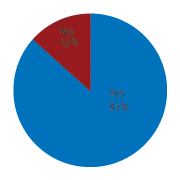
Survey respondents’ views on their presence in the Middle East, 2007 |
|
If you have an office in the Middle East, do you expect to boost your resources in the next two years? |
 |
|
Source: Cerulli Associates |
One European asset manager adds: “Originally most people, including us, put sales staff on the ground. But it’s a natural progression to see investment staff on the ground as well.” Those on the ground feel the debate has moved on from “should you be on the ground” to “what exactly should you put on the ground.” Daniel Smaller at Algebra Capital says: “Everyone now has to decide, do you make Dubai a centre for manufacturing? We think you should. When we created Algebra we felt that our competition in many ways hadn’t arrived yet.” He says that his firm’s tie-up with Franklin Templeton was done in part because “we wanted to prepare ourselves for those asset management groups who were going to view Dubai as a key financial centre and have manufacturing based there. If the competition continues to manage Middle Eastern funds out of London or New York or someplace else, we feel that being on the ground with nine analysts is quite enough to differentiate ourselves.”
The Franklin Templeton deal was a landmark, and closely watched. The US house took a 25% stake in Algebra Capital in a deal announced in September. This was an example of a multinational deciding it needed manufacturing expertise in the Middle East, but opting to get it by buying a stake in a local manager rather than building organically.
The two groups are in the early stages of working together but it has certainly helped Algebra: it has already topped $1 billion under management. “To go from zero to a billion in six months for a brand new firm that’s beginning to find its feet, you can see how much traction it has,” says Harshendu Bindal at Franklin Templeton. Partly, it reflects the fact that there are very few independents. “When you look to the MENA market and say: who can manage my money, there are only two or three,” he says. The two groups recently launched a Middle East investment product in South Korea and many more are expected to roll out in coming months.
For Franklin Templeton, it gets around any challenge of having to build local investment capability. “We view them almost like a manufacturer for us in this part of the world,” he says. “We get them to sub-advise any mandate that’s MENA-centric.”
Will others follow? Well, they’d be likely to if there was a choice of purchases. “There’s always a possibility, but there’s a finite supply of local asset managers with critical mass,” says Nick Tolchard at Invesco. “We’re monitoring the players in that space and we certainly keep our eyes open. But I would have said we were in more of an organic phase ourselves.”
Smaller thinks it’s already harder for new independents to set up anyway. “There may be a couple of others that pop up and want to start an asset management company, and who for some reason aren’t affiliated with a bank, but it’s going to get more and more difficult as the competition for people becomes tighter,” says Smaller. “There aren’t many fund managers with a lot of experience. A lot of the markets themselves only started in the last decade.”
There are, though, boutiques beginning to spring up. An example is Ajeej Capital, formed by two former investors from the Olayan Group in Saudi Arabia. “We had been investing money in the Middle East and GCC region for over 10 years, and started to recognize there was a significant gap for an independent investment manager in the region,” says Tarek Sakka, the co-founder and CEO, who also styles his business as an alternative long-biased fund which follows a conviction approach. “Basically we believe we are only scratching the surface in terms of where the opportunity is,” he says. “The Saudi market is not yet open to foreign investors; as it opens, the amount of inflows will be very substantial. This is by far the best economic cycle ever in the region, and it’s all happening while valuations are in some cases not much higher than their lowest ever position, in the worst economic cycle. We believe there’s tremendous upside potential, both from the investment point of view and as a business.”
Indeed, Saudi Arabia is the most natural place for independents to start up because of the huge volume of new licences that have hit the market for enterprises that are not affiliated with the country’s major banks (which are also the distribution network for funds). More businesses like Ajeej are likely to follow.
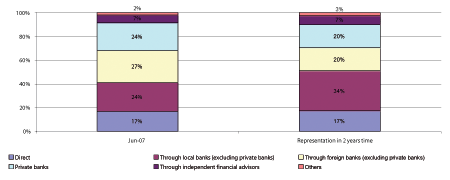
The decision on whether or not to go local will involve calculations on asset and client number thresholds. There is no hard and fast number here: some institutions have tens of billions of dollars of mandates from Gulf institutions without having a major presence on the ground, others have much less but have committed substantial resources to build further. From a distribution point of view, clearly any foreign-based business hoping to penetrate as far as retail or mass affluent needs to be in the Gulf in force, building branch networks or establishing relationships with existing distributors who can reach them. There is an increasing acceptance that high-net-worth clients and institutions should also be serviced by a presence on the ground, but so long as some GCC clients prefer to keep their money offshore there will still be plenty of scope for advisors based in Zurich or London to thrive.
|
Distribution trends 2007 |
 |
|
Source: Cerulli Associates |
Foreign entrants hoping to build local funds also need to consider what are accessible markets. It is very challenging, for example, to purchase Saudi Arabian securities; even many regional GCC funds cannot do this, although they can buy Saudi mutual funds, which is what many do. Only those with local licences in Saudi Arabia can participate in that market. Other markets are easier, but even in Kuwait, perhaps the deepest and most sophisticated stock market in the region, there are foreign ownership caps which can impede an investment strategy. Human resources is a big issue for everyone. “Every distributor, whether a private or consumer bank or a direct channel, or agencies attached to banks… they’re all hiring,” says Bindal. “They’re trying to get feet on the street and roll out plans.”
The pressure on staff is more acute in some places than others; probably the toughest hiring squeeze is in Riyadh. “Even for the most aggressive professional international newcomer, they have to recruit in what is a pretty small pool of potential employees,” says Douglas Hansen-Luke at Robeco. Even laudable efforts towards compliance have an unintended ill effect on the hiring problem. “It’s a good thing that every single company has to obey international norms,” he says. “But in a market that before had 11 compliance officers, now they need about 60. There’s a sextupling of demand for experienced, senior people. Something like that can’t be filled overnight.” Riyadh is full of people who have changed jobs three times in a year and a half and doubled their salary, at least, along the way.
Smaller says that in particular people with regional rather than country experience are a rarity. “In the past a lot of the funds in the Middle East were run at a bank, under a head of treasury, by someone who started a country fund for clients,” he says. “You had different banks in each country running country funds. Very few started money on a regional basis and that makes it that much more difficult to start up an independent asset management company. The bar has been raised: it’s going to take that many more people and it’s that much more difficult to find and pay those people.”
Local knowledge is, though, essential, not just in terms of people who know how to go and kick the tyres of local companies, but also those who understand the regulatory environment, relationships with regulators, and in particular the needs and aspirations of locally based clients.
When multinationals do decide to set up in the Gulf, one of the first decisions they need to make is where to go. The regulatory positions of Dubai, Qatar and Bahrain are outlined in a separate chapter; in essence both Dubai and Qatar offer separate regulators based on the familiar model of the UK’s FSA (or in Qatar’s case, best practice generally, but with more than a passing resemblance to the FSA); Bahrain’s central bank is (since its merger with the Bahrain Monetary Authority) still the same regulator that has been in place for decades, but is notably accommodative to foreign funds, the more so since the adoption of new collective investment undertaking laws last year. The regulatory position is altogether trickier outside those markets – see the Saudi Arabia strategy box on page 10 for more on the approaches foreign houses have taken to setting up there.
The human capital issue is perhaps easiest to address in Dubai, a city that people are generally happy to move to: it is considered vibrant and liberal to westerners and has ideal supporting infrastructure for expatriate communities, although the soaring rents there, and popularity of school places, have already become a concern. Bahrain, too, has welcomed expatriates for many years, and Doha is an increasingly liveable city too. Riyadh and Kuwait City are perhaps the locations that have the hardest time attracting people for relocation. In terms of the recruitment of skilled local staff, they are in great demand in every location.
IT, too, becomes a trickier proposition away from the hub centres; one banker bemoans that one should “truly never underestimate the challenge of installing a leased Bloomberg line in Riyadh”. Dubai’s DIFC is excellent in terms of its IT but faces a big challenge in building enough office space fast enough to accommodate the people who actually want to use it – the waiting list remains extensive and despite the remarkable pace of construction, space in DIFC and its environs remains at a premium in a way that does not afflict other centres less closely linked to a specific patch of real estate.
Naturally, new entrants don’t have to limit themselves to just one place. A recent study by International Fund Investment, conducted for the Qatar Financial Centre, found that 54% of the companies it interviewed had portfolio management in multiple locations, and 45% in just one centralized location, with some moving from one to the other. This study made some interesting findings about international fund manager behaviour. “The majority of those interviewed are not interested in locating portfolio management operations either in Qatar or in the Gulf, but are nevertheless open to the idea of developing sales operations in the region,” it said. But it added: “There is surprisingly widespread realization that the Gulf region offers fund managers a growing opportunity to raise assets, and contingent recognition that it will grow in importance as an emerging market in the future.”
The study found that the regulatory regime was the most important consideration for fund managers. “Over half the firms surveyed want to see a solid regulatory environment based on international standards, and widely recognized by investors and counterparties, not to mention the increasingly powerful compliance community,” it said. “Access and proximity to investment capital is a secondary reason fund managers would consider when opening an additional portfolio management office, or placing analysts there, but it should be emphasized that this is more appropriate as a tool for incentivising managers than the regulatory regime, which is regarded more as a pre-condition.” Cost of doing business is a third priority; “There is increasing disillusionment with the costs associated with some other centres in the Middle East, and an active quest for a cost effective alternative.”
New entrants should expect to find a competitive field. “People still think, even after 25 years, that they can walk around the Middle East with a bucket and find it filled up with cash by the time the leave,” says Smaller. “They are sadly disappointed. Most institutional business is given to those with an on the ground presence and long-term relationships.”
As one asset manager says: “It’s not that there is gold on the street waiting to be picked up; it’s an extremely competitive environment and everyone is hunting for money. If you don’t have a network and top-tier performance don’t bother booking your flight.”



