
IOs – an alternative play on mortgages

WHAT DO SANDY Weill, Lloyd Blankfein and Dan Loeb have in common with a Nascar driver, Sting and a cartoonist? There is a joke in there somewhere, for sure, but the less humorous answer is: they all bought apartments in 15 Central Park West, Manhattan. Known locally as 15 CPW, it is a “place to live graciously in New York”. With 210 apartments with views of Central Park, a 14,000 square-foot gym with lap pool, 20-seat cinema, a library, 30 climate-controlled wine rooms, suites for domestic employees, a club floor with a games room, terrace and meeting room, 15 CPW is the most prestigious apartment building in Manhattan, and in the spring the building was finally ready to be lived in. With all sales completed in March last year, 15 of the condos have reportedly already been sold on to second buyers. Some of the building’s most prestigious residents paid as much as $45 million for an apartment.
If there are concerns about the worst residential real estate slump in US history, they are not to be seen at 15 CPW. Nor in the rest of Manhattan. “We are not seeing the 20% increases in property value we have experienced the last several years and it is taking longer to shift property, but it’s not a downturn yet,” says a Manhattan real estate broker. She says the prices of condominiums in New York City are rising at about 5%. But nor are declines visible in the prices of single-family homes prices in the surrounding suburbs.
Denial of a housing crisis on Wall Street is less common than it was five months ago but there are still those who appear oblivious. “Oh yes, the real estate market in the US has really tanked but it’s not as serious as it’s being portrayed,” says a Wall Street banker. Maybe he should hop on the ferry and take the 15-minute trip across the Hudson River to Jersey City. There, a foreclosure adviser says: “There are so many for sale signs, it’s like a supermarket for houses.”
One shouldn’t just target New Yorkers – the US’s other metropolitan cities have also seen house prices rise.
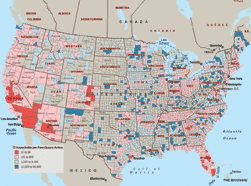
But take a car to the outer suburbs and it is quite a different story. Detroit, says a hedge fund manager, “is ground zero”. In Nevada, one in every two properties is in some state of foreclosure. But there are pockets of distressed assets, loans and securities that are ripe for investment now. Funds have been frantically raising cash ready to deploy when a bottoming of the market is signalled. Market sources estimate as much as $100 billion has been raised so far.
Where does this leave the securities markets that tanked as US sub-prime real estate collapsed?
For those funds waiting for the mortgage-backed securities market to bottom out, that time has just arrived. BlackRock’s purchase of $15 billion of UBS’s sub-prime and Alt-A mortgage debt in May was indicator enough.
|
“You have to sift a lot of gravel before you find gold” |
 |
That could be good news for the likes of MKP Capital Management, an alternative asset management firm with $5 billion under management. The firm has been investing in mortgage assets for 12 years. Tony Lembke, a principal of MKP Capital Management and, with Patrick McMahon, co-head of investing and risk management, says the market reached its low with Peloton Partners’ asset liquidation in March. The London-based hedge fund manager was forced to liquidate its roughly $15 billion portfolio of sub-prime and Alt-A mortgage securities after mortgage credit bets turned against them. “That liquidation was the bottom of the market for highly rated RMBS,” says Lembke. “And shortly after, the Fed stepped in to support Bear Stearns, effectively saying that no large financial institution would fail. That removed the systemic risk premium.” Since then, long bets on mortgage-backed securities have outperformed shorts on the ABX. But it is not a strategy suited to all managers. “Interestingly, the guys who made the sub-prime call last year were hedge funds with little mortgage market expertise or infrastructure,” says Lembke. “It was a macro call. Most of the mortgage experts actually got it wrong. The opportunities now available though do require infrastructure. There are millions of cash securities, and you have to sift a lot of gravel before you find gold.” MKP has spent years building a system that could monitor and analyse securities. “You need to be able to analyse between 50 and 100 securities every day, and each is backed by thousands of loans. Some managers will just not be able to do that.”
In addition to some funds lacking the infrastructure, one manager says lack of skill alone will prevent them from investing in distressed RMBS. “Several distressed and special situations funds are looking for opportunities in distressed RMBS assets but it requires a different type of analysis and skill,” says a hedge fund manager that toyed with the idea. “These assets are extremely untransparent. Who is the mortgage owner for every mortgage? Are they going to meet their payments? It’s too hard to know what these assets are really worth for a small fund without the adequate resources. It is not at all similar to analysing a distressed corporate.”
Don Brownstein, CEO and CIO of Structured Portfolio Management (SPM), a Connecticut-based hedge fund, agrees that the true value of mortgage-backed securities is still too vague. His firm made successful bets on the sub-prime market last year by shorting the ABX. “When we did our trades on sub-prime, triple-B minuses were in the mid 90s; now they are between 5 and 8,” he says. “Someone bought those. Triple-As were about in the high 90s, and that was considered the real value. Now they are in the 50s and 60s. So what is the value? Is it 50? Is it 90? Or is it 10? The problem with buying distressed mortgage-backed securities is simply that the information is too limited to tell what the real value is. The risks still appear to be too great for sizeable investments in distressed MBS.”
Lembke agrees that there are still risks. “We are bearish on housing, and it is not clear when home prices will bottom or what the housing market will look like over time,” he says. “So we invest conservatively in mortgage-backed bonds, and constantly survey the market so we can spot trends early and avoid landmines. You need to be disciplined.”
MBS alternatives
Pools of loans and mortgages, rather than mortgage-backed bonds, have received more interest from opportunistic investors such as hedge funds and private equity houses looking to make money from cheap assets. The leveraged loan boom was widely forecast to end badly and a lot of funds started raising capital ready for the bottom in the middle of last year. By November 2007, an estimated $70 billion had been raised to invest in leveraged pools of distressed loans, which would, given modest leverage, create $150 billion of purchasing power. Up until April, however, it seemed neither banks nor investors were quite ready to take the leap: the banks were unprepared to sell loans from originating at par that were down in the mid to high 80s, while funds were wary of buying paper when prices seemed to be heading south still. Those investors now seem to be leaving the sidelines and banks are realizing it is time to bite the bullet. In April Citi sold $12.5 billion of leveraged loans to Apollo, Blackstone and TPG. Deutsche Bank, also lined up similar types of investors to buy some of its hung loan book.
|
ESTATE OF THE UNION |
|||||||||||||||||||||||||||||||||||||||||||||||||||||||||||||||||||||
|
Foreclosure rates in the US |
|||||||||||||||||||||||||||||||||||||||||||||||||||||||||||||||||||||
 |
|||||||||||||||||||||||||||||||||||||||||||||||||||||||||||||||||||||
|
|||||||||||||||||||||||||||||||||||||||||||||||||||||||||||||||||||||
Jeff Kirsch, managing principal at American Real Estate asset management company (ARE) in Miami, is putting money to work in the loan market. His firm has recently launched two offshore investment fund vehicles that are buying up wholesale loans. “One is a fixed-income fund, the other is an opportunity fund. We think a bottom is coming in the US housing market. It’s important to get in before we reach there,” says Kirsch.
The two funds are open-ended and ARE already has commitments for $300 million on each fund. The fixed-income fund has a range of share classes, dividends and lock-up terms, with two-, four- and six-year terms with returns of 7.5%, 8.5% and 9.5% respectively. The funds will invest in first-ranking mortgages in US real estate, a substantial proportion of which will be commercial. On the opportunity fund, ARE is expecting higher rates of return. The fund will invest primarily in non-performing residential loans, where it is possible to buy mortgages at 50% of the original value.
“If we are right and we are close to a bottom – once some of the larger players come in, we will make 20% on our money overnight,” says Kirsch. “We can buy discounted loans in great parts of the country with plenty of upside potential,” he says.
Price opacity, however, is as much of an issue in the loans sector as it is in the securities market, and analysing each loan within a pool of mortgages is a time-consuming job. Kirsch is in a good position as ARE has extensive experience of buying non-performing mortgage loans and servicing them or selling them on, once the company has got them performing again. Several other funds have set up relationships with mortgage servicers, or made direct acquisitions. There are only so many servicers to go around, however, so funds that move first will have the advantage.
On the mezzanine floor
Perhaps the simplest strategy for taking advantage of the current US real estate fallout is mezzanine financing. Financing strategies have been growing among managers over the past three years but the withdrawal of liquidity for real estate developers and construction firms since last summer has opened up the market even more. For investment funds with cash, providing finance to developers halfway through a project is perhaps one of the simplest of all the real estate opportunities available at present. Joseph Nader, a partner with Miami-based Zenith Capital Partners, an investment management and wealth advisory firm, has been raising money to deploy into, among other areas, mezzanine financing. “There is a real demand here in South Florida for financing. Florida is one of the hardest-hit real estate markets in the US, and as a result banks and other traditional lenders have really taken a lot of liquidity out of the market,” says Nader. Zenith is looking aggressively at mezzanine and equity financing opportunities and expects to be putting money to work in the second half of 2008. “The traditional lenders are locked up at the moment, and developers who require capital really have no alternative than to pay higher rates of interest just to be able to finance their developments and complete them. We have seen a number of unsecured mezzanine financing projects with interest rates of 20% to 25%,” says Nader. In terms of investing directly in property in South Florida, it is still too soon, however. He adds: “There is still some further downside pressure on pricing in residential, office and raw land. We are well positioned with our clients to deploy capital when the right opportunities are identified but for the most part it still feels a bit early.”
Just when the property market in the US will bottom out is unclear. Most real estate investors interviewed for this article agree that it will be some time in the first quarter of 2009. Whether the $45 million apartments at 15 CPW will see their price deteriorate between now and then is questionable but more foreclosures on the low-income single-family homes are yet to come. It seems it is the time to invest but, in the words of one manager: “You need the best analysis possible to understand what you’re buying. That, or a large pair of balls.”



