 |
|
Deutsche Bank GECC GlaxoSmithKline EEB/TGI Bank of America |
There were few places to turn to for capital for US financial institutions as write-downs emerged and subsequently ballooned from the last quarter of 2007 on. Raising extra capital to bolster depleted balance sheets via traditional equity capital was problematic, not least because of the dilutive impact on shareholders.
Nevertheless, the circumstances were such that various banks were willing to turn to private investors such as sovereign wealth funds and private equity funds. Not all, however. Bank of America created a new, innovative preferred instrument that enabled a large capital input for itself, and changed the capital-raising landscape for other financial institutions.
Issuance of dividends received deduction (DRD) preferred stock increased dramatically as financials used this tax-efficient product to strengthen their capital base. Dividend payments on DRD securities are 70% tax deductible.
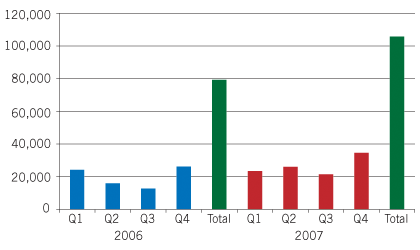
Total preferred stock including DRD preferred stock issued by US financials last year was more than $105 billion, up from just under $79 billion in 2006, according to Dealogic.
Bank of America’s total outstanding DRD preferred stock, for example, increased over 55% in 2007. “Financials needed to boost their capital base, and traditional preferred stock offered the most efficient capital-raising alternative for a number of financial institutions at the time,” says Tom Houghton, corporate funding executive at Bank of America.
But by the end of 2007, demand from traditional DRD investors waned, eliminating most of the historical pricing advantages. More important, the historical $500 million to $1 billion deal sizes were not large enough to address most financial institutions’ substantial capital needs. It was a similar story with the retail preferred market, where the size of transactions is also limited.
Rather than look to third-party injections of capital, as a number of its peers did, Bank of America decided to innovate. “We were fortunate in that we have a very conservative liquidity philosophy and strong capital base,” says Houghton. The bank tries to maintain two years of operating liquidity in reserve. “Having flexibility in a challenging market allowed us to take time and consider innovative alternatives,” says Houghton.
Although it did not suffer write-downs as large as some of its peers, Bank of America nonetheless had additional capital needs. The preference was to address those needs in the most efficient market, which meant tapping the institutional fixed-income investor base. Traditional investors in DRD preferred stock are banks and certain money manager accounts.
|
Preferred stock issuance skyrockets in 2007 |
|
All preferred stock issuance by US financials |
 |
|
Source: Dealogic |
“We looked at the structure of the traditional DRD preferred deals and tried to alter it in the simplest of ways to appeal to the broadest subset of the institutional market,” says Kyle Stegemeyer, head of client solutions at Bank of America.
The structural innovations were intended to enhance the liquidity of the security by making it more debt-like to investors. In addition, the structure enabled investors to have some comparison with traditional fixed-income instruments so as to compare pricing and performance. The main alterations included changing from a $25 par security to a $1,000 par security; altering dividend payments to be semi-annual with accrued dividends rather than quarterly with embedded dividends; and applying a debt Cusip number as opposed to the traditional preferred stock Cusip number.
The changes might appear minor but were applauded by the market, and the new structure unlocked substantial pent-up demand from large fixed-income investors such as money managers, insurance companies and pension funds, without compromising the demand from the traditional DRD buyers. “The beauty of the innovation was really in its simplicity – refinements were simple but very powerful in increasing investor appeal,” says Stegemeyer. Using the structure, Bank of America priced a $6 billion preferred transaction (the largest corporate preferred ever executed), alongside a convertible preferred transaction of $6.9 billion, after it announced its 2007 earnings.
“Raising a combined $12.9 billion in new capital in such a difficult market was testament to the strength of the Bank of America name, and the efficiency of the new structure,” says Houghton.
The innovative structure created by Bank of America has since become the new standard for financial institutions to raise preferred capital in the institutional market. JPMorgan, Citigroup, Wachovia and PNC all subsequently used the structure to raise a total of $16 billion in their capital-raising programmes.
As one syndicate official at a competing US investment bank says: “There are some financial institutions out there that are probably very grateful to Bank of America for coming up with that structure. I think we’re all reluctant to turn to private investors. Having a whole new means to raise large amounts of capital is invaluable.”