The week Wall Street went into meltdown

It’s getting very ugly out there. Euromoney’s day starts with the head of the repo desk at one of the leading Wall Street firms, an experienced banker whose face can’t long disguise the exhaustion and strain.
What’s happening? “Even the people at the Fed and the ECB don’t get what’s happening. Firms are almost closing down the doors. They’re refusing to finance any more collateral from their existing clients than they did previously, just when unsecured short-term funding is closing down and more collateral is coming out. And they won’t finance collateral even of the best quality from clients they have not previously dealt with. Think about that. We’ve got hedge funds who are saying ‘look, we have been in business for 10 years and we’ve paid $500 million in fees and commissions to Wall Street and you can’t give us a couple of days?’
“We are getting a lot of blunt decisions made by people far away from these markets and some of them are bad decisions. If someone comes down from the 40th floor and tells us not to accept a certain class of collateral or counterparty, we’re not going to disagree.” Haven’t the huge cash injections from the central banks helped? He laughs. “Oh sure, we had our hand up like everyone else when the ECB offered unlimited money at 4% when rates were 4.7%. At least they’ve moved the price and are asking what we really want it for. But what they and the Fed have been doing is purely symbolic. It’s achieving nothing. It just takes the good collateral out of the system and leaves the bad.”
What should they do instead? “Maybe they should temporarily accept the bad collateral or cut rates 50bp. But even if they do that, I’m not sure. There’s no easy solution to all this.”
What has been the biggest surprise? “It’s the speed. Countrywide was OK a week and half ago, now analysts are talking about bankruptcy. The time from a hedge fund’s problems hitting the Wall Street Journal to liquidation is now about two days.”
So, following the collapse of the Bear Stearns funds have there been other occasions where his repo traders have been left holding the collateral from funds that have failed? He looks blankly, as if disappointed to realize that this latest anxious person to sit before him and ask these questions doesn’t get it either. “Err, yeah, like, every day. That’s now routine. Not all of these funds are going into very public bankruptcies: some are just winding down, giving up the ghost, fading away.”
But given the problems in the asset-backed and conventional commercial paper markets, surely the repo markets remain as a source of funding for the core of the banking system? He sighs. “I’ve heard some banks are telling clients ‘look don’t expect liquidity from us, what we have we need for ourselves’. You’re hearing of US banks not dealing with European banks and vice-versa. We’re seeing a kind of crescendo of panic.”
|
The flight to quality becomes a panic |
|
US money market rates |
 |
|
Source: Bloomberg |
|
The commercial paper market is closing down |
|
ABCP due to roll and actually rolling |
 |
|
Source: Citi, Dealogic CPWare |
At least there’s been a little bit of good news. A rescue plan has been cobbled together for the Canadian asset-backed commercial paper market, whose troubles Merrill referenced in the analysis that touched on Countrywide’s potential bankruptcy. (Subsequently, on August 22, Countrywide is bolstered by a $2 billion equity injection from Bank of America). A consortium of local and leading international banks active in the market has agreed to an interim 60-day standstill in which CP holders will agree to roll over holdings with a view eventually to extending repayment maturities to match the assets in the conduits they are funding. In return, the conduits agree not to try to hit up the banks for the backstop lines. Bankers ask Euromoney for help finding out the details. Does this involve new money from institutional investors such as pension funds? A few conversations later, it appears that this is not new money, though some institutional investors have agreed to roll as well as the banks fearful of having their backstop lines taken up. In all, holders of two-thirds of market outstandings have signed up and the leaders of the rescue package are proclaiming confidence the rest will follow suit.
Most of these conversations end in shared mirth at how we have all had to get up to speed on the workings of the Canadian asset-backed CP market. Perhaps now we can all forget about it again. “At one stage, it looked really serious,” jokes one source. “They were telling me I would actually have to go up there for six weeks.”
Next stop is one of the leading credit strategists. No laughing here. “The intra-day volatility is unprecedented and the spread moves are violent. It doesn’t matter if you’ve been long, short, had a strong view or not… you’ve lost money.”
Isn’t there a very strong argument that some of these so-called problem assets, such as super-senior structured credit liabilities with 30% attachment points are to all intents invulnerable to default risk of any imaginable proportion (a 30% buffer means that seven out of 10 credits in a portfolio would have to default at 40% recovery rates before recording losses – an unprecedented meltdown, an Armageddon).
It’s a bit of an unfair question. The problem with the super-senior positions is that they were put on with credit spreads at historical tights on leverage of 15 to 25 times and more to generate a return and are far underwater for any investor who has to mark to market. “Yes, what’s amazing about this sell-off is that it’s been high-quality-led. And yes, it’s theoretically cheap. But the Street is now awash in this super-senior paper which used to sit in the SIVs and conduits and for which there is now no natural buyer. It was cheap at 88 cents on the dollar and it was cheap at 80 and it was cheap at 70. But if you’d bought it there… We spoke to one guy who was going to buy super senior, but he had to get 14 separate approvals and so just gave up. Coming on the heels of the ABS CDO market, where AAAs have traded down 20 points and more, people are just losing confidence in the whole system.”
Euromoney clings to the notion that this is all a temporary panic and disruption. What likelihood does he honestly attach to an outright seizing up of the wholesale capital markets. Euromoney is fearful he’ll put it as high as 25% or 33%. He blinks. “I’d say that’s a 40% chance.” Really? ‘Well, I can’t say 50-50. That would be like having no view at all.’”
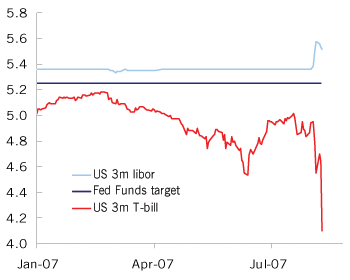
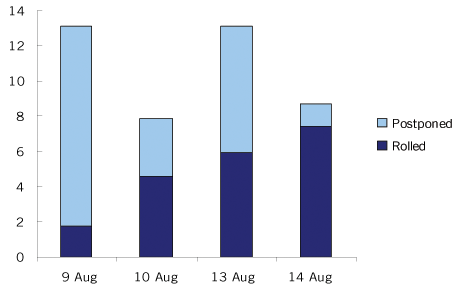
The Federal Reserve reports that commercial paper outstandings have fallen by $90 billion in the week ending Wednesday August 15 compared with the week ending Wednesday August 8, showing that one of the core markets underpinning daily operation of the financial system is seizing up. Near panic buying of three-month treasuries by money-market funds and other investors drives yields that were 4.7% on Monday morning to as low as 3.4% at one point on Thursday
Euromoney talks to some conventional investors. Their fear now is that what was once an obscure problem within an opaque inner circle of financial firms might soon damage the global economy. All these SIVs and conduits are starting to look like contingent liabilities of the banking system. Taking these onto balance sheets might stave off the immediate panic, as bank holders should be able to fund them at reasonable levels, hold them for investment and avoid mark-to-market volatility through the P&L. But with balance sheets bloated by these unwanted assets, banks will have reduced appetite for additional lending.
Late in the day, the stock markets rally in the expectation that the authorities will have to do something.
|
Friday August 17 – No one leaves unscathed “It’s really troubled. Everything is being tarred with the same brush and investors in funds that buy commercial paper are ringing and asking: ‘You’re not in that asset backed CP are you?’ And if funds have bought ABCP, investors don’t want to hear about whether it’s good ABCP or not, they’re out of there” Lessons of the market seizure They said it |