Hedge funds: Green trimmings
Impax Asset Management: Shorting the non-environmentalists
Climate Change Capital: Towards a carbon hedge fund
BioFinancial Corp: Creating new markets to trade in
 |
|
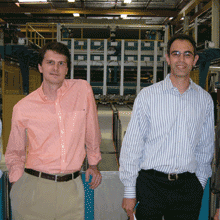
Greenwald and Coleman: shorting pie in the sky |
Craig Greenwald and Matt Coleman started looking at the liquid side of investment in renewable energy two years ago. Coleman was working for a firm that was focusing on financing alternative energy projects and noticed that many of the large institutional investors were making a push into renewable energy. Most, though, were investing in private equity that covered the sector and there was little opportunity to get exposure to renewable energy through the public markets. “Back then we saw very few hedge funds offering opportunities to invest via the public markets, and most were certainly very small in size,” says Greenwald.
The Clean Energy Fund launched in November 2006. It invests predominantly in listed companies around the world whose net income is 50% or more derived from alternative energy solutions. The five areas of focus are: large power, such as geothermal, hydroelectric and wind power; distributed power, such as solar, batteries and fuel cells; transportation, such as biofuels and hybrid electric systems; water technology, such as filtration, desalination or infrastructure build-out; and conservation, such as LED lighting, advanced metering or energy-efficient industrial motors.
Greenwald says: “We don’t discriminate on size or geography, but still, to make a pure play, we estimate there are 190 publicly traded companies globally that would fit our criteria. They have a combined market capitalization of nearly $300 billion.”
The fund goes long or short these stocks, looking at company fundamentals but also assessing whether technologies are feasible on a commercial basis. “For example, hydrogen fuel cells are a great idea but getting them to the masses at a reasonable cost will be difficult,” says Greenwald. “Also, this industry has historically been very promotional. There are a lot of ‘pie in the sky’ innovations. Those we would short.”
Greenwald says that on the long side the fund is looking for technologies that are already commercialized, often with the support of government incentives.
A smaller part of the fund trades renewable energy credits. “At the moment there is no official national trading system in the US, and these credits, derived from solar or wind farms, are traded bilaterally. In the western US, a formal tracking system has recently been launched, which should facilitate more trading activity,” says Greenwald.
Investors in the fund tend to be first and foremost those who are interested in alternative energy or who have a green mandate. That said, Greenwald says investors are expecting hedge fund type returns. “You can get exposure to alternative energies through ETFs or mutual funds. We have to produce the type of returns that hedge funds produce while managing the risks of investing in this space.” Since its inception the fund has produced unaudited returns of 14.2%.
But is it really helping the environment? Greenwald admits that while there is a social conscience element to the fund, it is first and foremost a business proposition. That said, by buying renewable energy credits, investors are directly contributing to the incomes of wind or solar farms. “It reduces the project risk by providing an additional revenue stream and that capital can allow them to add another wind turbine or solar module, for example. And by investing in public companies, it will encourage innovators and venture capitalists to put money into new clean energy technologies.”



