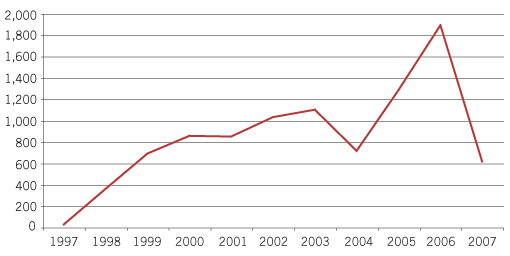
WHAT DIFFERENCE DOES a decade make? In 1997, communism in central and eastern Europe was still a recent memory. Privatization had begun just a few years before, and even the biggest companies were still finding their feet. Some firms from the region had started to spread their wings abroad but the companies they were buying were tiny. According to Dealogic, the top three cross-border M&A deals to be announced in 1997 where the acquirer was a CEE company reached a cumulative total of just $161 million.
Ten years later, even if the acquisitions made by the Russian natural resources companies are excluded, the figure will be more than 10 times as big. By August this year, the top three foreign acquisitions announced by CEE companies (discounting Russia) had already reached a total of almost $2 billion, according to Dealogic.
Corporate CEE, it seems, is feeling the benefit of having eight of its countries join the European Union in 2004.
The biggest firms in countries such as Poland, the Czech Republic and Hungary are no longer content to snap up the smallest companies in neighbouring states. As they increasingly take advantage of opportunities in CEE countries outside the EU, they are laying the groundwork to be able to compete against, and perhaps even overtake, their more western-based rivals. Soon, say industry insiders, CEE firms in the EU might be able to break western Europe’s dominance in the CEE M&A market, and win a majority of even the biggest cross-border M&A contests.
CEE firms from EU countries have begun to make tentative forays into western Europe. Earlier this summer, Hungarian oil and gas company MOL, for example, acquired Italian refining company IES for $954 million.
So it might, for some, come as a disappointment that as far as cross-border M&A deals in central and eastern Europe are concerned, western European and north American firms are still, for the moment, overwhelmingly dominant, both in pre- and post-EU accession countries.
According to the most recent report on the CEE M&A sector by accounting firm PricewaterhouseCoopers, in 2006 the number of cross-border deals initiated by CEE companies was less than a third of the number of deals in CEE initiated by companies from outside the region (principally the UK, Germany, the US and Austria). According to Dealogic, the top five cross-border M&A deals against CEE and CIS targets to have been announced in the first seven months of 2007 included just one deal in which the acquirer was from the CEE/CIS region. This deal, an acquisition of a 50% stake in Belarusian gas transporter Beltransgas by Russian natural resources company Gazprom, might be said to have relied on a willingness to exploit natural resources sprung from the largest country in the world.
The $2.07 billion takeover by Italy’s UniCredit of 95% of Ukraine’s UkrsotsBank, announced in mid July, is more of a case in point. At the time of its announcement, the deal was, according to Dealogic, the fifth-largest M&A transaction involving a CEE or CIS target to be announced so far in 2007. But while the bank was eyed up by Hungary’s OTP bank, OTP eventually had to cede place to its richer western rival and be content with the smaller scraps of the Ukrainian banking sector.
Ukrainian lessons
The same thing happened in 2006 in the bidding for UkrSibBank, Ukraine’s fourth-biggest bank by assets. OTP initially investigated the possibility of buying a majority stake in the Ukrainian firm, hiring PricewaterhouseCoopers to help it carry out due diligence. But France’s BNP Paribas was the eventual victor.
The Ukrainian banking sector might be said to be more generally representative of the extent to which EU central and eastern European firms are now a force to be reckoned with in the region’s cross-border M&A market, especially in those countries not yet in the EU. Ukraine’s banking system is particularly fast growing, and the country itself enjoys GDP growth of about 6%. It is geographically close to, and has a similar culture and socio-economic background to the ex-communist 2004 EU accession countries. It might be a particularly fertile ground for acquisitions by such companies as Hungary’s OTP and Slovenia’s Nove Ljubljanske bank (NLB), both of which are leaders in their home markets. Nevertheless, according to Klaus Requat, UniCredit Group’s head of the EEMEA investment banking at the subsidiary Bank Austria Creditanstalt: “The financial institutions sector in Ukraine has in recent years been taken over almost in its entirety by western European banks.”
Until about four years ago, most cross-border acquisitions made by CEE companies were minuscule. Discounting the odd big purchase by Russian natural resources companies such as Gazprom and Lukoil, the biggest deals, according to Dealogic, tended to be between $30 million and $50 million.
Hungarian oil and gas company MOL became, at the beginning of the present decade, something of a pioneer of cross-border M&A transactions made by CEE companies. Its purchase for $262 million of a 36% stake in Slovak oil refinery Slovnaft in 2000, and of another 32% for $515 million in 2002, were both more than twice the size of the next biggest cross-border M&A transactions made by CEE and CIS companies excluding Russia during the first three years of the decade. MOL’s purchase of 25.01% of Croatia’s state-owned oil incumbent INA for $505 million was also the biggest cross-border M&A deal of 2003 to be announced by a CEE or CIS company (excluding Russia).
Discounting Russian companies, it has only been in the past three years (not coincidentally, since the 2004 entry into the EU of eight CEE countries) that other players in the outbound M&A market in CEE have begun to follow MOL’s lead. Significant jumps in the number of foreign acquisitions by CEE companies have taken place every year since the EU’s big bang of 2004. PWC’s CEE M&A survey shows that 248 foreign acquisitions were made by CEE companies in 2006, compared with 43 in 2003, 70 in 2004, and 187 in 2005. The survey’s author, Margaret Dezse, says similar growth is expected to continue.
Since 2004, the new strength and reputation of CEE companies in EU countries has allowed them to follow a successful strategy of targeting companies in countries to their east and south outside the EU, such as Bosnia, Serbia, and Ukraine. This eastern movement has been in line with a trend also followed by companies from outside the region: PWC’s CEE M&A survey says that in 2006 investment overall in the region “continued to move eastwards”. The $2.5 billion purchase of Croatian pharmaceutical company Pliva by Barr of the US last year was a prime example.
For EU CEE companies, practical geographic circumstances might mean that it is natural that a more buoyant M&A market globally should take them to countries to their east. Thus, in the words of PWC’s CEE M&A survey, it is normal that CEE companies “consider business in immediate neighbouring countries as potential key targets and good investment opportunities”. But with the most active CEE cross-border investors being the Czech Republic, Poland, and Hungary (as well as Russia), it also seems to be a case of companies taking advantage of their countries’ entry into the EU to gain a foothold in their less-developed, faster-growing neighbours, before western companies scour the ground bare.
|
“What they think is that the right strategy for them is to go and consolidate whatever the remaining opportunities are in the EU accession countries plus countries further east such as Ukraine and Russia” |
 |
Over the past three years, there have been abundant examples of Czech, Polish, Hungarian, and Slovenian companies expanding to countries not yet in the EU. Czech energy company CEZ has followed the lead of INA. CEZ has become the largest electricity company in Europe after France’s EdF, having bought, in 2004, 51% of Romania’s Electrica Oltenia for $221 million, as well as 67% of three Bulgarian electricity distribution companies for $349 million (Bulgaria and Romania did not join the EU until January 2007). In 2005, Hungarian telecom company Matáv bought 51% of Telecom Montenegro for $150 million; Czech pharmaceutical company Zentiva bought a 51% stake in Romania’s Sicomed for $102 million; and Slovenian companies Mercator (retail) and Droga Portoroz (pharmaceuticals) made acquisitions respectively in Croatia and Serbia. Dmitri Rozanov, head of CEEMEA M&A at Merrill Lynch, says that part of the reason why more companies from countries such as Poland, Czech Republic and Hungary have been moving east has been that CEE markets outside the EU are less consolidated. “At this stage of their development they won’t feel strong enough to go and compete in western Europe, although some of them are looking at western Europe on an opportunistic basis,” he says. “What they think is that the right strategy for them is to go and consolidate whatever the remaining opportunities are in the EU accession countries plus countries farther east such as Ukraine and Russia, which will provide them with a further growth opportunity, and potentially additional scale so that they can compete effectively with their western counterparts.”
The march east
In 2006 and 2007, therefore, companies such as MOL, CEZ, and Zentiva seem to have stepped up another gear in their expansion strategies in non-EU countries. One of the most notable examples was the acquisition announced this March by Zentiva of a 75% stake in Turkish generics company Eczacibasi for $606 million – perhaps the biggest such deal yet. As another example, in the retail sector, having exhausted expansion opportunities in its relatively small home market (the country’s population is about 2 million), Slovenian firm Mercator has been working hard to dominate the wider Balkan market, taking over Serbia’s M-Rodic in 2006, and forming a partnership and joint venture with two Croatian retailers.
In the politically sensitive energy sector, where state ownership has protected certain companies from foreign acquirers, MOL, CEZ and Poland’s PKN Orlen have all been taking advantage in the past two years of their relatively large ready-made home markets to snap up companies in smaller countries, especially to their east and south. MOL, for example, signed an agreement to buy Croatian fuel retail and wholesale company Tifon for $204 million at the beginning of August. CEZ is in the early stages of a $6 billion international expansion programme. It has agreed to build a power station in Bosnia, partly with its own money and partly with money from the local government. CEZ spent a further $260 million on Bulgaria’s Varna Thermal Power Plant last year, and also has expansion plans in Romania and Kosovo. As a last example in the energy sector, Czech hydropower company Energo-Pro became a big acquirer in the non-EU CEE energy sector when it paid $312 million in 2006 for about 40% of Georgia’s electricity production and distribution network.
But despite these moves, the bigger EU CEE companies do not seem to be tiring. It seems unlikely that the trend towards more expansion by EU CEE companies in the non-EU CEE market will be reversed soon. Rozanov says that about 60% of the projects his team is working on involve regional companies looking to buy or sell to other regional companies. Most of this, he says, will be about EU CEE companies buying (or at least looking at opportunities) in non-EU CEE countries.
PWC’s Dezse says the growth of acquisitions by EU CEE companies in the non-EU CEE can be seen, in part, within a global growth in M&A activity over recent years. Trends in more developed markets, she says, often have “a delayed reaction” in CEE.
|
Number of announced M&A deals where acquirer is CEE or CIS |
|
1997-August 2007 |
|
|
|
Source: Dealogic |
But Dezse, together with a number of other industry insiders, says the entry of 10 CEE countries into the European Union since 2004 has also had a significant impact on the ability of CEE companies to strengthen their position relative to western rivals. Merrill Lynch’s Rozanov says entry into the EU has helped because these companies can now obtain cheaper debt. Since 2004, Rozanov says, CEE companies now inside the EU have found it easier to access the capital markets to finance their expansion. Benefiting from EU membership
Martin Schwedler, a board member at Austria’s Raiffeisen Investment, says that with this improved access to financing, EU membership has come within something of a virtuous circle for CEE companies such as Hungary’s MOL. For the 10 EU CEE countries, better financial and economic development facilitated entry to the EU, which in turn made more financial and economic development possible. For these countries’ biggest companies, better access to financial markets given by EU entry has allowed them cheaper funding, which has made them more attractive acquirers, which has made them bigger, giving them even better access to debt. This has, in turn, made them even more attractive acquirers. Furthermore, says Schwedler: “In the early 2000s, most companies in eastern Europe that aspired to EU membership would have preferred an EU buyer because they wanted to get closer to the EU, and become more integrated in its economy.” Before 2004, he says, companies in CEE tended to look for western European acquirers because of the sophistication and better access to markets afforded by such firms. But, he says: “That has changed. Companies such as MOL and CEZ are now so big they almost have the same level of prestige as the multinationals.”
Yet with their better knowledge of the situation on the ground, EU CEE companies, Merrill Lynch’s Rozanov suggests, can sometimes price out that “almost”. In their own backyard, he says, EU CEE companies can find it easier to identify bargains in non-EU CEE countries. “They have been through the same transition. In some cases they are prepared to pay more competitive prices than the western companies, because they understand the risks better.”
 |
“Companies such as MOL and CEZ are now so big they have almost the same level of prestige as the multinationals” |
If this is true, it might be possible to downplay the concerns harboured by the ratings agencies about the level of risk EU CEE companies are taking on in their expansion strategies. Standard & Poor’s, for one, says it is concerned about the expansion plans of OTP, MOL and CEZ in less stable markets such as Ukraine, Russia, and the Balkans. But perhaps CEE companies have good reason to be more confident about their CEE expansion strategies than New York- or London-based ratings agencies. Utilizing pre-accession experiences
To go back to Ukraine’s banking sector, then, we might ask if, despite the current dominance of western European banks, institutions from the 2004 generation of EU entrants are, in fact, making more inroads. And, in the past two years at least, the answer seems to be that they certainly are. NLB, Slovenia’s biggest financial group, opened a representative office in Kiev in May. OTP was balked by BNP Paribas and UniCredit for the bigger targets of UkrSibBank and UkrsotsBank but last year the Hungarian bank took over 93.5% of Raiffeisenbank Ukraine for $821 million. Having beaten off the other contenders (most notably France’s Société Générale and Austria’s Erste Bank), OTP has renamed the bank CJSC, and announced at the end of July plans to double its branch network to 135 in one year, rising to between 320 and 340 by the end of 2010.
What is more, the experience of EU CEE banks in Ukraine is mirrored in many other non-EU CEE countries. NLB, for example, has been particularly active in the Balkans. It recently announced a capital increase of €100 million to fund expansion. The group already has strong positions in several Balkan countries through the operations of members and subsidiaries such as NLB Tuzlanska bank. Having purchased two banks there this spring, NLB even has an 18% share in Kosovo’s banking market. Parex Asset Management, the largest investment management firm in the Baltic States, registered a representative office in Kazakhstan’s capital Almaty this July. OTP also has some strong positions in the Balkans. After buying Croatia’s Nova banka for $320 million in 2004, last year OTP bought three banks in the Balkans’ biggest market, Serbia (where the central bank has now decided to stop giving out greenfield banking licences).
One banker tells Euromoney that, the way things are going, central and eastern European banks might soon be in a position to overtake the western groups in the cross-border CEE M&A market. He emphasized that many of the characteristics of the financial institutions M&A sector could be applied to other sectors in the CEE M&A market. In as little as five years, he says, local EU CEE players will be able to take on the western groups head-on in even the biggest deals. “Some of these banks are getting sizeable operations. As soon as they approach a market value which is close to some of their competitors in western Europe, it will become more and more difficult to compete with them,” the banker says.