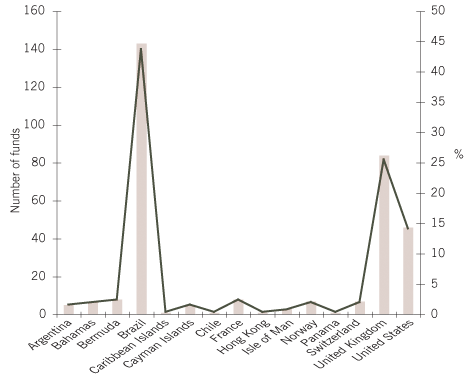
Of THE 148 hedge funds based in Latin America, only nine are outside Brazil, according to figures from Eurekahedge. Over the past two years, the hedge-fund market in Brazil has become increasingly mature. Multi-mercado funds, which are essentially mutual funds for domestic retail investors that can invest in several asset classes, and predominantly run a Brazil-only macro strategy, number more than 4,000. Onshore hedge funds that have structures similar to those in the US and Europe for high-net-worth clients and institutions number 139, up more than 30% on two years ago.
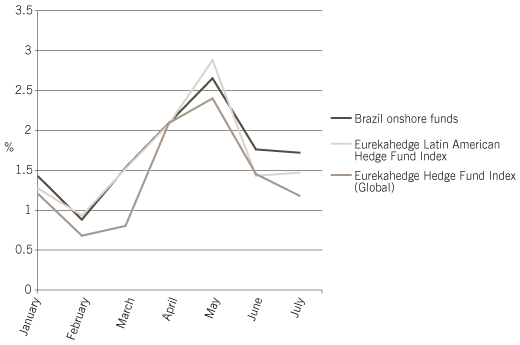
Peter Douglas, founder of hedge fund consulting firm GFIA in Singapore, runs the first fund of hedge funds to go into Latin America, which launched in 2005. He holds the market in high regard. “Brazil is by far the most sophisticated domestic hedge fund market in the world. It is well-regulated and transparent,” he says. Douglas says his firm’s Latin American fund of hedge funds has outperformed the global fund of hedge funds sector by a couple of percentage points. According to Eurekahedge, Brazilian onshore funds are outperforming the Latin America hedge fund index and the global hedge fund index this year (see chart).
For outsiders, it is easy to assume that managers have been performing simply by riding the Brazilian wave. However, those familiar with the industry say this is not the case. “There are some excellent managers there and, given economic history, managers are extremely considerate of liquidity and risk management,” says Douglas.
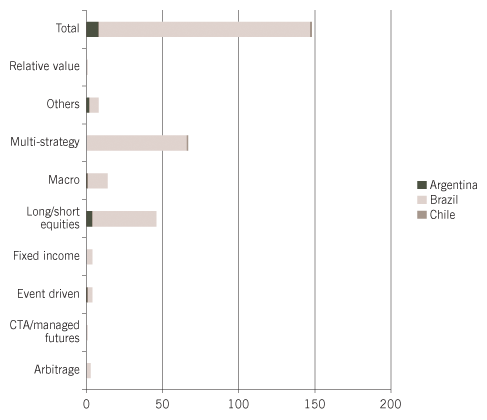
Long/short equity has been emerging as a close contender to the multi-strategy funds, which invest predominantly in fixed income. As domestic investors become more comfortable with hedge funds, and as Brazil’s capital market develops, the growth of the local industry shows no signs of abating.
The growth of long/short funds
It is only over the past three years that Brazil has begun to have a sizeable equity market. When interest rates were up above 20%, there was little incentive for investors to look to the riskier equity market for returns. Investors would keep their money in the bank, or would invest in fixed-income funds. Indeed, many of the multi-strategy funds were investing mainly in fixed income. The interest rate is now 11.5%. Fabio Alperowitch, partner at Fama Investimentos, says: “For the last five years, hedge funds in Brazil have been investing in currency and fixed income, and it was easy to have high returns. But now there is little upside left so we are seeing investors turn to equities.” Fama is one of the longest-standing equity investors in Brazil, having launched a long-only small-cap fund in 1993, and a long-only mid-cap and large-cap fund in 1998. In 2002, it launched a long/short equity fund in response to investor demand.
Investor demand, as well as Brazil’s growing domestic wealth, has spurred rapid growth in the equity market. In July 2005, there were 349 companies listed on Bovespa; there are now around 430. Market capitalization of the exchange has risen from $584 billion in July 2006 to more than $1 trillion over the past year, and there have been 46 IPOs this year alone.
|
Brazil dominates global Latin American hedge fund market |
|
Country-by-country distribution |
|
|
Brazilian Onshore funds outperform |
|
Returns of Brazils onshore funds vs indices |
|
|
Long/short and Multi-strategy funds dominate |
|
Strategies being run out of Latin America |
|
|
Source: Eurekahedge |
A larger equity market and, in turn, greater liquidity have provided conditions for long/short funds to be created to meet investor demand. There are now about 40 long/short Brazilian funds onshore and a similar number offshore. Most managers replicate their onshore strategies for offshore investors. Shorting the equity market is not as straightforward as in more developed countries, however, and funds need to run their own repo desks. However, liquidity has been improving. Renato Abucham, partner at Claritas Investimentos, which runs a macro fund and a long/short equity fund, says: “Two years ago, there were perhaps five to 10 easy stocks to short, now there are between 50 and 60.”
One of the big obstacles to shorting has been the lack of a stock lending market. In Brazil, stock is not held in street name and therefore the end investor has to agree to its being lent out. Andre Jakurski of multi-strategy fund group JGP says: “There is still a perception here of holding stocks, and that people worry about lending stock as it will result in that stock being sold, which could have a negative effect on the price.” Furthermore, lenders of stock have been trigger-happy, lending stock and recalling it at will, making it hard for long/short funds to manage portfolios.
But managers say this is changing. Ricardo de Campos is a partner at Hedging Griffo, an asset management house especially recognized for its hedge funds and equity funds. “There are more lenders of stock now,” he says. “It used to cost about 6% to borrow a stock, and now that rate is about 1% to 2% – that has probably increased over the past few weeks, however, due to market conditions and would be much more for some single names, but there is a growing stock lending pool.” One manager says that he is seeing investment banks trying to go into the stock loan market.
The growth in long/short equity funds in Brazil is met by some with cynicism. Given the growth in the domestic equity market, critics question whether some managers have simply been net long and riding the wave, rather than truly adding alpha. The lack of experienced equity players also raises concerns. Although returns were positive up to end of July, the fall in the stock market in August is likely to highlight those managers that have been adding alpha, and those that have simply been buying the market.
Alperowitch says: “The equity market is still new here, and there are very few funds in Brazil with experience in trading equities. It is not easy to pick stocks. In August there were certainly losses. The market devalued at one point by 8% and some names by as much as 20% – especially the recent IPOs. A lot of managers went with the mainstream and would have had the same positions, so everyone would have had to sell some stocks.” Many of the managers that have produced solid returns and that have been in the industry for some time have closed their funds, awaiting further liquidity and opportunities, and banks offering long/short funds to retail clients are believed to have been forced to put customers into funds run by managers with little or no experience of a bear market. “Some of the new IPOs this year have come at crazy prices. You have to be careful how you select managers. At the moment, it is not difficult to find assets but more difficult to find investment opportunities,” says Neil Steifel, co-head at UBS Pactual in Rio.
Indeed, it is hoped the market volatility will shake out some of the less-experienced funds. “We need to see a test in Brazil,” says Marcos Duarte, partner at Polo Capital Management, which has $800 million in market-neutral and event-driven funds. “A period of a market without a trend could help identify who is good at making money and who isn’t. In the last four years, there have been a couple of blips but not over a prolonged period. It will ultimately be good for investors if there is a shake-out, and there will be casualties for sure.”
Alternative strategies
The potential market downturn in Brazil, driven by the US sub-prime fallout, might have less impact on experienced funds than in the past. In the search for returns, investors have begun to accept less liquid terms on their investments. Given the relative shortage of quality funds compared with capital to invest, managers say that they can now implement a 30-, 60- or 90-day redemption notice period.
 |
|
“Flows are slow. Investors sometimes prefer to have their money in Swiss private banks but there is without a doubt space for Latin American hedge funds as an asset class” |
“A couple of years ago, if a fund fell below the interest rate for one or two months, investors would redeem. Now they seem more willing to stay the course,” says Elsen Carvalho, partner at Investidor Profissional, which has $1.3 billion in equity funds. “Lots of funds are now implementing 90-day notice for redemptions, and I would think that in one to two years’ time, we will even start to see lock-ups being accepted. We launched one of the first hedge funds with a lock-up in Brazil and the reaction of clients has been quite encouraging. Investors are being forced to learn. As a lot of the good funds are closed, if an investor jumps out after two months, they may well not be able to get back in.” Some of the managers interviewed admitted to being down marginally in August but said that their investors were prepared to hold on because of their track records and experience in equity investing.
This acceptance of less liquid terms is creating the beginnings of a private equity market in Brazil. Claritas is looking at private equity investments on a project-by-project basis, for example. Tarpon Investment Group also has an offshore fund that invests in both private and public Brazilian equity. This investment vehicle was launched in 2006 and has the flexibility to invest in different asset classes regardless of the liquidity of the investments. Through this hybrid fund, Tarpon focuses on the dynamic sectors of the Brazilian economy, with a strong emphasis on those where Brazil has a competitive advantage. One private equity investment has been in a Greenfield ethanol project called Brenco – a partnership between Tarpon, Philippe Reichstul (the former CEO of Petrobras), Vinod Khosla and Steve Case. Eduardo Mufarej, partner at the firm, says: “Up until recently because of the high interest rate, there was little incentive to invest in illiquid opportunities in Brazil. But there are private equity opportunities in Brazil that can offer good and uncorrelated returns. Up to now, we have had to raise money in the fund from offshore, but I think domestic investors will increasingly show an interest in private equity products.”
The lower interest rate could also lead to the creation of a corporate debt market, allowing for credit hedge funds. De Campos says: “The biggest change is occurring in the debt market. There has been no financing of corporate loans as it has been too expensive but with the interest rate now lower, I think we will see companies begin to borrow. First they will go to the banks, but then they will come to the capital markets. I imagine it will lead to a creation of new hedge fund strategies.” Claritas’s Abucham agrees. His firm recently hired a team to originate asset-backed securities in anticipation of the growth in the credit market.
Elsewhere in Latin America
While Brazil has been growing its hedge fund market, and looks set to expand further, other Latin American countries have struggled to build a hedge fund industry. Chile has one highly regarded manager, but Mexico, surprisingly, is devoid of hedge funds. “While it is the second-biggest and most liquid market in Latin America, it is still very closed,” says Pactual’s Steifel. “The amount in pension funds and mutual funds is very small, A lot needs to happen from a regulatory perspective.” Steifel says his firm has hired someone in Mexico to look at the market. “It’s going to be a long time, however, before a hedge fund industry develops there,” he says.
Argentina remains the second-largest hedge fund market in the region, with eight funds in operation run by five managers, according to Eurekahedge.
Andre Azicri became the fifth Argentina-based hedge fund manager this year, when he started managing Convex Management, a multi-strategy fund. Before forming Convex, he was a partner at Cima, another Buenos Aires-based hedge fund. Convex launched in June this year and has raised about $40 million so far.
Market participants say that regulation has dampened the growth of hedge funds in Argentina. “For some reason, and it’s unclear why, the Comisión [Comisión Nacinal de Valores – the regulator] is not pro hedge funds at all. They are deemed risky, and there seems no chance of that opinion changing in the near future,” says one portfolio manager.
It is not permitted to sell hedge funds to domestic investors onshore. Furthermore, opportunities for strategies that relate solely to Argentina are limited. Funds can lever only once under law, and the ability to short will not be granted by the regulator, although short-selling is not forbidden by law. “To get round the issue of shorting, you can short ADRs, and over the last five years there have been a lot of new instruments developed which have created some opportunities, but it is not a deep and liquid market,” says Azicri.
 |
|
“Domestic pension funds are not allowed to invest in funds that are leveraged, or that go short, or that are offshore” |
Pressure on the regulator is unlikely to come from investors. Martin Ivancich is head of sales and marketing at Copernico Capital Partners, a multi-strategy offshore hedge fund group headquartered in Buenos Aires. “Domestic pension funds are not allowed to invest in funds that are leveraged, or that go short, or that are offshore,” he says. “It is limiting the asset classes available to them. But given the circumstances, it is hard to see the regulators opening the game for new alternatives in the short/medium term. And only a few family offices and some boutique private banks in Argentina are familiar with the concept of hedge funds. Negative press reports regarding hedge funds also keep investors at bay.” To appeal to investors beyond Argentina but predominantly in order to broaden investment opportunities, both Convex and Copernico run regional Latin American funds, as do nearly all of Argentina’s hedge fund managers.
Copernico is the most mature regional hedge fund manager. It did run a pure Argentina fund after the country defaulted, to take advantage of the recovery, but closed it in December 2004, returning money to investors in March 2006 with a cash dividend of more than 20%, when opportunities dried up.
Most of Copernico’s $300 million in assets under management is in its Latin American strategic fund, which has been running for eight years. It follows an event-driven and current-income strategy and offers investors monthly liquidity. “It can be difficult to find value in Latin America sometimes, but given the correction in the market, there should be some good opportunities again,” says Ivancich.
To counteract the decrease in value in the markets, in August last year Copernico launched a Latin American special situations fund. “We realized there were opportunities in more illiquid investments and strategies like asset-backed lending,” says Ivancich. “There are good companies that can’t get access to credit. You can ask some of these smaller Latin American companies the last time a banker called, and they will say perhaps a year ago, perhaps never. We are good at analysing credit, so decided to get involved.” The fund has a two-year lock-up period but Ivancich says those terms might be relaxed given that the fund has a good one-year track record and the portfolio is now well balanced.
Azicri’s fund, Convex, looks only at liquid instruments across Argentina, Brazil, Chile, Colombia, Mexico, Panama and Peru. About 30% of the portfolio is invested in equities, and the remainder in fixed income, which is a deeper and more liquid area in Latin America according to Azicri. “The panic selling over the past few weeks indicates well the importance of being in liquid securities,” he says, “and there are actually not that many highly liquid opportunities in Latin America. We think the capacity for the fund at the moment is about $500 million.” Such a small capacity relative to the rest of the world is encouraging some potential Latin American hedge fund managers and investors to turn to Asia instead, say managers.
Furthermore, establishing a solid Latin American hedge fund is no mean feat. Ivancich says it took Copernico several years to be taken seriously as a regional player. “An edge comes only through developing a network in the region, and that takes time. We work as local in each country and have identified the smart investors in each country.” Copernico has also just set up an office in São Paolo. Even in as developed a market as Brazil, Latin American funds are scarce. As one manager points out, however: “We’re not Latin America. We are Brazil. We don’t speak Spanish. We have no idea what is going on in the rest of the region, and we have enough opportunities here on our front doorstep to keep us occupied.”
The challenges of running a regional fund mean managers such as Convex and Copernico have less competition. “There are a few local family offices, prop desks, etc, but they tend to focus domestically. And other hedge funds that look at Latin America as a whole often do so within a greater emerging markets portfolio, and they tend to pick up big tickets, leaving a gap for us,” says Ricardo Maxit, co-founder and CIO of Copernico. Azicri agrees that competition is scarce. “There is little in the way of regional dedication even out of Brazil, which is the largest hedge fund market. But there are lots of opportunities in emerging countries like Peru and Colombia adding to Mexico and Chile, for example, that I think there will be a trend towards more regional funds in the future.”
Ricardo agrees. “Flows are slow,” he says. “Investors sometimes prefer to have their money in Swiss private banks but there is without a doubt space for Latin American hedge funds as an asset class, and they are here to stay.”




