Euromoney Liquid real estate March 2007
There is clearly something about Hines that encourages staff loyalty. The average length of service of its executives is an astonishing 28 years.
The privately owned, international real estate firm is still run by its founder Gerald Hines and his son Jeffrey.
The statistics are impressive. It controls assets valued at some $13.5 billion and has developed more than 205 million square feet in more than 650 properties since its foundation in 1957.
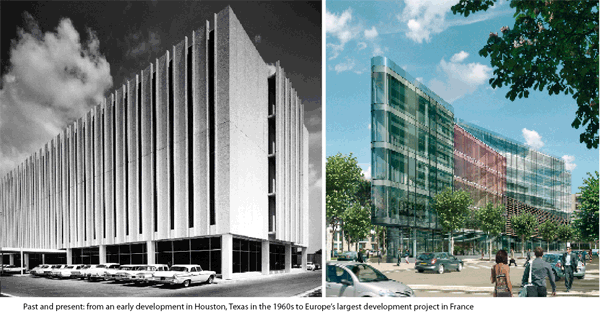
Hines does not stand still. The company realised the need to expand beyond the US and become international in the early 1990s when it moved into Europe, Latin America, China and Russia, and it is constantly seeking to open in new markets. Last year it opened in India and is now targeting the Middle East and North Africa.
With that in mind Hines has just sent one of its senior executives from its London office, Jürgen Herre, to Abu Dhabi to oversee development in the region as managing director for Hines Middle East and North Africa. He also is a member of the company’s capital markets executive.
Prior to joining Hines in 2000, Herre was head of the international real estate division of Westdeutsche ImmobilienBank, and financed properties valued at $17 billion. He describes taking the job at Hines as “the best move I ever made”.
On the following pages Herre tells Liquid Real Estate about the firm’s strategy, how it has been affected by the dramatic changes in the real estate market in recent years and the changing nature of its relationship with its banks and investors.
Q: What is Hines’ expansion strategy?
A: We want to build a new Hines region focused on the Middle East and North Africa. Hines started its international expansion at the beginning of the 1990s. Before that it was really a US-focused company.
The internationalisation was for two reasons: risk diversification from a real estate point of view; and secondly and equally importantly, all of a sudden, a lot of our clients, that’s to say our tenants, went global.
We started operations in Brazil, Argentina and Mexico. At the same moment we started our business in China and Russia and in Western Europe.
A year ago we opened Hines India. We have watched India for 10 years but we couldn’t invest for legal reasons. The laws in have India changed in favour of international investors and we now have an office there with 10 people.
What I am trying to do now is replicate what we have done in Europe, starting here in Abu Dhabi and the UAE. We will open offices soon in Saudi Arabia, Oman, Kuwait, and going up North Africa to Morocco.
What’s the time scale for this expansion?
It will take five to 10 years but this is such a rapidly growing region here and we want to be part of that. We want to contribute to sustainable change. There’s a lot of money in this region, but equally important is that all of a sudden you have young leadership that wants to bring their countries into the 21st century within the next five to 10 years.
They invest a lot in infrastructure and in education. The whole landscape is changing and we need to be in regions like this, maybe five years prior to the institutional investors. We are seeing already the first institutional investors here, doing their research. In a couple of years they will invest here in a massive fashion.
You didn’t mention Dubai. Is that part of your plans?
Dubai is on the list but it’s not a priority. Abu Dhabi, from a market entry point of view, is seven or eight, maybe even nine years behind, in terms of real estate cycle. So it is a much safer place to start. Secondly, the real money is not in Dubai, it is in Abu Dhabi – 90% of the oil reserves are here.
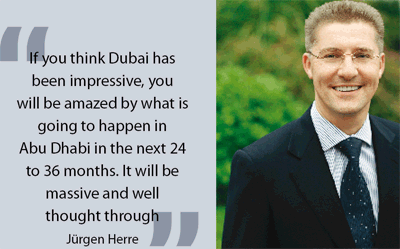
If you think Dubai has been impressive, you will be amazed by what is going to happen in Abu Dhabi in the next 24 to 36 months. It will be massive and well thought through.
How does Hines open operations in new markets?
We always grow organically. We take a handful of seasoned Hines people who build up the network, hire local people and then we train those people and let them grow. And in a couple of years we go back or move to the next challenge.
Describe your investment strategies for your funds.
We raise funds predominantly for institutional investment with a clear geographical focus, and with clear management style. We have funds purely focused on the US, purely focused on Europe and purely focused on the less developed markets such as China and Russia.
Typically the funds take a high risk, high return approach like development funds but we also have value added funds, where we buy existing buildings, enhance the value and sell on.
At the lower end of the risk spectrum we have one core fund in the US and one in Europe where we buy existing buildings with long-term leases. Then the focus is to deliver a stable cash dividend to investors.
How long have you been running the business like this?
We developed this fund model at the beginning of the 1990s. Prior to that, all our transactions were financed more or less in a one-off style, that’s to say we identified a property, we talked to the bank for the non-recourse financing and we started talking to investors.
At the beginning of the 1990s, because of the internationalisation of the company, but also equally because of the increased competition, we changed our model and we started with the fund management business.
So we raised funds purely from institutional investors on a discretionary basis which we then invested around the world.
Two years ago, again because of diversification, we started to raise retail money in the US through a private non-listed Reit. We have raised now nearly $1 billion through this route. And in Europe we started to do the same, through retail fund raisers like Deutsche Bank.
A year ago we started to tap into the high net-worth market where we team up with banks involved with those clients and they raise money for us.
Today we are highly diversified on the equity sourcing side. Institutional investors are still the majority but the retail money and the high net worth money is rising.
What sort of banking relationships do you have?
We are extremely decentralised. We always try to use local banks – in Europe for example we have two or three major banks, and because of the size of our projects, typically they syndicate. The same is true for the US and emerging markets.
When we started in the emerging markets, we didn’t get any bank financing because it wasn’t available at all.
For example, in China, the first financing we got was in 2001, then Russia in 2002. Margins were at 500 to 600 basis points and today they are more in the region of 175bp to 300bp because competition between banks has increased.
So that’s good news for you?
It is. And it’s good for the market too because it means more liquidity, which means better prices at the end of the day.
All around the world liquidity has dramatically increased and therefore values of real estate have increased substantially and this is all to do with transparency.
If you look back 10 years, there really was not much international real estate investment. Off the top of my head, in 1995 real estate turnover worldwide was roughly $100 billion, out of which $10 billion was international business, predominantly done by Japanese investors. Last year, turnover worldwide was $600 billion and the international turnover was nearly $400 billion. That just shows you what has happened in the last 10 to 12 years.
What drove such dramatic change?
The number one factor is market transparency for investors because all of a sudden you can do due diligence on places such as China and Brazil.
Even in Europe, looking back to 1995, there were not a lot of pan-European investments. Nobody really knew how to invest in Spain or Italy because nobody had done it before. Today, because of the transparency of the markets, real estate is becoming globalized for risk diversification reasons. And this is also why yields are becoming more or less equal all over the world. Because there’s too much liquidity in today’s market and investors want to diversify they are prepared to accept lower yields.
How are investors adapting to the new market?
Real estate has seen a re-pricing. All of a sudden in the last 24 to 36 months, real estate, for institutional investors, has become a separate asset class. Before it was part of the alternative investments spectrum.
This is down to transparency. Because it’s a separate asset class and because real estate has performed well in the last few years and now you even have real estate benchmarks that didn’t exist before, institutional investors have dramatically increased their real estate allocations.
If you take Europe, for example, where the average real estate allocation is around 6%, investors are now targeting 8% to 10%. In the US, where it’s typically around 4%, they are targeting 6% to 8%. If you add up those small percentages, you are talking about billions of dollars at the end of the day. It’s a massive, massive scale.
What effects will this injection of investment have?
The likely scenario is that we will see more and more equity deals in the years to come. That means less business for the bank lenders. We have seen this before in the 1970s.
Because yields are so low and in some markets you no longer have any positive leverage, so people will invest equity into property and not spend much using leverage. We have seen already in the last 12 months, in markets like London, that the highly leveraged buyers actually disappeared, because it no longer makes sense. So the buy-side has changed in London. There are more equity investors, in particular coming from the Middle East.
How do you work with your banks?
One way is the classical non-recourse construction financing or non-recourse long-term financing. They also provide subscription financing, which we use for our fund business. The subscription facility is purely secured by the creditworthiness of our investors. They own a security and the bank has the assignment of our right to call the capital. So investors actually don’t invest equity, they commit a balance sheet. This has nothing to do with real estate, and more to do with financial engineering.
The reason is that pension funds and insurance companies typically do not like to invest in development because they don’t see a return in the first four years but then get a huge capital gain if it works out. But during the four years this has a real impact on their overall portfolio return and therefore we structure the subscription facilities in a way that they can keep their cash on their balance sheet, earn whatever they can earn during the development period and after the development period they get a nice gain.
Are you making much use of derivatives?
They are really becoming important. The market is still small in terms of capitalisation, however we are watching this very closely and I am 100% sure that 24 to 36 months from now, this market will be well established and we will be actively participating.
What will be the main use?
Simple things like selling the indexation of a lease in return for getting lower interest rates from the bank. You have to give up part of the inflation but you have an immediate positive impact on cash flow from day one. And you don’t lose the value creation during the holding period because you still own the project and after 10 years the value has increased, whether you have sold the indexation or not.
Are banks pushing these products?
They are very proactive in this respect. This started nine to 12 months ago.
Which banks do you work with and do you shop around for the best deals?
We try to have long-term relationships with our banks. This is much more important than driving down the last cent in a deal. We work with the major players, familiar names. We are not a new player so they know our track record, they know we can execute deals and so we get good terms.
Globalization has had a positive impact for us because banks are opening in more and more markets, such as in India and Russia, and so they already know our organisation inside out.
Is the market more exciting and more challenging for you now?
I have been in this business for 25 years and for me it is amazing how this industry has developed. From a professional point of view but also in terms of how the industry became global. This is fascinating for me and for all of my colleagues. The internationalisation of real estate has been the best thing to happen to us. Now we can do things in China, in Russia, Latin America, the US and Europe. For us, that’s perfect.
So when you started your career, you wouldn’t have imagined how things were going to develop?
[Laughing] The honest answer is no. LRE