The plan of the big US money centre banks
to set up a fund to buy mortgage-backed
securities from hedge funds and bank conduits
aims to relieve the log jam in credit markets.
But it is also a scam to get the banks out of a
mess of their own creation.
It might work and free up credit markets.
But it won’t reverse the contraction of global
liquidity and the rising cost of capital in the
longer term. We are set for slower liquidity
growth, providing little room for further asset
price inflation (whether in equities, emerging
markets or commodities).
“Put more than one capitalist in a room and
what you get is not competition, but conspiracy
to defraud the public” – to paraphrase Adam
Smith. The latest attempt by the world’s mega
banks is a neat example of such a situation.
The very villains who created the mess have
now turned saints who want to save the
world from a folly that is of their own making.
They are putting together a $75 billion fund,
the Orwellian-sounding master (!) liquidity
enhancement conduit, or Mlec.
Mlec might relieve the log jam of lousy bank
assets in special purpose vehicles and the overleveraged
state of the asset-backed commercial
paper market. But the real purpose is to save
the skins of the very idiots who, together with
irresponsible central bankers, danced the
wild fandango and now hope to live to dance
another day.
In reality, their heads should roll – and so
they already have at Merrill Lynch and Citi.
So should the heads of central bankers who
wittered on about not being able to control
leverage-financial asset bubbles. That is, until
after they retire and write hypocritical I-toldyou-
so books. Of course, like the cigar-smoking
fat men in the smoke-filled rooms of Marxist
caricature, many of these global captains
of finance will probably give themselves
absolution and survive to sin again.
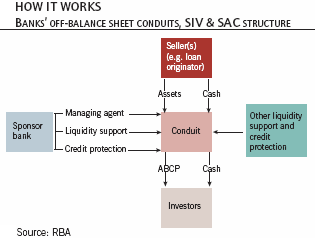
The Mlec structure they propose is smart
in two ways and this might ensure its
success. First, it creates a mechanism for the
transmission of liquidity being provided by
central banks to the smaller SPVs and other
leveraged players that it could not reach until
now.
These small players didn’t have any access
to the discount window or to free money being
thrown at markets by central banks. They relied
in normal times on banks and debt markets for
finance. Once the markets dried up, so did their
source of funding.
 |
Since the August crisis, central bank liquidity
injections have been pent up behind the walls
of fearful banks that
wouldn’t even lend
to each other in the
short-term inter-bank
market. The central
banks were powerless
because the liquidity
they provided was
not getting lent onto
where the locus of
the problem was.
Mlec will deliver the
liquidity to the core of
the problem.
But this will only
happen if a price can be agreed for liquidation
of the lousy assets held by the SPVs and other
leveraged owners. This is where the second
smart characteristic of Mlec appears and, with
it, the word conspiracy re-enters the equation.
The bankers want to minimize the writedowns
of assets they will buy through Mlec for
fear they will have to write down the assets of
their own SPVs as they reintermediate them.
Many of the current owners of assets that Mlec
will target are both insolvent and illiquid. They
will be only too happy to oblige: the higher the
price at which they sell their assets to Mlec the
less pain they (and the banks that own Mlec)
will have to endure.
The stage is set for a US Treasury-backed
scam of the first order. The credit crisis will
eventually pass but not its consequences. The
biggest consequence is the repricing of risk. In
the future, it will cause liquidity growth to be
much closer to nominal GDP expansion, leaving
little for asset price inflation.
This will happen because credit will only
grow as permitted by the capacity of banks’
balance sheets. There will be much less
creation of securitized debt. And because loans
will stay on banks’ balance sheets, risk will be
more accurately priced (that is, money will cost
more on average).
What central banks and mega banks are
doing cannot reverse this contraction of the
liquidity cycle. The contracting financial
economy will drive the global economy close
to recession (with the US being in it) next year.
When that happens, the price of all assets that
are real economic growth counters will fall.
Among the most vulnerable will be emerging
market assets (debt and equity), global
equities, hard commodities and energy.