 |
Euromoney’s borrower awards 2007 |
| Overall awards | |
| Best sovereign/supranational/agency borrower | Best bank borrower |
| Best insurance borrower | Best ABS |
| Best CDO borrower | Best covered bond issuer |
| Best corporate borrower | Best high-yield/leveraged finance borrower |
| Latin America regional awards | |
| Best sovereign borrower | Best corporate borrower |
| Best financial borrower | |
| Central & Eastern Europe regional awards | |
| Best sovereign borrower | Best corporate borrower |
| Best financial borrower | |
| Asia regional awards | |
| Best sovereign borrower | Best corporate borrower |
| Best financial borrower | |
| Middle East and northern Africa regional awards | |
| Best borrower | |
In 2002/03, Uruguay was in serious trouble – and ended up taking an enormous loan from the IMF and essentially defaulting on its bonds. It did so in a very market-friendly way, however, and there was a lot of goodwill towards the country in the international capital markets. This survived the election of leftist Tabaré Vázquez as president in March 2005.
Another survivor of the transition from a centre-right to a leftist government was Carlos Steneri, Uruguay’s longtime debt liaison official in Washington, who was actually promoted to run a new office of debt management in the Vázquez administration.
Steneri got straight to work, alongside advisers from Citigroup, Morgan Stanley and UBS. He determined that Uruguay’s enormous burden of IMF and World Bank debt was far too expensive – and he also saw dangerously large spikes in the country’s maturities.
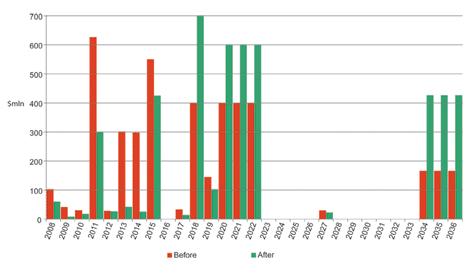
In the end, Steneri undertook an enormous swap that extended Uruguay’s average maturity from five years to 8.5 years.
In doing so, Uruguay managed to create a large new 2036 dollar benchmark bond, as well as a slightly shorter-dated bond maturing in 2022. The country also created a new benchmark maturing in 2018, this one denominated in UIs, or inflation-indexed Uruguayan pesos.
|
Clearing the debt |
|
Uruguay’s amortizations before and after the bond exchange |
|
|
Source: Republic of Uruguay |
The way the bond worked, any holder of Uruguayan debt could tender into the exchange – but they were only allowed to swap into new debt with a maturity at least five years longer than their old bonds. A holder of 2017 dollar debt, for instance, couldn’t swap into 2018 UI debt. In the end, 58% of the short part of the Uruguayan curve was tendered, and 51% of all Uruguay’s outstanding bonds. “If you look at the maturity profiles before and after November, we cut all the trees,” says Steneri.
With the new benchmarks created, Uruguay embarked on an issuing spree. It ended up borrowing a total of $3 billion, or a mind-boggling 15% of GDP, in one year.
Most of that money – $2.4 billion – was spent on paying back the IMF, the Inter-American Development Bank and World Bank, in full.
The reason wasn’t politics, it was economics. “The World Bank and IDB were charging Libor plus 400bp for 2008 and 2009 loans,” says Steneri. “The IMF was also quite expensive because we were over quota. We were paying 9.5%, compared with about 7% yield on the new bonds.” Indeed, the new bonds trade at about the same level as Brazil’s, despite the fact that Uruguay is rated a notch lower.
No dollars
Steneri says he’s done with dollar debt, now. “We will continue with only UIs, not in dollars,” he says. But he’s not done with liability management: he’s already talking about a local exchange, where domestic investors get the same opportunities that were afforded to foreign investors in 2006.
And Uruguay is always interested in yen debt, too. In November, the country issued a ¥30 billion ($254 million) bond with a warranty from JBIC, through Sumitomo.
Despite the size and complexity of his 2006 deals, Steneri remains modest. “There are sunny days and rainy days,” he says. “It’s fishing time. When there’s fish, you get fish.” Right now, the fish are biting. But Steneri knows from painful experience that they can disappear at any time, which is why he was so keen to get the deals done when he did.



