 |
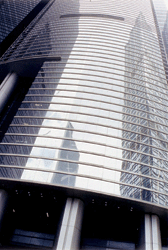
| The only one: Citibank Plaza, Hong Kong is the sole component of the Great Eagle Holdings’ Champion Reit |
ASIA’S REAL ESTATE investment trust sector is the regional market story of the moment. It’s got everything that’s needed for a good old-fashioned Asian investment party: booming issuance, property tycoons, retail fervour, epic oversubscription and some questionable financial structuring. There’s just one thing missing: China. That wasn’t the plan. People had talked about the possibilities of Asian Reits for years before the first one appeared in Singapore in July 2002. From the outset the most exciting thing about an Asian Reit market was the idea of getting exposure to Chinese real estate in a neat, regulated, well-structured form. Four years on, Reits have certainly swept the region – when Sun Hung Kai’s Sun Millennium trust lists in Hong Kong this month it will be the fifth from that city in a year, to go with the 10 listed in Singapore and several in Malaysia and Taiwan. However, there is still only one Chinese Reit: GZI Holdings, which raised US$230 million in a Hong Kong listing in December, holding four commercial properties in Guangzhou.
Why? After all, the appetite is there. GZI, in line with many Hong Kong Reit listings, flew out of the door – almost 500 times oversubscribed on the retail side and more than 80 on the institutional portion. Expectation at the time was it would be the first of a landslide of issues. “China has a lot of provinces,” says Paul Pong, managing director of Pegasus Funds Management in Hong Kong. “If each of them has one or two that list you’re going to end up with a lot of property.”
Other Reits are in the pipeline, but progress is slow. Beijing Huarong Investment plans to put about Rmb2 billion (US$250 million) of assets from Beijing’s Finance Street into a Reit, but the listing in Hong Kong won’t take place this year. Mainland developers China Vanke, Beijing Northstar and China Resources are all known to be looking at Reits, although their interest appears to be in a mainland listing, for which there is no legal framework in place yet.
|
“There are issues that need to be overcome but they’re not insurmountable” Daniel Scamps, UBS Investment Bank |
 |
One reason for the hesitancy is a tricky conflict between Hong Kong Reit regulations and Chinese real estate rules. Any Reit in Hong Kong, as in most markets, has to pay out almost all of its profits to shareholders as a dividend. But mainland real estate investment companies are required to set aside some of their profits against depreciation costs on their properties. You can’t have it both ways – reserve and pay out – so no Chinese Reit can hit the market without some elaborate structuring. This so-called cash trap is irksome but it’s not the end of the world. “There are issues that need to be overcome, but they’re not insurmountable,” says Daniel Scamps in the real estate team at UBS Investment Bank. Tax is another issue. Mainland property held onshore incurs 33% income tax and a 5% business tax on turnover. Offshore, there’s a 10% withholding tax on gross rental, plus the business tax. But putting assets offshore then incurs land appreciation tax of between 30% and 60%.
GZI got away with just the withholding tax, partly because the assets had been held offshore for five years anyway and partly because each property was housed in a special purpose vehicle through which rental revenues were exchanged from renminbi to Hong Kong dollars and transferred to the listing vehicle. Not everyone’s going to be able to swing that.
Some investors argue that it’s no bad thing if investors are kept away from Chinese real estate. “Does 5.5% yield turn me on in China, to take China risk?” asks Peter Churchouse, the former Morgan Stanley property analyst who now runs the $80-million real-estate portfolios at LIM Asia Advisors. “No. I can buy a perfectly well-run, greatly regulated, terrific Aussie Reit and get 9%.” He feels retail investors in particular have unrealistic expectations. “These are not growth instruments. You can’t say: ‘It’s only 5.5% yield, but hey! You can get 30% earnings growth’. That’s not how it works with a Reit.”
Although it might not be how Reits work in Australia or even Singapore, some investors clearly see a punt on a Chinese Reit not only as a source of income but also as a play on growth in Chinese property – and also, perhaps, on movements in the value of the currency. “Chinese Reits give exposure not only to Chinese real estate but potential appreciation in the renminbi,” says Scamps.
But is the yield appropriate for true emerging market risk? “I think the market has spoken on that,” says Seat Moey at DBS, one of the bookrunners on the deal alongside Citigroup and HSBC.
The yield issue relative to Australia is a compelling one – 8% is typical for a well-known and well-regulated structure – but is perhaps a bit of a red herring. “When you’re comparing it, you’ve got to remember interest rates across Asia are lower,” says Peter Sartori of Treasury Asia Asset Management, a Sydney-based fund manager that holds several Reits. “Yes, in Australia you can get 8% on a property trust, but you can also get 5% on deposit. The spread between the two is how you should look at it.”
And, despite protests about what Reits ought to be bought for, the truth is that Chinese real estate ought to be a growth sector. “Certainly there’s an expectation that within some of the sectors there’s likely to be good medium-term to long-term earnings growth associated with growing affluence and retail sales,” says Scamps.
Besides, if investor expectations are unrealistic about China Reits, that’s entirely in keeping with how they have been about those containing Hong Kong assets. As the sector has expanded from Singapore’s successful but mainly straightforward issues to Hong Kong, so too has arrived a retail investor base expecting growth stock behaviour from what should be income securities; a frothy market in which companies can boost their own share prices just by murmuring that they might launch a Reit; and financial structures that have some investors perplexed.
It’s unsurprising that Reits have captured the market’s imagination. For issuers, they are an opportunity to get lazy assets off the balance sheet and generate a better return from them. For investors, they fit neatly with the growing Asian demographic of a population starting to think ahead about retirement and suddenly taking an interest in defensive assets that pay yield rather than the promise of choppy growth. “In Hong Kong a lot of our investors are aged 41 to 45. We’re all getting older, one day we’re going to retire, and we need an annuity with regular income,” says Pong at Pegasus.
But the way the boom is taking place is troubling some institutions. “In Hong Kong the audience is singularly undiscerning,” says Churchouse. “The retail market is pricing these things as if they are growth stocks, and growth stocks they clearly are not. There’s going to be a bit of a bump along the way when people realize these things are not going to give you 25% growth in earnings.”
In a market like that, he thinks, anything can get away. “I think many of the Hong Kong potential Reit sponsors are really rubbing their hands in glee: here’s a wonderful opportunity for us to offload a whole lot of rubbish assets,” he says.
Hong Kong’s Reit market kicked off with Link, after a lengthy delay while a court battle was concluded with a public housing tenant. It is one of the world’s largest ever Reits and made up mainly of shopping malls and car parks owned by the Hong Kong Housing Authority. Although it certainly attracted plenty of retail fervour – 28 times oversubscription with orders from 7% of Hong Kong’s population – Link was generally a well-received deal in which everyone is perceived to have done well. It’s the transactions that have followed it, and those mooted, that have created more debate.
In December, the Prosperity Reit raised US$250 million, containing seven office properties owned by Li Ka-Shing company Cheung Kong. It was another huge success, with a retail tranche more than 130 times oversubscribed. However, two things about it were troubling.
One was that it didn’t look as if Cheung Kong had selected any of its best property assets for the structure. Only one was even on Hong Kong island, and even that was six stops away from Central on the MTR railway; all the rest were dotted around Kowloon.
The other was the use of an interest rate swap in the trust, in which the first-year yield was boosted by pushing some debt interest costs back into future years. The theory of the swap arrangement was that it reflected the rapidly changing office rental environment in Hong Kong. About 60% of Prosperity’s assets were coming up for renewal and, given moves in the market, are almost certain to get higher rents on their next lease. Effectively Prosperity used this expected future growth to boost the up-front yield at launch by pushing interest rate costs into the future.
That’s fine if the assumptions are right and rental earnings increase faster than the increased expense ratio. It’s not fine if those assumptions are wrong. “I had hedge fund managers phone me and say: ‘Am I reading this right?’” says one fund manager who opted out of the deal. “Some professional investors have been a bit outraged but retail investors don’t really care or spot it. Superman [Li Ka-Shing’s Hong Kong nickname] can do no wrong.”
In fairness, most institutional investors didn’t mind it either: their portion was more than 40 times oversubscribed, despite a book where orders were limited to $15 million. And rival banks not in the deal are reasonably supportive. “In many cases, for prudent financial borrowing, there will be interest rate swaps in place,” says Paul Lai, head of Hong Kong coverage in the investment banking advisory division of HSBC. “It’s a question of the extent we’re talking about.” And Michael Smith, head of Asia real estate investment banking at Goldman Sachs – like many leading Asian Reit bankers a veteran of the Australian listed property trust sector – recalls using income support mechanisms in Australia. “From the investor perspective you need to make sure you know exactly what you’re buying,” he says. “But because of values in Hong Kong, if you’re going to convince a tycoon to sell real estate, they want to make sure they get full value for that real estate.”
 |
“From the investor perspective you need to make sure you know exactly what you’re buying” Michael Smith, Goldman Sachs |
Anthony Ryan, head of real estate at JPMorgan, who led the deal with Merrill Lynch, says it’s likely that more and more Hong Kong Reits will use a step-up swap structure. And, since speaking to Euromoney, he has developed such a structure in another sale, for Great Eagle Holdings’ Champion Reit, which listed on May 24 through JP Morgan, Merrill Lynch and Citigroup. This deal launched with the promise of a yield of up to 5.57% thanks to a five-year interest rate swap operating on the same principle as the Prosperity structure. More cash is available to investors at the start of the Reit, less later in the investment, with improvements in the office rental market supposed to compensate for this. In this case the underlying asset is much more of a landmark building: the Citibank Plaza in Central. The catch, perhaps, is that it’s the only asset in the trust.
Others court controversy for different reasons. Sun Hung Kai’s new trust, expected to list this month through Morgan Stanley and HSBC, has poured 10 office and industrial properties into its structure, but One and Two International Finance Centre in Central, the company’s choicest asset, is not included. And Chinese Estates, a Hong Kong real estate company, has said it plans to press on with a Reit despite reports that its first submission for a sale was rejected by the Securities and Futures Commission for trying to include a property that it didn’t fully own.
And it’s entirely likely that similar structures will emerge in China, too: a combination of Chinese assets and financial engineering, a heady brew at the best of times. They might work. They might make a fortune. But they’re not, in any traditional sense, the passive, buy-and-hold property trusts of other markets, where you glance at them every couple of years to make sure they’re delivering their predictable and steady yield without volatility.
Still, is Hong Kong really doing things all that differently from Singapore, the home of the stable, sensible Reit? Churchouse thinks “the Singapore guys are playing very sensibly for the long term, with quality assets, quality injections and good management in place. I think that’s the difference” with Hong Kong.
But some of the same concerns have arisen in Singapore too. Last year, Singapore’s Suntec Reit announced that it intended to buy 11 properties and would fund the acquisition through a combination of cash and deferred payments. The idea was that the deferred payments would involve six equal instalments beginning in 2008. Ho Ching, chief executive of Temasek Holdings, the investment arm of the Singapore government, publicly called the deferred issue of units in an asset purchase “charades” that “shore up short-term performance indicators at the expense of longer-term pain”. Amendments to regulations have since permitted deferred payments, provided Reits categorize them as debt.
And the latest developments in Singapore, the city state that recently hosted two listings of pan-Asian Reits in the same week, have also slightly polarized opinion. Singapore has long hosted Reits with some offshore assets – MapleTree Trust, backed by Temasek itself, holds logistics properties regionally, and Li Ka-Shing’s Singapore-listed Fortune Reit holds Hong Kong shopping centres – but the two new ones have been flagged as the vanguard of a new wave of listings domiciled in Singapore but not necessarily holding much there.
One, called ART, holds a portfolio of serviced apartments in Singapore, China, the Philippines, Vietnam and Australia. The other, Allco Reit, backed by Australian finance company Allco, bundles together office properties in Perth and Singapore.
The debate here is whether such structures take managers beyond their areas of competence. The case for the defence is that the structures makes sense.
|
“The biggest factor that’s moved the prices of assets has been acquisition” Anthony Ryan, Merrill Lynch |
 |
“A lot of the Reits, particularly in Singapore, will seek to expand their geography in order to continue to acquire assets,” says Ryan at JPMorgan, which led the ART deal. “The biggest factor that’s moved the prices of assets has been acquisition. By expanding geographically you expand the opportunity set in order to buy more assets.” The structure of Reits in these markets means acquisitions tend to make a lot of sense. “You have to look at yield as a proxy for cost of capital,” says Smith at Goldman. What he means by that is that Reits, with low levels of gearing and an obligation to pay out capital, have to raise equity when they want to make acquisitions. “So the lower the yield, the lower the cost of capital a Reit has, and the easier it is for it to grow. Mapletree can go out and buy physical real estate that yields 6% to 8% but is itself trading at a 4.3% yield. So it’s naturally beneficial to investors for it to acquire.”
The other side of the debate is investors worrying about whether Reit managers know what they’re doing overseas. “The regional property trust thing is a little bit of a tougher story. People tend to know their own domestic markets,” says Sartori. On Allco he will only say: “It didn’t make it through our screens.”
Another investor says: “I find it a bit flakey. What’s the logic in it? I can understand Mapletree or Ascendas doing logistics centres around the region, the pan-Asian play on trade growth, that’s a very clear story. I understand ART too. But dump a few assets from Perth with something else, that doesn’t really hang together.”
Allco sees things differently. “We’re very much a pan-Asian trust,” says Nick McGrath, executive director and director of funds management at Allco. “Australia is part of the Asia Pacific region; we intend to continue to hold Australian assets on the Reit balance sheet but expect to make acquisitions in Asia.” He speaks of a “great affinity” between the two markets and the fact that Perth and Singapore share the same time zone. “We didn’t see any problems in bundling Singapore and Australian assets together.”
Others plan to go regional too, among them Macquarie MEAG Prime, which holds two retail malls on Singapore’s Orchard Road but wants to grow overseas. “Singapore deliberately set itself up as a centre for regional Reits,” says Graham Sugden, the trust’s deputy CEO. Apart from trusts like his looking outwards, he notes that in countries without Reit legislation – such as India, the Philippines and Indonesia – the only way to get property listed is to put it in a structure in Singapore or Hong Kong. Issues are already rumoured from Manila’s Ayala Land and from Indonesia.
In looking at what comes next, it’s instructive to consider the Australian experience. Here, after a period of Reits acquiring assets, they began entering riskier areas like construction and fund management, then started buying one another, before finally running out of investment grade property there and heading offshore. “Something like 40% of the Australian Reit market is now in non-Australian real estate,” says Smith. “But I don’t think it will take 10 years here. I think it will be quicker.”
And in China, things move quicker than ever. In April Wu Xiaoling, vice-governor of the People’s Bank of China, pledged to promote domestic real estate investment trusts. It could be that, perplexed by the complexity of getting issues away overseas, China will opt to build its own domestic market instead. And if it does, watch it soar. At first, anyway.
| The evolution of a regional reits market |
| Macquarie’s Eclipse analysis |
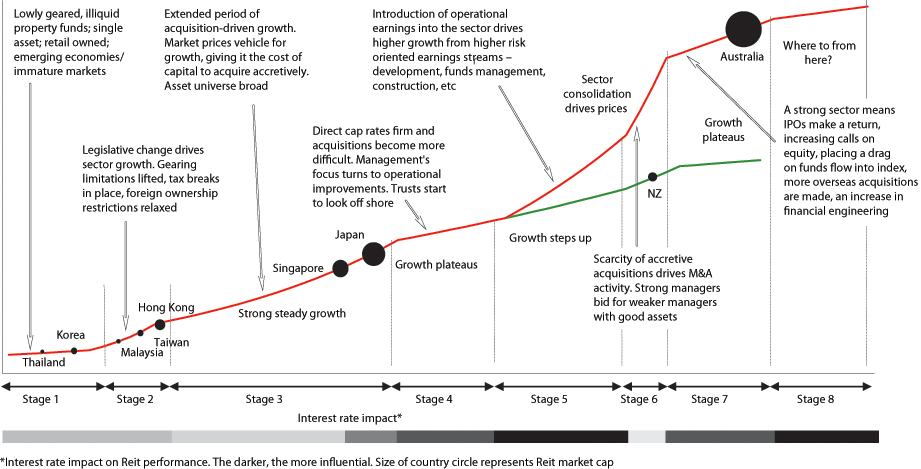 |
| Source: Macquarie |