With three-month euro interest rates then just below 3% and 10-year government bond yields just above 4%, while headline inflation was running at 2.5%, it was hard to quibble with that. Five months and two more 25bp rate increases further on, in October, he said interest rates were “still low” and monetary policy “continues to be accommodative”. No “very” this time, no “nominal and real” and no “maturity spectrum” but hardly a wild claim with three-month rates at 3.5%, 10-year yields at 3.9% and inflation projections of 2.4% for this year and next. Think back six years, when inflation was 2.4% and the refi rate peaked at 4.75%.
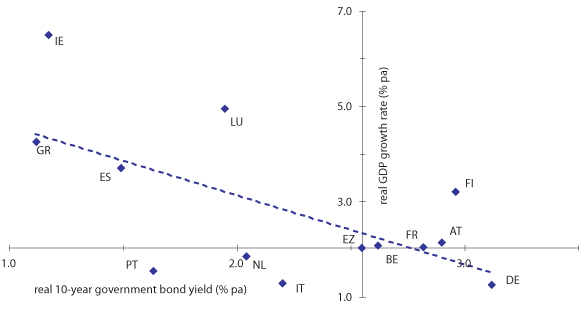
But not everyone sees it quite like that. Despite these EMU-wide yardsticks, national inflation rates – and hence real interest rates – differ widely from country to country within the euro area. On average since the start of monetary union, the range between the highest and lowest three-month money market rates in real terms has averaged 320bp and the overall dispersion, measured as standard deviation, has averaged +/– 97bp, with no marked diminution over time. For those countries with the highest inflation rates, real interest rates have for long periods been negative, while in low-inflation countries they have been consistently positive. Real long rates, of course have been higher across the board but, even so, in countries with the fastest inflation real yields on 10-year government bonds have averaged little more than 1% (and have at times been negative) while in several low-inflation countries they have averaged 2.5% to 3% (see Chart).
| Real long-term interest rates and GDP growth |
| (annual averages 1999-2006) |
 |
| Source: ECB; EuroZone Advisors |
Should these persistent differentials matter? A single currency necessarily entails a single monetary policy. One size has to be worn by all, even if it does not quite fit each, or indeed any, individual economy. Trichet also likes to point out (see for instance his recent monetary dialogue with the European Parliament) that inflation differentials within the euro zone are of much the same magnitude as those between the different statistical regions of the US. Real interest rate differentials can even prove salutary. Among those with the highest inflation and lowest real interest rates are relatively under-developed low-cost economies – notably Greece, Ireland and Spain – which have benefited from strong growth that has been helping them catch up with their richer, higher-cost, partners. At the other end of the spectrum in the German economy, which had locked into the single currency at a competitive disadvantage, high real rates and slow growth have been accompanied by a strong improvement in relative costs, the benefits of which might now be starting to bear fruit.
Even so, some high-inflation economies have not enjoyed a growth premium: Portugal, Italy and, in the early years of monetary union, the Netherlands. But this can hardly be laid at the door of the ECB. Trichet points the finger squarely at the lack of adequate structural reform, in labour and product markets, tax and benefit systems and government finances, citing Ireland and, latterly, the Netherlands as examples of what this can achieve. Furthermore, he continues to exhort other eurozone members to push further ahead with their own reform agendas, in order to raise the non-inflationary growth potential and competitiveness of the euro area as a whole (see Trichet’s Ludwig Erhard Lecture last month).
In the meantime, the ECB will stick to its last and carry on with its “progressive withdrawal of monetary accommodation” as long as risks to price stability persist.
John Arrowsmith is a senior partner of Eurozone Advisors, an independent research company. He was formerly senior adviser on western European and EU affairs at the Bank of England, played a key role in drafting the Maastricht Treaty and advised the UK Treasury and Foreign Office on the policies of the European Central Bank. (www.eurozoneadvisors.com)
ECB Watch: John Arrowsmith