Search the results Four years ago Brazil’s Banco Itaú committed itself to building a world-class private bank. Its efforts are already paying off
Brazil’s Banco Itaú has had a private banking business for 15 years and an international private banking presence in Luxembourg for 10 years. Four years ago, the bank’s senior management went one step further and decided it wanted to build a world-class operation to serve high-net-worth clients. Since then it has grown organically and through the acquisition of five businesses, in the process making heavy investments in people and technology.
Unsurprisingly, Itaú has gained ground in Euromoney’s ranking of Brazilian private banks for the past three years. In 2003 it took fifth place, a year later it was fourth and in 2005 it ranked third. Only Citigroup and UBS beat it.
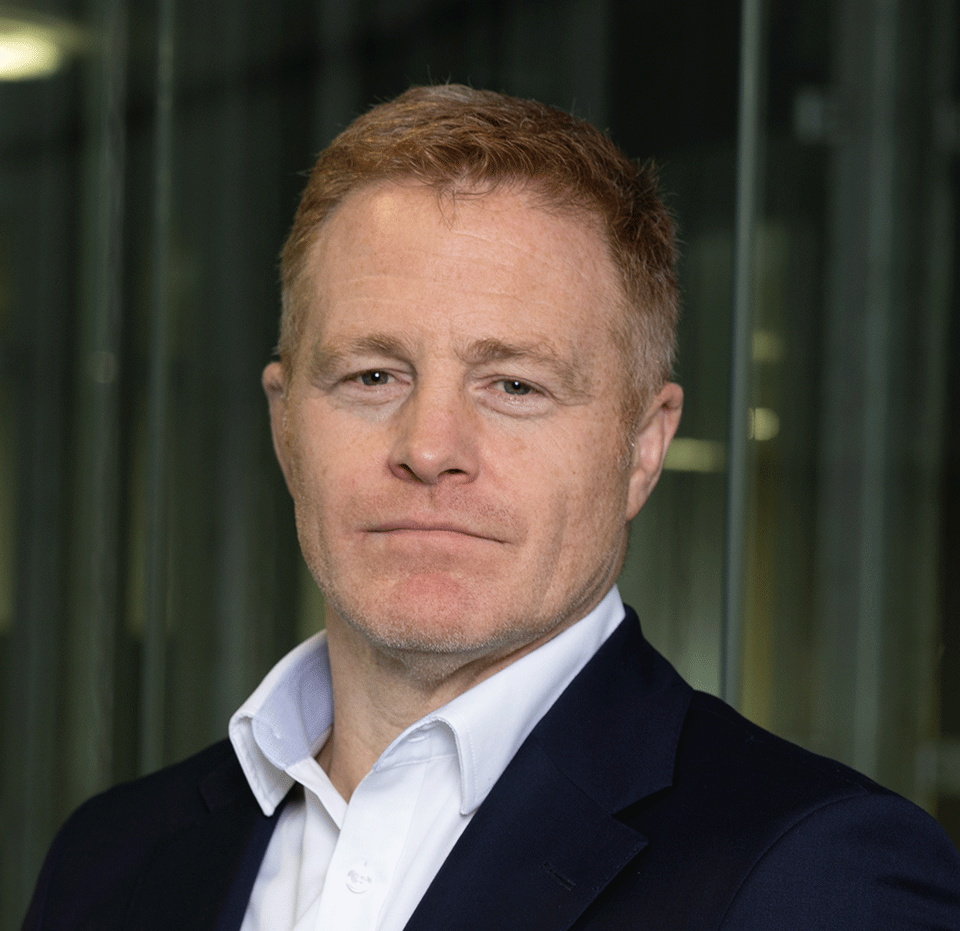
Lywal Salles, senior managing director and CEO of Itaú’s private bank in Brazil, keeps a close eye on its much larger rivals and says the bank constantly benchmarks itself against them. However, he thinks that the strength of Itaú’s retail brand and its commitment to the domestic market also work strongly in its favour. “We have not just the knowledge of the local market but also a commitment to it,” he says. “Whenever there is increased political or economic volatility, the foreign players pack up and move out.” He has witnessed this sort of thing at first hand, having worked at Chase for 16 years before joining Itaú.
In the past 12 months, the bank has made notable improvements to its franchise. It has enhanced its strategy and portfolio management businesses by creating several new positions. It has also hired two senior managing directors and four or five senior bankers for the commercial side of the business, most of them from outside Brazil. “We went to New York and Europe looking for the most competent Brazilian professionals working for the international investment banks,” says Salles. It has also set up an in-house executive MBA programme tailor-made for private bankers in conjunction with a local management school.
Salles points out that as Itaú’s private banking business originated from the retail bank, it initially entered the lower end of the high net-worth business. That’s no longer the case – in 2005 it created a wealth advisory platform to serve ultra wealthy individuals, entrepreneurs and family offices, offering trust, insurance, foreign exchange, tax and financial planning and succession services.
Salles says the private bank also takes advantage of Itaú’s corporate and investment bank and its presence in financial markets around the world and has strengthened its links with Itaú’s asset management team and with broker dealers in all the main international markets.
He is delighted with the bank’s continually enhanced performance in Euromoney’s poll but says this also puts a spotlight on the company. “It’s a lot of responsibility on our shoulders,” he says wryly. “Now were are in third position, the challenge is there. How can Itaú move from third to second?”